
The first crack sounded like someone dropping a grand piano underwater.
On the aft deck of a 2-million-euro yacht off Gibraltar, crystal flutes rattled, a plate slid, and every head turned at once toward the stern.
Then came the second hit—harder, angrier—followed by the sickening grind of fiberglass under pressure.
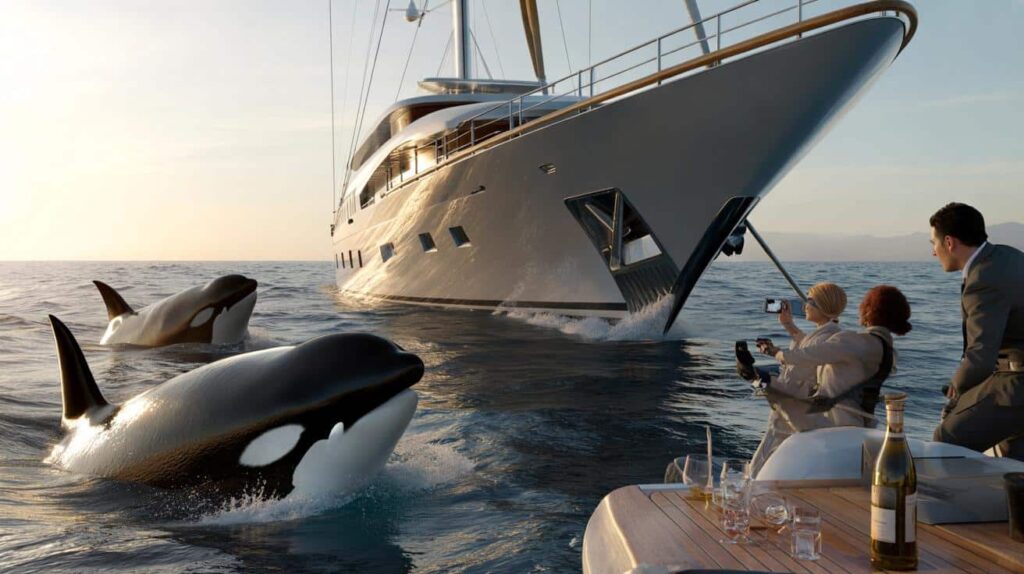
Below deck, alarms flashed as the autopilot failed. Above, a panicked skipper shouted for everyone to grab life vests. Someone started filming. Someone else started crying. At the rail, a teenager pointed and screamed: “Orcas!”
The black-and-white shadows circled, nudging the rudder like a toy. One powerful tail slap, and the steering wheel spun uselessly in the captain’s hands.
What was supposed to be a champagne sunset cruise suddenly looked a lot more like an evacuation drill.

Out here, the line between luxury and prey feels surprisingly thin.

When a million-dollar toy meets a 6-ton predator
The clash playing out off the coasts of Spain, Portugal and Morocco doesn’t look like the usual nature documentary.
It looks like shaken owners on 50-foot yachts watching their dream boats get battered by a group of highly intelligent, very focused orcas.
Since 2020, sailors have reported hundreds of “interactions” with these animals, mostly around the Strait of Gibraltar. Some are light nudges. Some end with broken rudders and emergency tows.
Most of the time, nobody gets physically hurt. Yet the fear on deck is very real. And the repair bills definitely are.
Out at sea, money doesn’t shout as loud as a 6-ton killer whale ramming your hull.
On a windy June evening last year, a 15-meter sailing yacht named Grazie Mamma II was on a routine delivery trip.
The crew knew the headlines, they’d joked about “orca insurance” at the marina bar. Still, when the first impact came, it felt surreal.
Within 15 minutes, three orcas had slammed the rudder repeatedly. The steering failed, water started seeping in, and the captain called for help.
The crew was evacuated by a nearby oil tanker. They watched from the safety of steel decks as their yacht slowly rolled and disappeared under gray waves.
The clip of that sinking went viral. Not for the drama alone, but for the uncomfortable question behind it: who really owns this stretch of sea?
Marine authorities have a clear answer: nobody. Or everyone. Depends how you look at it.
Spanish and Portuguese officials now log orca interactions like traffic incidents. They issue maps, warnings, and guidelines, but they’re firm on one point—these orcas are a protected population. Harming them isn’t just bad form. It’s illegal.
That stance drives some yacht owners mad. For them, each damaged rudder can mean tens of thousands in repairs, lost charter weeks, and insurance nightmares.
They talk about **terror on the water**, about “sabotage” by an animal that seems to target their floating status symbols with surgical precision.
Yet for coastal communities and many scientists, the orcas are not villains. They’re residents defending a home that’s getting louder, busier, and strangely shaped by towering white hulls and spinning propellers.

How sailors are learning to share a sea they thought they’d rented
Out on deck, when those black fins appear, the first rule is simple: slow down.
Research teams working with authorities recommend dropping speed to under 5 knots, disengaging autopilot, and staying calm.
Some crews shift into reverse briefly to disrupt the animals’ approach. Others just let the boat drift. The goal isn’t to “win”; it’s to show the orcas there’s nothing interesting to push against.
Noise also plays a role. Cutting the engine can help reduce the very vibrations that seem to attract curious or frustrated animals in the first place.
It feels counterintuitive when adrenaline is spiking, but sometimes the least heroic action is the most effective.
One of the most shared mistakes? Treating the ocean like a private swimming pool with leather upholstery.
Skippers recount how, in the first years of the interactions, some owners tried clapping, banging pots, even blasting music to drive the orcas away. A few idiots threw objects.
Not only does that cross ethical and legal lines, it often prolongs the encounter. The orcas are smart. They adapt, they test, they come back.
The sailors who cope best are the ones who prepare like it’s a weather event, not an attack. Rerouting around known hotspots, traveling in daylight, briefing guests.
Let’s be honest: nobody really does this every single day. But the ones who do sleep a lot easier at anchor.
There’s a quiet shift happening in some marinas: fear turning into a kind of rough respect.
Skippers trade orca stories over beer the way they once swapped tales of sudden squalls. The enemy becomes a neighbor you don’t fully understand, but can no longer ignore.
“People arrive furious, talking about ‘killer whales destroying my yacht’,” says a harbor master in Cádiz. “Two days later they’re asking where they can donate to the research fund. It’s strange. The sea humbles people fast.”
- Practical moves when orcas appear
Drop speed, disengage autopilot, keep hands away from the stern. - Route planning
Check the latest interaction maps before long passages through Gibraltar and western Iberia. - Mindset shift
Accept that *you are crossing someone else’s living room*, not the other way around.
Between rage and reverence, a new coastal culture is forming
What’s happening off the coasts of Spain and Portugal isn’t just about boats and whales. It’s about who gets to feel at home on the water.
In fishing villages, many locals quietly side with the orcas. They’ve watched industrial traffic, mass tourism, and noise push traditional ways of life toward the margins. If the animals push back, it feels almost like justice.
Luxury yacht owners see something else: hard-earned dreams literally taking on water, while officials tell them to “adapt” and insurers raise their eyebrows. The rage is real, and so is the helplessness.
Some charter companies now advertise “orca-safe itineraries” or partner with biologists for onboard talks. Others move their boats to different seas altogether. Not everyone wants to share.
We’ve all been there, that moment when the world reminds you you’re not the main character. Out at sea, that lesson just arrives with more salt spray and fewer comforting walls.

| Key point | Detail | Value for the reader |
|---|---|---|
| Orca interactions are rising | Hundreds of rudder-focused incidents logged since 2020, mainly around Gibraltar | Understand why you’re seeing more of these stories in your feed and on sailing forums |
| Authorities prioritize protection | Orcas are a protected population; harming them brings heavy sanctions | Clarifies why “fight back” solutions are off the table, even for expensive yachts |
| Sailors can adapt | Route choices, slower speeds, and calm responses reduce risk and damage | Concrete ways to travel more safely and thoughtfully through these contested waters |
FAQ:
- Are the orcas really “attacking” yachts?
Most scientists avoid the word “attack”. The animals focus mainly on rudders, often in small groups, and rarely hurt people. The behavior looks like a mix of play, curiosity, and possible frustration linked to noise and past encounters.- Can yacht owners defend themselves if their boat is at risk?
They can take evasive actions like slowing down, changing course, or stopping the engine. Using weapons or trying to injure orcas is illegal in these waters and can lead to serious penalties.- Why do authorities seem to side with the orcas?
Marine agencies are tasked with protecting endangered and vulnerable species. These orcas belong to a small, threatened population. From a legal and ecological standpoint, their survival weighs heavily in policy decisions.- Is it still safe to sail in the affected areas?
Most passages are completed without incident. That said, there is a real risk of rudder damage in known hotspots. Skippers now factor orca reports into trip planning, the same way they watch weather forecasts.- What can sailors do to reduce encounters?
Avoid peak zones and seasons when possible, travel in daylight, keep speed modest, and follow updated guidance from local coast guards and research groups. Supporting monitoring projects also helps build better maps and predictions.
