
Seven retirees in bright sneakers were lining up their water bottles, proud of the steps on their watches, when the physiotherapist dropped the sentence that froze them: “Daily walks aren’t enough anymore.” A few heads turned sharply. Someone checked their wristband, almost offended. For years, they had been told: walk 30 minutes a day, go to the gym once a week, and you’ll age well. Safe recipe. Clear rule.
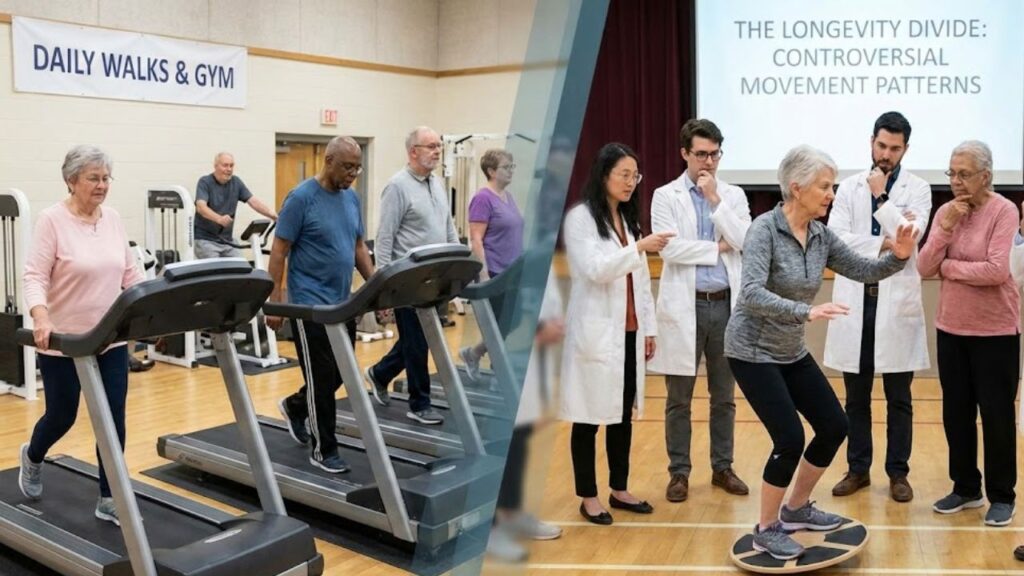
Then she showed them a slow, awkward shuffle, a quick side-step, a sudden turn as if avoiding a puddle. “This,” she said, “is what will decide how you move at 80 or 90.” Not your Sunday walk. The room grew very quiet.
Because the new obsession in longevity science isn’t walking further. It’s moving weirder.

The Surprising Pattern: It’s Not Just About 10,000 Steps
In longevity labs and rehab centers, a strange idea is gaining ground. Your future independence might depend less on how much you walk than on how varied and unpredictable your movements are. Not just forward, steady, same pace. But sideways, backwards, up, down, on one leg, turning, reaching, catching yourself before you fall.

Researchers call it “movement variability” or “multidirectional load”. Trainers use a simpler word: chaos. The human body ages badly when every day feels the same for its joints, tendons, and brain. The more your system has to adapt, react, adjust, the more it stays awake. Like a muscle of uncertainty that refuses to retire.
That’s why a neat routine of daily walks and one weekly gym session, always identical, starts to look strangely fragile once you pass 70. Strong on paper. Brittle in real life.
The Risks of a Narrow Routine
Take Margaret, 74, who walks 8,000 steps every day on the same riverside path. Her smartwatch loves her. She also goes to the gym every Thursday morning for her “senior fitness” class: bike, light machines, a bit of stretching. She hasn’t missed a week in years.
Last winter she slipped on a wet supermarket floor. Nothing dramatic, she thought. Yet she couldn’t twist fast enough to catch herself. Her feet stayed straight, her torso turned, her knee exploded in pain. Later, the sports doctor told her something that stuck: “You’re fit in a straight line. Life doesn’t happen in a straight line.”
On the other side of the debate is Alain, 79, former electrician, no gym membership, no smartwatch. He walks to the market, climbs stairs two at a time on good days, carries irregular shopping bags, kneels to fix a loose tile, gets up from the floor without thinking. No perfect program, just a messy life that keeps dragging his body in every direction.
Experts looking at their two cases argue quietly behind the scenes. Some say discipline and metrics will win the war of aging. Others point to people like Alain and say: the body thrives on randomness. Who is right? The answer seems to sit in between.
Why Moving Differently Matters
The logic behind this new obsession is brutally simple. Aging shrinks your “movement vocabulary”. You stop squatting low, so you lose it. You avoid stairs, so each step becomes a small mountain. You never twist or reach above your head, so one day closing the shutters feels like climbing Everest.
Walking forward and doing the same gym routine keep a narrow slice of that vocabulary alive. Heart, yes. Some strength, yes. But balance, reaction speed, joint range, coordination between eyes and feet? Those fade quietly in the background. Until one dodged curb, one stumbling dog, one missed stair asks your body to speak a language it hasn’t practiced in years.
The Shift in Longevity Science
Current longevity science is pushing a different lens: think less in “minutes of exercise” and more in “number of movement options you still own at 80.” A long life spent trapped in three safe motions – sit, stand, walk straight – is a very poor life physically. Even if your step count is high.
The “Micro-Chaos” Routine That Benefits All
The pattern that divides opinions is not a fancy biohacking device. It’s a daily sprinkle of tiny, odd moves that look almost silly. Short backward walks in the corridor. Side-steps while brushing your teeth. Standing on one leg when you wait for the kettle to boil. Slow, deep squats to a chair instead of falling into it. Practising getting down to the floor and back up, once a day.

Longevity coaches speak of “incidental agility”: using normal moments of the day to challenge your balance and coordination by 5–10%. Not more. Not less. Enough to wake your nervous system without scaring you or your joints. A 70-year-old doesn’t need burpees. But stepping over an invisible obstacle ten times, eyes looking forward, sends a powerful message to the brain: we still do complex things here.
Attaching Micro-Moves to Daily Habits
The big trap is thinking this has to look like a perfect workout. That’s where a lot of motivated seniors give up. They imagine they need a specific “dynamic stability” class, a new pair of shoes, the right playlist. Then life happens, and the idea dies after three Tuesdays.
The people who actually succeed do something else: they attach micro-moves to habits already there. Every kitchen visit becomes a chance for two slow heel raises, hanging on to the counter. Every TV ad break is a standing moment, not a sitting one. On a good day, the hallway becomes a 30‑second backwards walking lane, hands on the wall at first. On a bad day, it’s just one long stretch reaching for the doorframe. Nothing heroic.
Small Actions for Big Gains
We’ve all had that moment when we realise a simple action got weirdly hard. Getting out of a low car. Getting up from the ground. Turning quickly when someone calls our name. These are the micro-alarms the body sends. Often ignored. Until they’re not.
One sports geriatrician in Lyon told me recently: “After 70, the question is no longer ‘How much do you move?’ but ‘How many different problems do you give your body to solve every week?’ A walk solves one problem. Life throws twenty.”
A Realistic Approach to Longevity
Here’s where the controversy kicks in. Some classic rehab protocols still focus on linear strength and cardio. Others push hard for agility, floor work and “controlled instability”, even for frail patients. In the middle, you have actual people, with fears and bad knees and limited time, trying to navigate all this.
What a Human-Sized Pattern Looks Like
- Walk most days, but change pace or surface at least twice a week.
- Add 5–10 minutes of “odd moves” on three days: sideways, backwards, turns.
- Touch the floor, or something close to it, at least once a day.
- Stand on one leg daily while holding on to something sturdy.
- Once a week, practise getting up from the floor in the safest way you know.
For Those Over 70 or Those Who Love Them
The shift is subtle but radical: you don’t need to move more hours, you need to move in more directions. Your daily walk and weekly gym trip are a base camp. The real “longevity work” happens in the in-between moments, in the way you bend to pull on socks, twist to check the oven, step around the dog, carry shopping unevenly rather than perfectly balanced.
It can be strangely freeing. Instead of chasing an ideal program that never quite fits, you start to play. Can I put my socks on standing, today? Can I take the stairs a bit differently – bigger steps, or smaller, hand on the rail but weight doing the work? Can I roll my shoulders in big lazy circles when the kettle sings? Tiny experiments. Low stakes. Cumulative power.
The emotional undercurrent is strong here, even if we don’t say it out loud. Moving in weird ways means facing the fear of looking old, or fragile, or ridiculous. It means accepting that balance has changed, that knees complain, that the ground feels a bit further away than it used to. Yet every time a 72‑year‑old practises getting up from a mat in a quiet room, they buy a little more freedom for their future self at 82, in a much less controlled moment.
The Takeaway: Keep Moving in All Directions
Longevity science is still arguing exact doses, ideal intensities, the best protocol names. Seniors are less interested in jargon. What they want is almost disarmingly simple: to keep getting out of bed alone, to keep using stairs, to keep walking outside without fear of a fall that changes everything.
Between the straight-line camp and the micro-chaos camp, the path is probably this: keep your walks and your gym sessions, but refuse to let them be the whole story. Let your day become a quiet obstacle course, made of cups, steps, chairs, and doors. A life where your body keeps learning, right up to the last chapter.

Key Takeaways
- Movement variability: A mix of directions, speeds, and joint angles in daily life helps preserve balance, coordination, and reaction time after 70.
- Micro-chaos routine: 5–10 minutes of simple “odd moves” sprinkled through the day makes longevity training realistic without extra gym hours.
- Floor interaction: Regular practice of squatting lower and getting up from near the floor is directly linked to independence and fall survival in very old age.
