Sharing a carriage with one of the world’s deadliest snakes is not.
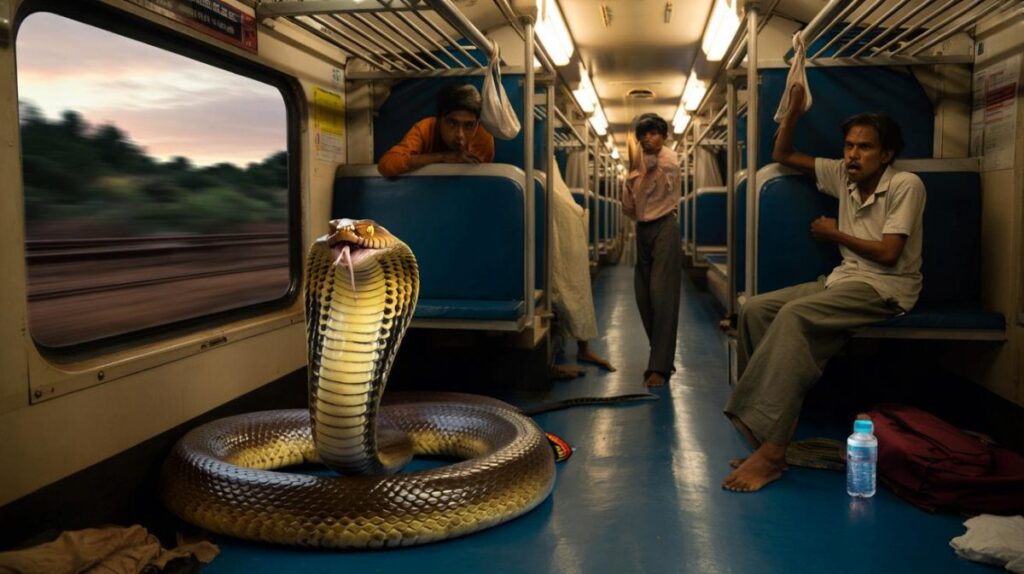
Reports of venomous snakes slipping into carriages, riding on luggage racks and even peering from train windows are rising – and scientists now suspect these unwanted passengers could be quietly reshaping where endangered king cobras live.
Snake on the sleeper: when a train ride turns deadly
King cobras are the longest venomous snakes on Earth. An adult can stretch beyond five metres. Their venom, if untreated, can kill a person in as little as 15 minutes.

That is alarming enough in open forest. On a crowded overnight sleeper, it becomes a nightmare scenario.

In India, such encounters are no longer isolated stories. Travellers regularly post phone videos of snakes on platforms, beneath seats or coiled near train doors. In one widely shared incident from 2023, a snake-catcher in the western state of Gujarat filmed a spectacled cobra perched in a train window frame, staring into the carriage.
Back in 2017, biologist Dikansh Parmar, volunteering with an animal welfare group, was called aboard a train after terrified passengers spotted a snake in their coach. That experience later fed into a scientific study, published in the journal Biotropica, that asks an unusual question: are India’s trains helping snakes, including king cobras, spread into places where they would not normally survive?
Scientists now suggest that rail lines act not just as paths for people, but as unintended high-speed corridors for venomous snakes.
From forest streams to steel tracks
The new research focuses on a local king cobra population in the coastal state of Goa. This region is better known for beaches and tourism than for deadly reptiles, but its hill forests and river valleys are prime cobra habitat.
Researchers used habitat models that factor in rainfall, temperature, vegetation and the presence of prey. These tools help identify where a species should live if it follows its ecological preferences.
Where king cobras should be – and where they show up
For the king cobra species in Goa, known as Ophiophagus kaalinga, the models painted a clear picture. The snakes should mainly occupy the interior of the state, especially:
- Moist forested areas
- Regions near rivers, streams and wetlands
- Landscapes with dense vegetation for cover
- Zones with abundant prey, such as other snakes and small vertebrates
Between 2002 and 2024, sightings and records of this king cobra came from 47 locations in Goa. Five of these were close to heavily used railway lines.
According to the models, those rail-adjacent spots are badly suited to king cobras. They tend to be drier, more open, and poorer in prey. Vegetation is often sparse due to construction, maintenance and human activity around the tracks.
The presence of king cobras near busy rail corridors clashes with what their preferred habitat should look like, raising questions about how they got there.
Unwilling hitchhikers on India’s rail network
To explain the mismatch, the research team put forward a simple but provocative idea: some snakes are accidentally travelling by train.
Railway lines are already known to influence wildlife movement. Animals may walk along the tracks, use embankments as corridors or forage around rubbish near stations. But in this case, scientists say the trains themselves may be moving the snakes.
Snakes could slip into carriages while the trains are stopped in forested or rural stations. They might shelter in gaps under seats, in cargo areas or around brake cables beneath the carriages. Startled by noise or movement, they could then be carried many kilometres to areas that are drier and more urban – places they would normally avoid.
The study’s authors describe railways as potential “high-speed links” that unintentionally connect separate wildlife populations. For threatened species like king cobras, that may sound positive, but the outcome could be far less helpful.
A new twist in human–wildlife interaction
For scientists, this “train displacement” is a fresh angle on how infrastructure shapes nature.

The potential of rail routes to shuffle threatened animals into poor-quality habitats adds a new, often overlooked layer to human–wildlife conflict.
Yet the researchers are cautious. Their hypothesis relies heavily on patterns and anecdotal evidence, not on direct, tracked journeys. So far, no team has tagged a king cobra and proved that it boarded at one forest station and got off in a dry, unsuitable town.
Still, the circumstantial evidence keeps mounting. With cheaper smartphones and wider social media use, passengers are documenting more incidents. The study notes that in just 30 days of 2024, three separate snake-in-train episodes were formally recorded, with several others circulating online.
Bad for cobras, terrifying for passengers
King cobras are already classified as vulnerable. Habitat loss from logging, agriculture and urban expansion eats into their forest homes. Road kills, persecution and illegal trade add further pressure.
If trains keep dropping snakes into marginal habitats where food and cover are lacking, many of these animals may simply die. They may struggle to find prey or suitable nesting sites. They might also come into more frequent contact with people, leading to conflict and retaliatory killings.
| Group affected | Main risks |
|---|---|
| King cobras | Stress, poor habitat, starvation, persecution, fragmentation of stable populations |
| Rail passengers | Potentially fatal bites, panic in confined spaces, disrupted services |
| Rail operators | Safety concerns, liability, pressure to adapt infrastructure and training |
For travellers, the danger is more obvious and immediate. A venomous snake in a sealed carriage can cause chaos. People may stampede towards exits, risking injuries on top of any potential bites. Staff, often without specialist training, must decide quickly whether to stop the train, call wildlife rescuers or try to handle the animal themselves.
What railways and authorities could do next
The study hints that India’s booming rail network could integrate wildlife considerations into basic operations. This does not mean shutting down lines through forested regions, but tightening simple practices.
At stations near key habitats, staff could carry out rapid checks under parked trains, especially in the rainy season when snakes move more. Carriage maintenance areas could be cleared of debris and clutter where animals might hide. Basic training for frontline rail workers on how to respond calmly to snake sightings could prevent both bites and panicked crowds.
Conservation agencies might also monitor rail corridors as potential hotspots for displaced snakes. Systematic logging of sightings, backed by photos and GPS coordinates, would allow researchers to refine their models and confirm whether trains really are reshaping cobra distributions.
Why snakes end up in human spaces at all
Snakes do not seek human contact. They often wind up in houses, fields or trains for simple reasons: warmth, shelter, or food such as rats. The metal undercarriage of a train can hold heat on cool nights. Station yards attract rodents, which in turn attract snakes.
Urban expansion around tracks adds further complexity. As people build closer to railway lines, the boundary between wild habitat and human life blurs. A snake leaving a shrinking forest patch may have little choice but to pass through or settle near infrastructure.
Understanding a few key terms
Two scientific ideas underlie this research:
- Habitat suitability models: computer tools that estimate where a species should thrive based on climate, vegetation and other environmental data.
- Wildlife corridors: natural or human-made routes that allow animals to move between fragmented habitats, sometimes helping maintain genetic diversity.
In this case, railways are acting as a hybrid: part corridor, part trap. They may help a snake move, but not always to a place where it can live well.
Future scenarios: from tracking tags to public awareness
One next step for scientists would be to fit a sample of king cobras with GPS tags in areas near rail lines. If tagged snakes repeatedly appear at distant, dry stations or in rail-side settlements, that would strongly support the train transport hypothesis.
Public awareness could also shift outcomes. Simple advice for passengers – stay calm, keep distance, alert staff, avoid cornering the snake – can reduce risk. Communities near tracks might benefit from regular visits by trained snake rescuers who can safely remove and relocate animals spotted around stations.
If more data confirms that trains are quietly moving king cobras into harm’s way, rail safety, conservation policy and urban planning will all need to adapt. For now, the idea of a king cobra riding in the next carriage remains a chilling reminder of how closely human networks and wildlife are now intertwined.