
Around 2 a.m., you wake up with that strange, heavy feeling in your head. The air in your bedroom feels thick, almost used up, like a meeting room after a long day. You roll over, push the blanket away, and your eyes drift toward the door. It’s closed, as always. Safe. Protected. But suddenly you remember that TikTok video saying sleeping with the door open could lower carbon dioxide levels and deepen your sleep.
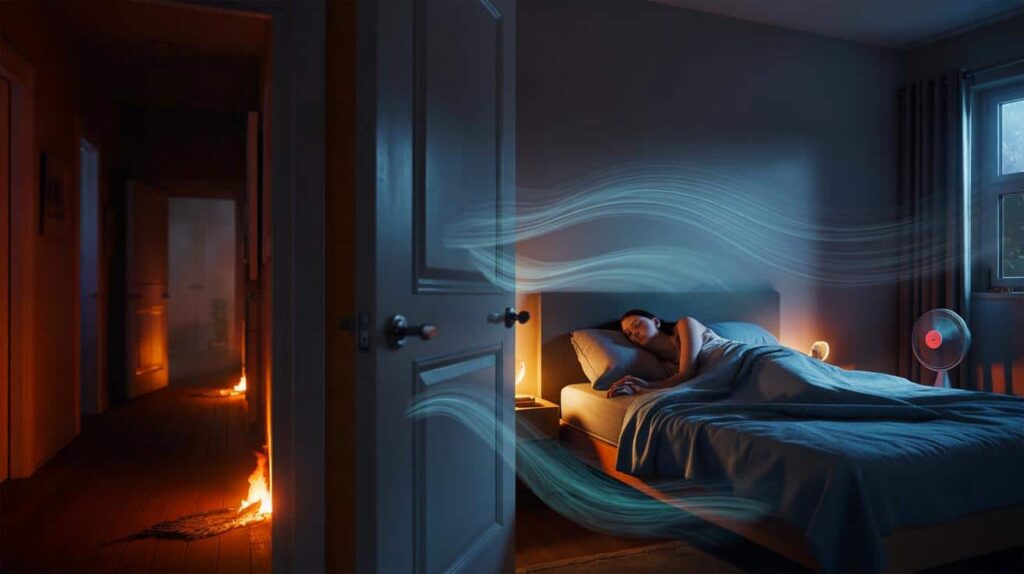
You start wondering if your restless nights are not about stress or screen time, but simply about stale air trapped inside four walls.
And then a second thought hits you: firefighters keep saying closed doors save lives in a fire.

You stare at the handle, caught between oxygen and danger, and sleep feels very far away.

Does an open bedroom door really help you sleep better?
Walk into almost any modern bedroom at night and you’ll see the same scene. Curtain edges glowing faintly from the streetlight, a phone screen lighting up the ceiling, and a closed door sealing everything in. That door doesn’t just block sound or light. It also traps the air you breathe out all night long.
Some researchers say that in a small, tightly insulated room, carbon dioxide can slowly climb while you sleep, making the air feel stuffy and your sleep a bit shallower. So the open-door trend was born.
One Dutch study on bedroom ventilation found that people slept more deeply when more fresh air circulated through the room. Their CO₂ levels dropped, and they woke up feeling slightly more alert. That’s the kind of result that gets turned into viral sleep hacks in seconds.
Suddenly, people on social media were posting side-by-side sleep tracker screenshots. Night one: door closed, restless sleep. Night two: door open, fewer awakenings, “Best sleep in weeks!” The message spread fast: crack the door, sleep like a baby.
The logic is pretty intuitive. More airflow helps dilute CO₂ and odors, and can cool the room slightly, which many bodies love at night. With the door open, the air can mix with the rest of the home rather than stagnate.
Yet sleep quality is a messy thing. It isn’t just about air, it’s about noise, light, temperature, anxiety, and routines. Open the door, and you may get fresher air—but you also invite hallway light, roommates, pets, and every creak of the house right into your dreams.
When better airflow collides with basic fire safety
If you’ve ever taken a home safety course, you’ve probably heard firefighters repeat the same quiet mantra: “Close before you doze.” They’re not being dramatic. A closed bedroom door can slow down smoke, flames, and toxic gases long enough to buy you precious minutes to escape.
In fire tests, rooms with doors closed stayed dramatically cooler and less smoky than rooms with doors left open. That simple wooden barrier can be the difference between waking up in time and never waking up at all.
That’s why many safety experts get nervous when they see social posts casually telling millions of people to sleep with their doors open for “better air.” They know how real house fires are. A forgotten pan on the stove, a faulty phone charger, an overloaded power strip — it doesn’t take much.
One firefighter described real incidents where kids survived because their bedroom doors were shut, while hallways were black with smoke. Those stories don’t go viral as fast as sleep-hack reels, but they stay etched in first responders’ minds.
So where does that leave you, standing in your doorway at night, wondering what to do? You don’t have to choose blindly between breathing easier and staying safe. The real question isn’t “door open or closed?” but “how can I get fresh air without throwing away basic protection?”

The answer lives in small, practical tweaks: windows, vents, gaps under the door, and smarter ways to move air. Because **airflow doesn’t only come from a wide-open door**.
Practical ways to breathe better at night without ignoring safety
Start with the simplest move: look at your bedroom like a little climate system, not a sealed box. Is there a window you can crack open slightly, even in winter, just for a narrow gap at the top? Is there a vent that’s half blocked by a dresser or dust?
A small fan near the door, pointed away from you, can help pull fresh air from the hallway through the gap under a closed door. You’d be surprised how much movement you can get from that narrow strip of space without swinging the door wide open.
A lot of people secretly feel guilty that their room is stuffy, yet their days are too full to turn into amateur ventilation engineers. Let’s be honest: nobody really measures CO₂ in their bedroom every single day.
What you can do is experiment gently. One week, sleep with the door closed but a window cracked and the fan on low. Another week, try the door almost closed, just a finger’s width open, to see if you feel a difference. Pay attention to how your head feels in the morning, not just what your smartwatch says.
A fire safety specialist summed it up to me in one straightforward line: “If you want to sleep with peace of mind, treat airflow like comfort, and a closed door like a seatbelt.”
- Crack a window slightly rather than leaving the door wide open.
- Use a small, quiet fan to move air from the hallway under a mostly closed door.
- Keep exit routes clear so a closed door doesn’t slow you down in an emergency.
- Install working smoke alarms inside and outside bedrooms, and test them regularly.
- Consider a simple air-quality monitor if you’re really curious about CO₂ levels.
Balancing fear, comfort, and those quiet 2 a.m. thoughts
This debate isn’t really about a slab of painted wood on hinges. It’s about that tension between wanting to feel safe and wanting to feel well. At night, tiny details take on enormous weight: a squeaky door, the whisper of a draft, the thought of smoke from somewhere down the hall.
*We’ve all been there, that moment when you lie awake listening to the house breathe and wondering if you’re making the right choices for yourself and the people sleeping next door.*
Some people will read the data, listen to firefighters, and decide: door closed, window cracked, fan on low. Others, living in noisy apartments or shared houses, might accept a partially open door because hearing the rest of the home helps them relax. There isn’t one perfect rule that fits every floor plan, every neighborhood, every nervous system.
The plain truth is this: you’re allowed to experiment until your nights feel both restful and sane. Try changes slowly. Talk with your family about fire plans. Ask where you personally draw the line between comfort and risk.
You may find your sweet spot is a nearly shut door, not latched, with air moving quietly underneath and a smoke alarm glowing overhead. Someone else might sleep best behind a firmly closed door, fan humming, knowing they have that extra thermal barrier if something ever goes wrong.
What matters is not blindly chasing a viral myth about airflow or dismissing your body’s need for fresh, cool air. It’s about treating your bedroom like what it really is: the place you return to every night, where you breathe, dream, and reset the day. That small rectangle of space deserves more than a quick, thoughtless push of a door handle.

| Key point | Detail | Value for the reader |
|---|---|---|
| Airflow affects sleep | Better ventilation can lower CO₂ levels and slightly deepen sleep | Helps you understand why your bedroom sometimes feels “stuffy tired” |
| Closed doors protect in fires | Closed doors slow smoke, heat, and toxic gases during a house fire | Gives you a safety-first lens before changing night habits |
| Small changes beat extreme hacks | Fans, window cracks, and door gaps offer airflow without wide-open doors | Lets you improve comfort while keeping a solid layer of protection |
FAQ:
- Should I always sleep with my bedroom door closed?Most fire experts recommend a closed door at night for safety, especially if you have kids or sleep on a different floor from the kitchen or living area.
- Can an open door really improve my sleep quality?It can help if your room is very sealed and stuffy, but you often get similar benefits from a cracked window or a fan without leaving the door wide open.
- What if I feel anxious with the door closed?Try leaving it slightly ajar at first, using a nightlight and a fan, then gradually closing more as you get used to it and your alarms and escape plan are in place.
- Is a gap under the door enough for ventilation?In many homes, yes: a standard gap plus a small fan can move a surprising amount of air while the door stays mostly shut.
- Should I buy a CO₂ monitor for my bedroom?It’s optional; if you’re curious or very sensitive to air quality, it can be eye-opening, but simple steps like opening a window often make a noticeable difference on their own.
