In factories from steel to beer, that lost warmth looks like a necessary evil – but Chinese researchers now claim it can be upgraded and reused, without a single moving part turning.
A heat pump that doesn’t spin
A team at the Chinese Academy of Sciences has built an experimental heat pump with no rotating machinery, no compressor and no pistons. Yet it still pushes heat “uphill” to far higher temperatures, exactly what a traditional industrial heat pump does.
The device sits at the Technical Institute of Physics and Chemistry in Beijing, led by physicist Luo Ercang, and it relies on a strange but well‑studied relationship: the tight link between sound and heat.

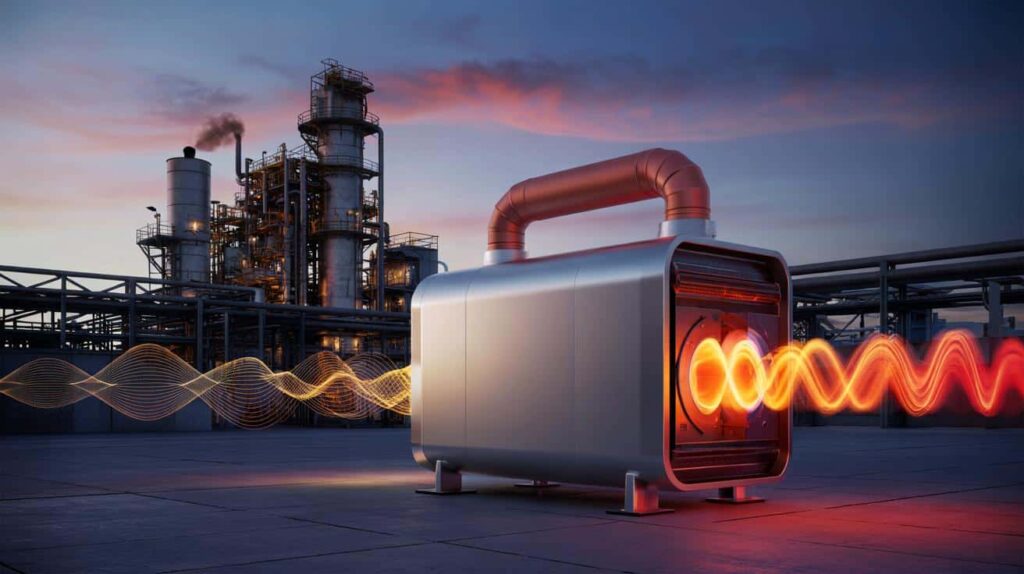
Instead of compressing and expanding a refrigerant gas, the pump generates powerful standing acoustic waves inside a resonator. Those waves behave like an invisible conveyor belt. They grab heat at one temperature, then release it at a much higher one.

This Chinese prototype has already raised waste heat from 145 °C up to 270 °C using only sound waves and static components.
The system follows what’s known as a thermoacoustic Stirling cycle, a cousin of the classic Stirling engine. In a Stirling machine, heat differences create motion. Here, the motion is sound, and the end goal is not work but hotter heat.
Why 270 °C is such a big deal
Industrial heat pumps already exist, yet they hit a wall beyond about 200 °C. Efficiency falls, materials suffer, and equipment grows bulky and expensive. That’s why most commercial units top out around 100–200 °C.
Chinese researchers say their thermoacoustic prototype has smashed that comfort ceiling. In lab tests, they started with a 145 °C source – the kind of “lukewarm” waste heat that usually vents out of chimneys – and boosted it to 270 °C.
That 120‑plus‑degree jump unlocks a temperature zone that conventional heat pumps tend to avoid. Many industries live exactly there.
Industries waiting for hotter heat
Sectors such as paper, brewing, textiles and pharmaceuticals often operate between 100 and 200 °C. New generations of industrial heat pumps already aim at these markets, cutting fuel use and emissions.
The real challenge lies further up the scale. Ceramics, glass, metals and much of petrochemicals need from 400 °C to above 1,000 °C, temperatures usually supplied by coal, gas or oil burners.
The Chinese group argues that with better materials and smarter geometries, thermoacoustic heat pumps could eventually reach around 1,300 °C by the 2040s. That would place them in the same conversation as fossil boilers, not just as a sidekick technology.
At high enough temperatures, sound‑driven heat pumps start to look less like efficiency gadgets and more like direct fuel replacements.
How can sound move heat uphill?
The underlying physics sounds almost like a puzzle. Heat is applied to part of the device. That heat excites gas inside a resonant cavity, creating loud, standing acoustic waves – essentially “trapped” sound bouncing between walls.
As the sound waves compress and relax the gas in specific regions, they shuffle thermal energy from one area to another. Careful design of the resonator shape and internal structures forces this net movement of heat against the natural temperature gradient.
Key advantages of no moving parts
- No rotating shafts or bearings, which cuts mechanical wear.
- No oil lubrication, which reduces contamination risks.
- No complex refrigerants under high pressure, easing safety and regulatory issues.
- A sealed, largely solid‑state architecture, attractive for harsh industrial sites.
For plant managers used to babysitting compressors and pumps, the idea of a “silent block of metal” that simply shunts heat around looks tempting, at least on paper.
China’s 27% heat loss problem
China’s factories devour more thermal energy than any other country. By some estimates referenced by the research team, 10–27% of all the energy consumed in China ends up as low‑grade waste heat discharged into the environment.
That means smokestacks, cooling towers and even warm walls act as giant leaks in the energy system. Turning that leak into a loop is where the opportunity lies.
Heat as a raw material, not a by‑product
If a steel plant or chemical complex can harvest its own exhaust heat, upgrade it and feed it back into the process, waste heat stops being a problem and becomes a resource.

| Current situation | With thermoacoustic heat pump |
|---|---|
| Flue gases at ~150 °C released to the air | Flue gases captured and boosted to >250 °C |
| New fuel burned to reach process temperature | Recycled heat offsets a share of fuel demand |
| CO₂ emissions locked to fuel input | Lower fuel use, lower emissions per tonne of output |
The International Energy Agency already tracks waste‑heat recovery as a major lever for cutting industrial emissions. What China deploys in this space tends to ripple worldwide, because equipment makers, standards and costs follow its choices.
China’s approach to industrial heat will heavily influence how fast global heavy industry can decarbonise without shutting down production lines.
Where could the heat come from?
One unusual strength of this “non‑rotating” pump is its indifference to heat source. It only cares about getting access to a medium‑temperature input.
Possible sources of input heat
- Waste heat from industrial furnaces, kilns and reactors.
- Low‑temperature nuclear heat from dedicated industrial reactors.
- Concentrated solar power fields producing several hundred degrees of heat.
- Biomass or geothermal systems delivering steady thermal output.
In principle, a petrochemical plant could pair a solar‑thermal field with a thermoacoustic pump to reach process temperatures on sunny days, then lean on nuclear or biomass backup at night, all while squeezing every last degree of waste heat from flue gases.
Engineering hurdles still ahead
The research remains at prototype stage. Scaling any lab device into rugged megawatt‑scale equipment needs years of engineering work and field data.
Challenges include building resonators and internal components that survive repeated high‑temperature cycles, corrosion and dust. Acoustic losses at large scale also matter: the louder and larger the system, the more energy can leak out as useless noise or vibration.
Cost will decide everything. If a thermoacoustic heat pump can compete with gas‑fired boilers over a 10‑ to 20‑year lifetime, it has a commercial case. If not, it stays in journal papers.
Risks and trade‑offs
Industrial investors will weigh several questions:
- Can the technology be retrofitted into existing plants without major downtime?
- How loud are these devices in practice, and will they meet noise regulations?
- What happens if a resonator cracks at 250 °C in the middle of a production run?
- Who takes responsibility for performance guarantees – the factory, the equipment maker or the technology licenser?
Thermoacoustic machines also compete with other emerging options, such as high‑temperature solid‑state heat pumps and advanced gas‑cycle systems that push conventional compressor technology further up the temperature ladder.
Putting the jargon in plain language
The term “thermoacoustic” simply combines two ideas: thermal (heat) and acoustic (sound). In this setup, sound waves are not just a by‑product; they act as the main tool for steering heat from one place to another.
The “Stirling cycle” label comes from a 19th‑century engine design that uses a closed volume of gas and no internal combustion. In a conventional Stirling engine, temperature differences produce motion. In a thermoacoustic Stirling heat pump, acoustic motion driven by heat differences is harnessed to push temperatures higher.
For plant technicians, that means thinking of sound not as noise from machines, but as an active working medium. It is similar to how engineers treat compressed air in factories – invisible, but carefully controlled to do useful work.
What a future plant might look like
Imagine a cement works in 2040. Its key kilns still demand 1,200 °C, yet the plant’s main fuel input has dropped sharply.
Solar towers outside pre‑heat air to several hundred degrees. A cluster of thermoacoustic units then take this heat and the plant’s own exhaust gases, boosting both to the extreme temperatures needed for clinker production. Gas burners remain, but as backup, not as the primary driver.
The control room screens show not just tonnes of output, but megawatt‑hours of heat recovered, upgraded and reused. Sound levels are monitored as carefully as temperature and pressure, because acoustic performance directly tracks energy efficiency.
If the Chinese research effort stays on track, scenarios like this shift from science fiction into a technically plausible roadmap. The promise is not clean industry overnight, but new tools to stop treating waste heat as an inevitable loss and start treating it as energy that still has work left to do.