
On a cold spring evening in the Canary Islands, a small team of astronomers gathered inside a telescope control room, mugs of coffee slowly cooling nearby. As new data appeared on their monitors, a faint moving dot sharpened into focus. It was a silent visitor from beyond our Solar System, gliding through dense star fields like something out of place. For several moments, no one spoke. They simply watched each exposure load, each frame revealing a little more from the darkness.
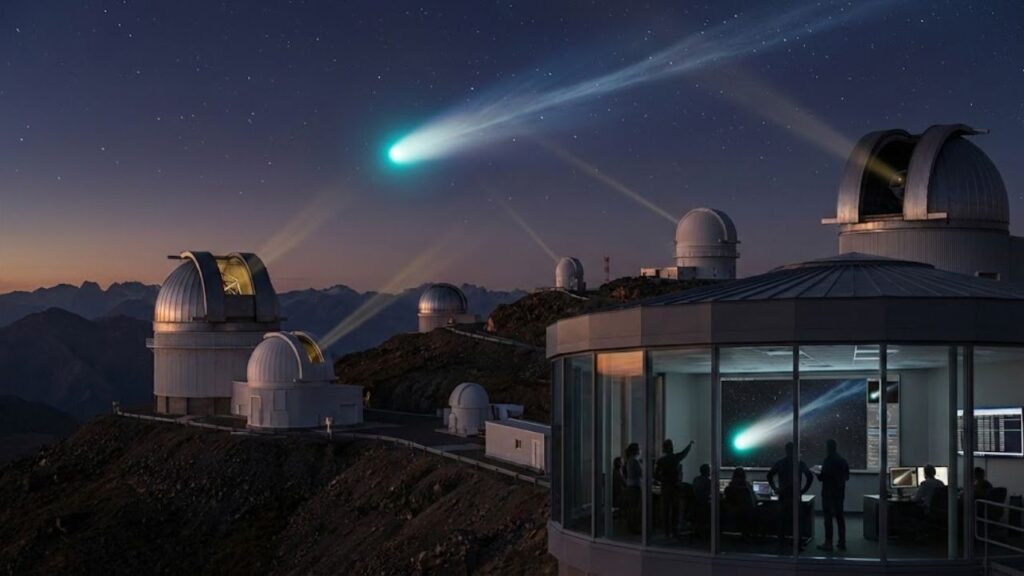
That barely visible object was 3I ATLAS, only the third confirmed interstellar comet ever identified. The images captured that night would soon leave astronomers around the world stunned.
When an object from another star system steals the spotlight
At first glance, the new images of 3I ATLAS almost look unreal. The comet appears as a soft blue streak, its faint tail brushing across a backdrop of razor-sharp stars like paint on black velvet. It lacks the fame of ‘Oumuamua or 2I/Borisov, yet it delivers the same quiet jolt: this object formed around another star, light-years away.

In some exposures taken just minutes apart, its motion is visible frame by frame. It feels like the universe caught mid-movement.
 $2,000 Direct Deposit for U.S. Citizens in February Eligibility, Payment Dates & IRS Instructions
These images were not produced by a single flagship telescope. Instead, they came from a carefully assembled network: the Pan-STARRS survey in Hawaii, the ATLAS system that first flagged the object, European observatories on La Palma, professional telescopes in Chile, and even several advanced amateur setups sharing data online.
One team in the Czech Republic captured its first clear image just after midnight, as clouds parted at the last moment. Another group in Arizona battled strong winds and a malfunctioning dome shutter. The final image set feels like a group photograph taken across continents, with everyone leaning in to catch a glimpse of a fleeting guest.
What makes these images compelling goes beyond their beauty. Subtle changes in the tail’s curve and brightness allow astronomers to infer the dust structure, the amount of volatile ice evaporating, and even hints about the direction the comet may have been ejected from its original system.
The Sun does not control this object’s path. Its hyperbolic orbit means it is moving far too fast to be captured. The images confirm what calculations already showed: 3I ATLAS is passing through once and will never return.
How a worldwide telescope effort came together
Capturing these images required something closer to event coordination than a routine observing run. Once 3I ATLAS was identified as a possible interstellar object, astronomers began quietly coordinating through Slack channels, mailing lists, and Discord servers. Who had clear skies? Who could observe at dawn? Who could run long exposures without excessive star trailing?
- The grandmother’s old mix that makes floors shine using a method trusted for decades
- Government orders mandatory digital IDs for all citizens starting next year, raising privacy concerns
- After 250 years, a lost explorer’s ship is found preserved off Australia’s coast
- People with poor social skills often repeat these phrases without noticing their effect
- Behavioral scientists link fast walking habits to shared personality traits
- ATM keeps your card: the fast action and button you need to know
- A new series of spacecraft images reveals 3I ATLAS with unsettling clarity
- Phrases people over 65 use that sound outdated to younger generations
The goal was to observe the comet from different angles and at different times, building coverage no single observatory could achieve alone. This meant tightly scheduled imaging windows, shared spreadsheets, and frequent messages like, “Can you cover the next two hours? My sky just clouded over.”
Several teams nearly missed the moment. An observatory in Italy lost an entire night to Sahara dust in the atmosphere. Another in South America suffered a guiding system failure just as the comet crossed a particularly striking star field.
A few fortunate breaks made the difference. A robotic telescope in Australia, primarily set up for routine surveys, scanned the right patch of sky at exactly the right time. Its data filled a critical gap and delivered some of the sharpest early images. Not every major discovery arrives by grand design; some appear through a backup system running quietly at 3 a.m.

Taken together, images collected over weeks and across continents reveal a consistent picture: a nucleus likely less than one kilometer wide, releasing dust into a long, feathered tail as it warms in sunlight. Color filters suggest the presence of different gases, while the uneven halo around the comet hints at jets erupting irregularly from its surface.
This level of work is not routine. It represents the cutting edge of comet science, pushed further by the fact that this object does not belong to our Solar System.
“Every new image of 3I ATLAS feels like a postcard from another planetary system,” one researcher involved explained. “We’re not just observing a comet, we’re seeing how other stars build their worlds.”
- Multiple observatories collaborated to track 3I ATLAS across the sky
- High-cadence imaging captured its motion and subtle brightness changes
- Color and spectral data are beginning to reveal the makeup of this alien ice
What images of alien ice reveal about our own origins
As astronomers continue studying the latest images of 3I ATLAS, familiar patterns emerge. The soft plumes of dust streaming from its nucleus closely resemble material that once surrounded our young Sun, later forming comets, moons, and planets. It is a humbling reminder that what we label as alien may reflect a process we know well, unfolding around another star.
In this way, 3I ATLAS offers a glimpse into another system’s origin story, delivered by a fragment that happened to pass through our cosmic neighborhood.
Researchers are already comparing its brightness curves with data from 2I/Borisov and long-period comets originating in our own Oort Cloud. Differences in reflected light or gas emissions could point to a distinct chemical recipe in its home system, perhaps richer in carbon or lacking certain ices.
There is also the growing suspicion that such visitors may be far more common than previously believed. They are simply faint, fast, and difficult to detect. The ATLAS discovery, reinforced by follow-up imaging, supports the idea that interstellar debris may regularly pass through our Solar System, unnoticed until now.
These new images do more than satisfy curiosity. They hint at what lies ahead. Wide-field surveys, AI-assisted detection tools, and globally coordinated observations are gradually turning Earth into a distributed super-telescope. Each new detection helps clarify whether our Solar System is typical or unusual within the galaxy.
Some readers may scroll past another striking space image without pause. Others will stop, zoom in, and wonder where that small, wandering iceball began its journey. For them, the impact is real. These images are not only about astronomy. They are about perspective.

Key takeaways from the discovery of 3I ATLAS
- Interstellar origin: 3I ATLAS follows a hyperbolic path and moves too fast to be bound to the Sun, highlighting its rarity
- Global observation effort: Coordinated imaging from observatories worldwide shows how modern astronomy relies on collaboration
- Insights into other systems: Color, brightness, and tail structure provide clues about the chemistry of distant planetary systems
