
The gym carried a faint mix of floor polish and sweat, and every desk showed a small groove worn in by last year’s pencil. The teacher entered holding a whistle, not a laptop. There was no PowerPoint, no online quiz. She began with a look that silently explained respect, consequences, and expectations.
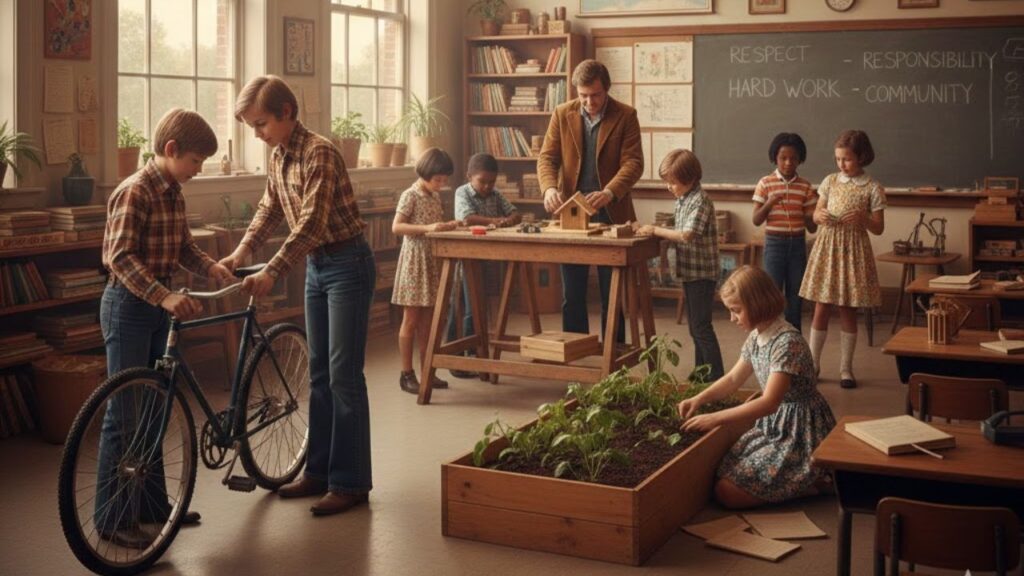
If you went to school in the 1960s or 1970s, you likely learned things that never appeared on the chalkboard. How to offer a firm handshake. How to sit with boredom without unraveling. How to repair something before throwing it away. Nobody labeled these lessons as “life skills.” They were simply part of everyday life.
Somewhere between rotary phones and smartphones, many of those lessons quietly faded from classrooms.

The Quiet Strength Schools Once Taught
Speak with someone who graduated in 1972, and their school memories sound different. They don’t talk about apps or testing platforms. They recall being sent outside to run laps for talking back, or teachers who didn’t ask if you felt inspired but expected effort regardless.

Beneath those routines was a shared message. You fall, you stand back up. You don’t understand, you stay after class. You don’t like the rule, you follow it anyway. These ideas weren’t slogans on posters. They were reinforced through habit, repetition, and structure.
One woman, now in her late sixties, still remembers failing a math test in eighth grade. There was no extra credit and no discussion about fairness. Her teacher slid the paper back and said, “You’re smarter than this. Be here at 7:30 tomorrow.”
She showed up every morning for two weeks. No snacks. No praise. Just chalk dust and long division until it finally made sense. She shares that story with her grandchildren whenever they say, “I’m just not a math person.”
Her lesson wasn’t about kindness. It was about the belief that struggle belonged in learning, not as a signal to quit.
Today, resilience is discussed constantly, often packaged in worksheets and slogans. In the 60s and 70s, resilience was more direct. Long walks to school. Detentions that involved real work. Sports without trophies unless you actually won.
That system had flaws, and sometimes crossed lines. Still, it taught many that discomfort is not an emergency. Waiting, retrying, boredom, even embarrassment would not destroy you. When every inconvenience becomes a crisis, the old “just get on with it” mindset feels almost radical.
Respect, Responsibility, and Daily Habits
One of the biggest differences people recall is how respect was practiced, not debated. You stood when an adult entered. You didn’t use a teacher’s first name. You began letters with “Dear Mr. Smith”, even for something minor like a missing book.
Those formalities may sound outdated now, yet they trained children to pause and recognize others. The message was clear: you are not the center of every moment, and your behavior shapes the space you share.

Many adults today quietly admit something feels off. Children are bright, funny, and digitally skilled, yet often struggle with eye contact, basic courtesy, or sustained effort. Anxiety is higher. “I can’t” appears more often than “I’ll figure it out.”
This isn’t about blame. When we remove every point of friction from childhood, we also remove the small moments where responsibility once took root. Paying for a lost library book. Calling to apologize instead of texting. Acknowledging your role in a conflict without multiple adults managing it for you.
No one handles this perfectly every day.
Those raised in the 60s and 70s often describe responsibility as non-negotiable. Chores came before play. Helping younger siblings was expected. If you broke something you borrowed, you worked to replace it.
As one retired teacher explained:
“We didn’t ask kids how they felt about responsibility. We gave it to them and let the feelings come later.”
Some of these habits are easy to reintroduce at home:
- Having children greet visitors with a clear hello and their name
- Asking them to call instead of text when canceling plans
- Giving one household task that is fully their responsibility
- Allowing natural consequences instead of rescuing every time
These aren’t dramatic gestures. They are small, repeated signals that say: you are capable, you matter, and your actions carry weight.
Relearning What Was Left Behind
Listen closely to people who grew up in the 60s and 70s, and you’ll hear a quiet sense of homesickness. Not just for music or cars, but for clarity. You knew where the lines were. You understood what adults expected. You accepted that life was often unfair and believed you would manage anyway.
Few want a return to the harsher sides of that era. There is no call for more fear or less compassion. Instead, there is a question: did we discard a few quietly powerful lessons while rushing to modernize everything?
 Using the Same Shampoo for Years Can Backfire - Hair Often Needs a Monthly Clarifying Reset
| Key point | Detail | Value for the reader |
|---|---|---|
| Everyday resilience | Struggle and boredom were seen as normal parts of learning | Helps reframe challenges as training, not personal failure |
| Habitual respect | Rituals like greetings, titles, and handwritten notes | Offers simple ways to rebuild social confidence in kids |
| Real responsibility | Chores, consequences, and owning mistakes | Gives practical ideas for raising more self-reliant children |
