
The HVAC technician glanced at the living room vent, then back at the homeowner, and gave a small laugh. “You really shouldn’t be closing these,” he said. “It ends up costing you more and puts extra strain on the system. You’re lucky it’s still coping — next time, you might need a bigger unit.”
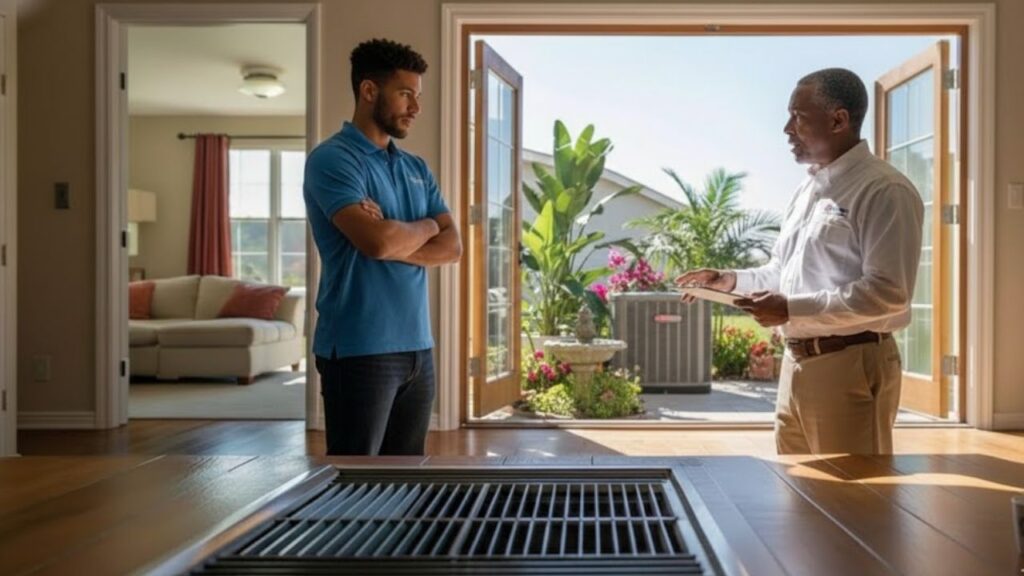
The homeowner nodded, partly convinced, partly doubtful. Because the strange part was this: a different technician had said almost the exact same thing the previous winter, nearly word for word.
Only two rarely used rooms had their vents closed. The energy bill hadn’t surged. The system hadn’t failed.

Yet the phrase lingered like dust hanging in sunlight: “Closing vents costs you more.”

And that raises a quiet question: what if this warning isn’t really about your wallet at all?
Why HVAC Companies Push Back Against Closed Vents
Step into almost any older home during summer and you’ll notice the same pattern: a few vents closed in guest rooms, basements, or an office that barely gets used. It’s a natural instinct. Why cool spaces you rarely occupy?
Then the HVAC technician arrives for routine maintenance, and suddenly that simple choice becomes a lecture. You’re told you’re “restricting airflow,” “overworking the system,” and “throwing money away,” all while quietly damaging your furnace or air conditioner.
Oddly enough, the conversation often drifts toward one conclusion: you need a larger system.
Consider Sarah, a teacher in Ohio. She lived in a 2,000-square-foot home with an older but functional 2.5-ton AC unit. To keep cooling focused where she actually spent time, she closed vents in a formal dining room and a spare bedroom.
When her technician arrived, he immediately noticed the closed vents and warned her: “That’s why your upstairs struggles to cool. You’re putting excess pressure on the blower. You should really upgrade to a 3.5-ton system.” He even handed her a glossy sizing chart that conveniently leaned toward oversized units for nearly every home.
Out of concern, Sarah reopened the vents for a month. The bill didn’t drop. Comfort didn’t improve. What changed was her confidence in the advice.
The reality is far less dramatic: closing one or two supply vents in a typical ducted system doesn’t automatically spike your energy costs. It slightly alters airflow and static pressure. If the system is already poorly designed or oversized, that change simply exposes problems that were already there.
For some companies, that explanation is convenient. It shifts blame to your habits, supports recommending a bigger unit, and avoids admitting that the ducts were undersized or the original system was oversized from the start.
And so the myth spreads: closing vents is expensive. The nuance — and your actual experience — quietly disappears.
How to Close Vents Safely (And When You Shouldn’t)
If you want to experiment with vent adjustments, think in percentages, not panic. In a home with around 10 to 12 supply vents, it’s usually safe to partially close one or two in rooms that see little use.
 Goodbye Hair Dye for Grey Hair: The Conditioner Add-In That Gradually Restores Natural Colour
Make changes gradually. Close a vent halfway and leave it that way for a week. Notice airflow in main living areas, glance at your utility bill, and listen for new sounds like whistling, rattling, or an unusually loud blower. Then adjust if needed.
This isn’t delicate surgery. You’re simply redirecting comfort where it matters.
Problems arise when people shut off half the house and expect a standard system to behave like a zoned setup. Most central HVAC systems aren’t designed for that. Closing four or five vents at once can raise static pressure and shorten blower life, especially in older systems or budget installations with undersized returns.
Another common misstep is closing vents near thermostats or main return ducts. That confuses temperature readings, causes erratic cycling, and quickly wrecks comfort. If one room suddenly swings between freezing and stifling, you’re not imagining it.
“Most people hear ‘don’t close vents’ as an absolute rule,” says Matt, an independent HVAC designer who often fixes oversized systems. “What they’re rarely told is that the unit was oversized from the start. Any small airflow change gets blamed, when the real issue was the sales decision.”
- Limit adjustments to 10–20% of vents, and avoid fully sealing them.
- Focus on rooms without thermostats, major returns, or extreme temperature swings.
- Pay attention to new noises or weak airflow after changes.
- Compare utility bills before and after instead of relying on fear-based advice.
- Request written static pressure readings before accepting any recommendation for a larger system.
What the “Closing Vents Costs More” Myth Really Hides
Once the fear is stripped away, closing vents highlights a truth the industry rarely promotes: proper sizing and duct design determine real efficiency and comfort. A well-matched, properly ducted system can tolerate minor airflow changes without issue. An oversized, poorly designed system struggles even with every vent fully open.
When someone claims that closing a single vent will “damage your system” or “increase costs,” it often serves to defend earlier design choices. Oversized systems short-cycle, wear out faster, and rarely operate at peak efficiency. Undersized return ducts force blowers to work harder than necessary. Both problems cost far more over time than a closed guest room vent.
There’s also a subtle psychological angle. If you believe every airflow adjustment is dangerous, you’re less likely to question tonnage, duct layout, or the absence of zoning in a fragmented floor plan. You’re pushed into a passive role — the homeowner who shouldn’t touch anything.
Once that mindset takes hold, selling a bigger system feels like a rescue rather than an upsell. The story shifts: you didn’t get oversold, you simply “outgrew” your unit. Your habits stressed it. Your closed vents forced the upgrade.
No one realistically stands beside their HVAC system with gauges and calculators every day.
The alternative is calmer and far more empowering. Treat your home like a low-risk experiment. Adjust a vent slightly. Observe the results. Ask technicians for measured static pressure, duct dimensions, and load calculations. Notice who can explain clearly without jumping straight to replacement.
You don’t need to be an HVAC engineer to recognize when a story doesn’t add up. If your bill didn’t spike, your system didn’t fail, and comfort stayed stable after closing one vent, that evidence matters more than a rehearsed warning.
The idea that “closing vents costs more” survives because it’s simple, alarming, and profitable. What replaces it takes longer: data, observation, and a willingness to question a polished sales pitch.

- Closed vents aren’t automatically expensive: Targeted adjustments in low-use rooms rarely cause major cost increases.
- Oversizing is the real issue: Many homes receive larger systems than needed, making small airflow changes look dangerous.
- Numbers matter more than opinions: Static pressure readings, duct sizing, and load calculations reveal the real limits.
