On that day, a father and son from South Africa rolled out a strange 3D‑printed quadcopter, pressed the throttle, and quietly rewrote what a “home project” can achieve.
A drone that outruns a high‑speed train
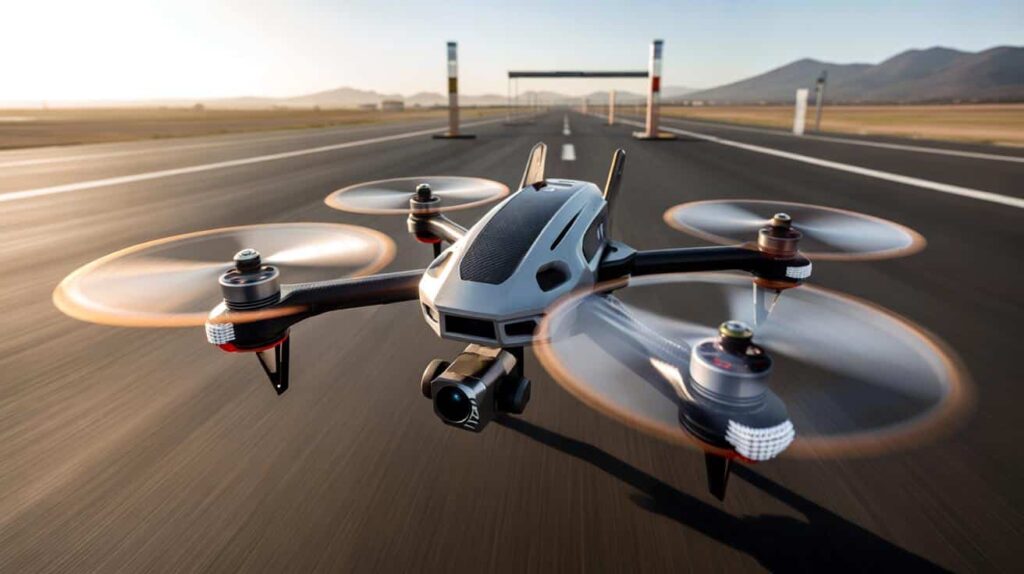
The machine is called Peregreen V4, and it has just been certified by Guinness World Records as the fastest quadcopter on Earth. During an official run in December 2025, it reached an average speed of 657.6 km/h (about 408.7 mph) over a measured course near Cape Town.
Peregreen V4 now holds the Guinness record for the fastest four‑rotor drone, with a speed close to twice that of a French TGV.

To meet Guinness rules, the drone had to complete two consecutive passes in opposite directions. The idea is simple: by averaging both runs, wind advantage gets cancelled out.
- Outbound pass, facing the wind: 599 km/h
- Return pass, with shelter from the wind: around 658 km/h
- Guinness‑certified average: 657.6 km/h
This figure nudged the previous record up by around 14 km/h, and that earlier mark was already held by the same duo: Mike and Luke Bell. It is the third time their names have been etched into the record books for drone speed.
The timing also carried a hint of rivalry. Only weeks before, an Australian engineer had briefly grabbed the title with a DIY machine named Blackbird. The South African team responded with Peregreen V4 and took the record back.
Why Guinness cares how fast a quadcopter can go
On paper, a 657 km/h hobby drone sounds like a curiosity. In practice, it is a focused engineering project. Guinness brings strict procedures, from calibrated timing systems to independent witnesses and flight‑path rules. That framework forces builders to move beyond one‑off lucky flights and reach consistent, repeatable performance.
For the Bells, the record is less a party trick than a validation step. Every new version of Peregreen has been used to test ideas in aerodynamics, power systems, and structural design. The fourth iteration is the most ambitious so far.
3D printing, airflow and obsessive refinement
Peregreen V4 is not a typical racing drone built from off‑the‑shelf frames and parts. Its frame, camera mount and landing gear are printed as a single piece on a Bambu Lab H2D dual‑extrusion 3D printer. That decision shapes almost every aspect of its performance.
A single‑piece frame for cleaner aerodynamics
By printing the structure in one go, the team removed most joints, bolts and exposed edges. All those little interruptions in shape normally add drag by throwing the surrounding air into turbulence.
A smoother surface means less disturbed airflow, less drag, and more usable speed from the same power.
The pair also relied heavily on digital fluid simulations. Using the AirShaper CFD (computational fluid dynamics) platform, they modelled how air wrapped around the fuselage and arms. They then tweaked angles, cross‑sections and smooth transitions until they hit a balance between lift, stability and low drag.
This process took about five months of intense work. Each component went through rounds of redesign, reprinting, sanding and retesting, with the goal of shaving off tiny bits of resistance that add up at several hundred kilometres per hour.
Hand‑tuned props and brutal acceleration
Power comes from four T‑Motor 3120 brushless motors rated at 900 kV. In simple terms, that “kV” value describes how many revolutions per minute the motor will attempt per volt applied. Higher values generally mean higher rotational speeds, provided the rest of the system can keep up.
Rather than stick with standard propellers, the Bells trimmed and reshaped their blades by hand. Each prop’s length was reduced to roughly 15 cm, allowing the motors to spin faster without overloading or losing efficiency. At these speeds, even small differences in blade profile can change the way the drone responds.
The frame itself, enlarged slightly from previous versions, is built from carbon fibre elements that have been sanded and polished carefully. The finish is closer to a high‑end racing bicycle than a weekend FPV build.

The result is not only raw speed in a straight line, but also a platform that remains controllable and stable beyond 600 km/h.
Family project first, industry benchmark later
Despite the high‑tech numbers, Peregreen V4 is not an industrial programme. It is a family project driven by curiosity and a taste for challenge. Mike and Luke have spent more than two years pushing through a series of prototypes, crashes and redesigns.
They document much of this journey on YouTube, where they break down complex topics—like thrust‑to‑weight ratios or CFD post‑processing—into digestible videos. That transparency has turned their project into an unexpected teaching tool for aspiring drone builders, students and hobbyists.
| Project aspect | Approach |
|---|---|
| Design | Iterative, simulation‑driven geometry refinement |
| Manufacturing | 3D‑printed monocoque frame, hand‑finished carbon fibre |
| Powertrain | Four 900 kV brushless motors with custom‑cut props |
| Testing | Multiple real‑world runs, telemetry analysis, crash‑driven redesign |
Their work shows how far consumer‑grade tools have come. A desktop 3D printer, some mid‑range motors and open CFD software, in the right hands, can now rival specialised labs in niche performance metrics like multirotor top speed.
Why extreme racing drones actually matter
A record‑breaking speed run might sound like a stunt, yet projects like Peregreen V4 often act as flying test benches. Each experiment feeds into future applications where speed and control might save lives or reduce costs.
From record runs to real‑world missions
Fast, agile drones could reshape several areas:
- Emergency response: A high‑speed drone could deliver medical supplies or automated external defibrillators to remote locations before an ambulance arrives.
- Inspection work: Covering long stretches of pipeline or coastline at higher speed cuts mission time and costs.
- Military and security: Rapid‑response scouting platforms benefit from the same blend of speed and manoeuvrability tested in record attempts.
- Racing and entertainment: Organised drone racing already exists; faster and more reliable craft raise the ceiling for this niche sport.
High‑speed prototypes stress every weak point—materials, software, and human reaction times—forcing solutions that later filter into mainstream drones.
Knowledge gained from keeping a quadcopter stable at 650+ km/h can be reused in flight controllers, sensor fusion algorithms, and fail‑safe systems. Those improvements then trickle into more conservative designs used for mapping, filming or agriculture.
Risks, limits and what still holds drones back
Running a drone at these speeds is not just a thrill. It raises real safety questions. A small mass moving at 650 km/h carries enormous kinetic energy. A collision with a bird, a power line or even a gust of turbulent air could be catastrophic.
That is why such flights require strict segregation from people and property, robust range safety procedures and redundancy in radio links and power systems. Many of the same constraints already apply to commercial drone operators, but they are amplified when the machine moves faster than many light aircraft.
Regulation also lags behind technology. Most aviation authorities focus on altitude, weight and beyond‑visual‑line‑of‑sight operations. Horizontal speed is harder to track and enforce, particularly when hardware is built from common parts at home.
What terms like kv and CFD really mean
Some of the jargon around Peregreen V4 is worth unpacking. The “kV” rating on a brushless motor reflects its unloaded rotational speed per volt. A 900 kV motor aims for about 900 RPM per volt. Pair that with a suitable battery and propeller, and you can predict thrust, current draw and top speed more accurately.
CFD, or computational fluid dynamics, refers to software that simulates how air flows around objects. Instead of building ten physical frames, a designer can test dozens of shapes on a computer, then print only the most promising ones. That combination of simulation and rapid prototyping lies at the heart of this record.
For hobbyists, the Bell project offers a roadmap: start with basic safety and control, then use tools like CFD, 3D printing and data logging to iterate. The path to a Guinness certificate is narrow, but the path to a more efficient, more stable personal drone is open to anyone willing to tinker as hard as they did.