
Saturday morning at the salon, the scene repeats itself like a ritual. A client drops into the chair, runs a tired hand through her hair and sighs, “My hair just looks… sad.” The strands are fine, flat at the roots, frayed at the ends. On her phone, a screenshot of a celebrity cut that, on her, gave the opposite effect: less volume, more scalp on show, and a styling time that doubled overnight.
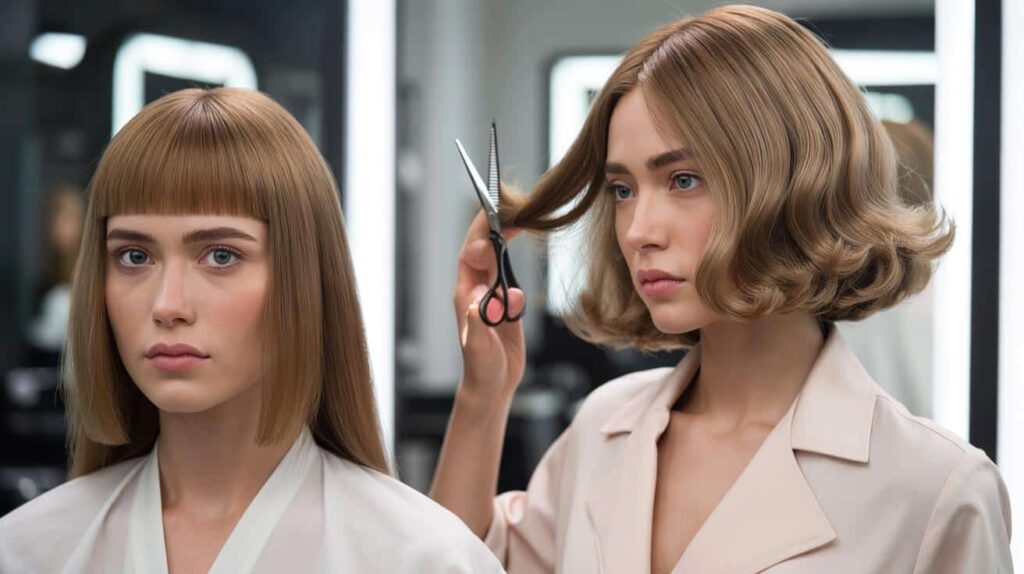
The hairstylist smiles, but you can see it in her eyes: she already knows which “trend” did the damage. She’s seen it a hundred times this month.
The truth is, some hairstyles are almost designed to crush fine hair.

And stylists are starting to say it out loud.

The 2026 hairstyles that suffocate fine hair (and why pros are over them)
Ask any hairstylist what they’re tired of fixing, and they’ll list the same “worst offenders” for fine hair. Ultra-long mermaid lengths that cling to the face. Poker-straight glass hair that shows every gap. Thick, blunt cuts with heavy fringes that look amazing for one photo… then collapse into a lifeless sheet.
On TikTok and Instagram, these looks still rack up millions of views. On fine hair in real life, they age the face and make hair look thinner than it actually is.
Stylists see the gap between the filtered trend and the bathroom mirror.
One Parisian colorist tells the story of a client who arrived with waist-length hair, inspired by a K‑pop star. Her hair was naturally very fine, with low density. From the front, you could see through it like a curtain.
“She thought long hair would hide how little hair she had,” the stylist explains. “In reality, the weight of all that length dragged everything down.” Once they cut 15 cm and added soft, invisible layers, the client walked out looking as if she had twice as much hair.
The “wow” didn’t come from magic. It came from letting go of the wrong hairstyle.
Fine hair has two main challenges: each strand is thin, and often there aren’t that many of them. So anything that adds weight, flattens roots, or creates big, heavy blocks of hair works against you. Thick blunt ends with no movement create a straight vertical line. Super-long lengths stretch that line further, pulling everything down.
Add a dense, straight fringe to the mix and you’ve just covered the one place where volume matters most: the roots framing your face. The result is a compact, pressed-down silhouette that draws the eye to the scalp, not the hair.
When stylists say “worst hairstyles”, they’re talking about cuts that fight physics.
The cuts to forget in 2026 (and what stylists secretly wish you’d ask for instead)
The first style most pros would quietly retire for fine hair in 2026: the ultra-long, one-length cut that hits mid-back or lower. On thick hair, it looks romantic. On fine hair, it behaves like a heavy curtain, glued to the scalp with no air between the strands. The longer it gets, the thinner the ends appear.
Next in line is the ultra-straight, “glass hair” look with a middle part and zero movement. It reflects light, yes, but it also highlights every gap, swirl and cowlick. Volume? Gone.
Finally, that thick, straight-across fringe that people bring in on celebrity screenshots. It can look stunning on camera, yet on fine hair it usually splits, clumps, and steals precious density from the rest of the head.
We’ve all been there, that moment when you leave the salon convinced this will be your “new signature look.” Day one, the blow‑dry is perfect, the hair smooth and shiny, the fringe obedient. Day three, you wash it at home. Suddenly the long, flat hair hangs in sad strings, and the fringe separates into three wisps that cling to your forehead.
One London stylist tells me she sees this with the “glass hair + fringe” combo at least twice a week. Clients arrive convinced their hair “got thinner”. In reality, it didn’t. The haircut just exposes everything. She pulls up old photos with more layered, shorter cuts and there it is: same hair, more movement, more life.
The cut changed the story. Not the hair.

There’s a logic to all this. Fine hair needs lift, air and strategic “gaps” to look fuller. That means shorter to medium lengths, light layering, and shapes that push hair away from the scalp. When you do the opposite — extra length, no movement, center part glued flat — you create a pancake effect.
Think of hair as fabric. A thin silk dress looks luxe when it’s draped, pleated, moving. When you stretch it tightly over something, you see every line beneath. Same with fine hair: big, heavy blocks reveal the truth, while subtle shape and texture create an illusion of abundance.
*The worst hairstyles for fine hair are not ugly, they’re just unforgiving.*
What hairstylists recommend instead: real‑life, not just Instagram
The pros aren’t saying you need to chop everything off. They’re saying: play with length smarter. For most fine hair, they love anything between the jaw and the collarbone — bobs, long bobs, soft shags. These lengths give enough weight to feel feminine, but are light enough to lift at the roots.
One precise method they rave about: “internal layering” or “ghost layers”. From the outside, the cut looks almost one-length. Inside, tiny sections are removed to create hidden volume and movement without those outdated, obvious choppy layers. The hair swells slightly instead of lying flat.
Root volume products suddenly work better because they’re not fighting 40 cm of hair.
Another big tip: rethink the fringe. Instead of a thick, horizontal bar across the forehead, stylists suggest curtain bangs, wispy shaping, or a soft, diagonal fringe. These create openness around the face and take advantage of your natural fall without stealing too much density.
A common mistake with fine hair is wanting to “prove” you have hair by keeping everything long and solid. The emotional instinct makes sense, especially if you’ve always felt your hair was a bit “too light” or “too baby‑soft”. But that choice often has the opposite visual effect: the longer and straighter the hair, the more scalp shows.
Let’s be honest: nobody really does a full, precise salon blow‑dry every single day.
When you ask stylists what they wish more clients with fine hair understood for 2026, their answer is surprisingly gentle.
“Fine hair isn’t a problem to hide,” says Claire, a hairstylist in Lyon. “It’s a texture to dress differently. Once you stop fighting it with the wrong cuts, everything becomes easier. You spend less time styling and you look less ‘done’, more natural. That’s where real chic lives.”
So what does “dressing it differently” look like on a practical level? Many pros suggest simple, low‑stress switches:
- Swap ultra‑long hair for a collarbone or jaw‑length cut with light internal layers.
- Trade a heavy, straight fringe for soft curtain bangs or face‑framing pieces.
- Move from a rigid middle part to a slightly off‑center or zigzag part for instant lift.
- Ask for textured or feathered ends rather than a thick, blunt, straight line.
- Choose subtle waves or bends over aggressive straightening or tight curls.
Each small change chips away at flatness and adds quiet volume where it counts.
Letting go of “dream hair” and choosing hair that actually works on you
There’s a quiet revolution happening in salons: more clients are showing stylists screenshots… of people who actually share their texture and density. Less “I want Kim Kardashian’s hair” and more “Here’s someone with fine hair like mine — what can we do in that direction?”
That shift might be the real 2026 trend. Moving away from fantasy cuts that punish fine hair — the XXL mermaid, the glass sheet, the dense straight fringe — and toward cuts that let it move, swell, breathe. Cuts that look good at 7 a.m. in the kitchen light, not just in the salon spotlight.
Some will still cling to their long, flat lengths because it feels safe, and that’s human. Others will let a stylist quietly remove 5, then 10, then 15 cm, and suddenly discover cheekbones, a neck, a lighter head.
Somewhere between those scissors and the mirror, there’s a new question taking shape: not “Which hairstyle is trending?” but “Which hairstyle gives my fine hair a chance to exist?”

| Key point | Detail | Value for the reader |
|---|---|---|
| Skip ultra‑long, one‑length cuts | They drag fine hair down and expose thin ends | Instantly avoid the “stringy” look and gain visual density |
| Rethink heavy fringes and glass‑straight styles | These flatten roots and reveal scalp | Choose movement and lightness for a fuller, softer frame |
| Choose medium lengths with invisible layers | Internal layering, soft bobs, curtain bangs | More lift, easier styling, and a cut that works beyond the salon |
FAQ:
- Is short hair always better for fine hair?Not always. Extremely short cuts can sometimes reveal the scalp. Most stylists prefer short to medium lengths — from jaw to collarbone — with smart layering rather than going ultra‑short by default.
- Can I keep long hair if my hair is very fine?You can, but aim for just below the shoulders instead of mid‑back, and ask for invisible layers and face‑framing pieces. Very long, poker‑straight hair is what tends to make fine hair look the thinnest.
- Are blunt cuts bad for fine hair?Blunt cuts can work when they’re not too long and when they’re slightly softened or textured at the ends. The “worst” version is a very long, thick, perfectly straight line — it flattens everything.
- What kind of fringe is best with fine hair?Curtain bangs, soft side fringes, or very light, wispy bangs. They frame the face without stealing too much density from the rest of the hair.
- How often should I cut fine hair to keep it looking full?Most stylists recommend every 6–8 weeks for short to medium cuts, and every 8–10 weeks for slightly longer ones, so the shape doesn’t collapse and the ends don’t get see‑through.
