New scientific research reveals that large areas of Greenland were free of ice only a few thousand years before the pyramids rose in ancient Egypt. This unexpected discovery is pushing researchers to reassess how quickly Greenland’s ice sheet can shrink and what that means for global sea levels in a rapidly warming climate.
Greenland was not always locked in ice
Today, Greenland is almost completely covered by an ice sheet that reaches up to three kilometres thick. From space, it appears as a vast, continuous white surface. However, geological evidence shows that this frozen state has not always been permanent, as ice expands and retreats in response to temperature changes over time.
The name “Greenland”, rooted in Old Norse, reflects a landscape once associated with green land and grazing areas. Recent findings suggest that parts of the island were not only greener during Viking times but were also entirely ice-free around 7,000 years ago. For ice sheets that typically evolve over tens or hundreds of thousands of years, this shift is remarkably recent.

Data from the study indicate that sections of north-west Greenland remained ice-free between roughly 6,000 and 8,200 years ago. Published in Nature Geoscience, the research shows that Greenland’s ice sheet is far more dynamic and sensitive to climate changes than many earlier models suggested.

Drilling deep to uncover Greenland’s past
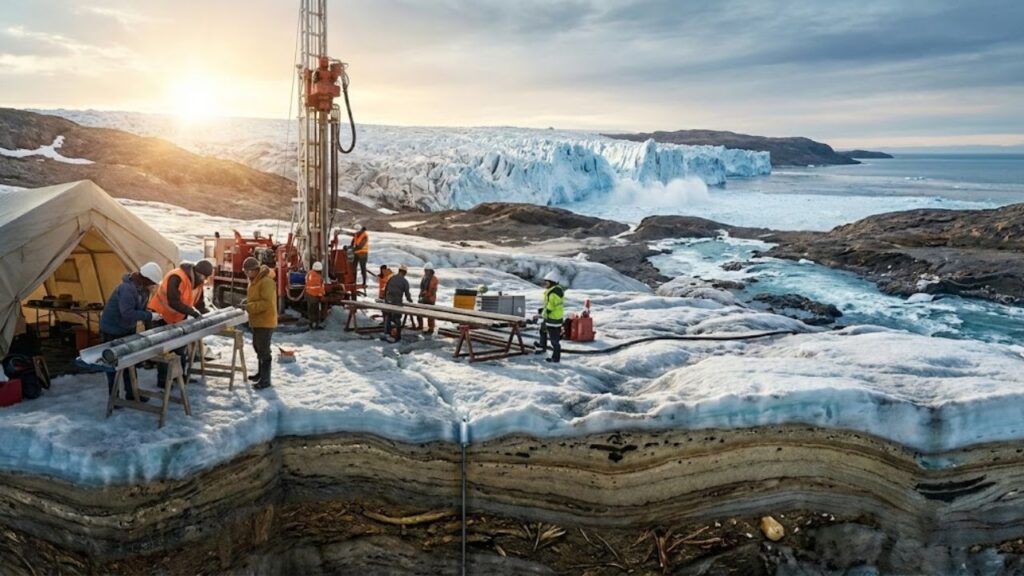
The strongest evidence comes from Prudhoe Dome, an area in north-west Greenland long assumed to be permanently frozen. Scientists drilled through more than 500 metres of solid ice to reach the ground beneath.
At the base, they recovered layers of sediment made up of fine sand and silt. These materials once lay exposed on the surface before being buried by advancing ice. Crucially, these grains contain a record of when they were last exposed to light.
How trapped light reveals ancient timelines
To determine the age of the sediments, researchers used luminescence dating, a method that identifies when mineral grains last saw daylight.
- Mineral grains absorb energy from natural background radiation while buried.
- Sunlight exposure resets this stored energy when grains are at the surface.
- Once covered by ice or sediment, energy builds up again.
- In laboratory conditions, scientists release this energy as light and measure it.
- The amount of light indicates how long the grains remained buried.
Results from Prudhoe Dome show the grains were last exposed to daylight between 6,000 and 8,200 years ago. This confirms that the land was open to the sky during that period, with ice beginning to accumulate only around 7,000 years ago. What was once thought to be ancient, permanent ice is now understood to be a relatively young section of the ice sheet.
A warmer Greenland during the early Holocene
This ice-free interval aligns with the Early Holocene Warm Period. After the last Ice Age ended about 11,700 years ago, the Arctic experienced several millennia of milder conditions.
- Summer temperatures in Greenland exceeded present-day levels.
- Vegetation and soils spread farther north than today.
- Glaciers and ice sheets retreated across much of the Arctic.
The study confirms that this warmth was strong enough to remove large sections of ice in north-west Greenland. Researchers estimate that the ice sheet may have been hundreds of kilometres smaller than it is now.
Why ancient ice loss matters for future sea levels
Early Holocene warming was driven mainly by natural shifts in Earth’s orbit and tilt, which changed how sunlight reached the Arctic. In contrast, modern warming is largely caused by human-produced greenhouse gases. Despite these different causes, ice responds primarily to temperature and melt, not to why warming occurs.

If Greenland lost significant ice under relatively gentle natural warming, the current rapid, human-driven temperature rise could lead to even greater ice loss. Climate models already identify Greenland as a major contributor to future sea-level rise. A complete melt would raise global sea levels by about seven metres, although this would unfold over many centuries.
Comparing past and present warming
Scientists are now using these findings to improve climate models by comparing real historical events with simulated future scenarios.
- Early Holocene warming unfolded gradually over thousands of years and still caused major regional ice loss.
- Modern warming is occurring over decades, with accelerating melt, retreating glaciers, and surface meltwater lakes.
- Sea-level impacts in the past contributed to several metres of global rise, while current projections point to significant future increases.
The contrast is striking: earlier warming was slower, yet it dramatically reduced Greenland’s ice. Today, Arctic temperatures are rising much faster, at roughly four times the global average.
Implications for coastal communities
Even small increases in sea level can profoundly affect coastal regions. Ports, river deltas, and low-lying islands face heightened risks, especially when combined with storm surges and erosion. Greenland’s ice loss is only one factor, alongside Antarctica, mountain glaciers, and the expansion of warmer ocean water.
Scientists emphasise that ice sheets do not always respond smoothly. They can cross critical thresholds, after which retreat accelerates and becomes difficult to halt. Evidence from Greenland’s past shows that once ice disappears from certain regions, it can remain absent for long periods.
Key concepts explained
What defines an ice sheet?
An ice sheet is a massive body of ice covering more than 50,000 square kilometres. Only two exist today: Greenland and Antarctica. They form as layers of snowfall compress into ice over thousands of years and flow slowly under their own weight toward the sea.
Luminescence dating in simple terms
Luminescence dating works much like a rechargeable battery. Sunlight drains the stored energy in sand grains, while burial allows energy to build up again. In the lab, this energy is released as a faint glow, revealing how long the grains have been hidden from daylight and helping scientists identify when land was ice-free.
Looking ahead thousands of years
While no one can predict Greenland’s exact future, climate models explore different emission pathways. If greenhouse gas emissions fall sharply, warming could slow enough to preserve much of the ice sheet, limiting sea-level rise. If emissions remain high, long-term melting could leave large areas of Greenland resembling the partially ice-free landscape of 7,000 years ago.
The study offers a powerful reference point: Greenland has undergone extensive melting before under milder warming. Beneath Prudhoe Dome, land once open to sky and vegetation now lies under 500 metres of ice. Whether it becomes exposed again will depend largely on decisions made far beyond the Arctic.