
Saturday morning at the salon, the coffee machine hisses and the radio plays 90s hits. On the third chair by the window, Claire, 56, watches her reflection with a tiny frown. Her sweater is bright, her lipstick is fresh, but her hair? Flat, rigid, pulled back so tightly that her features look sharper, tired.
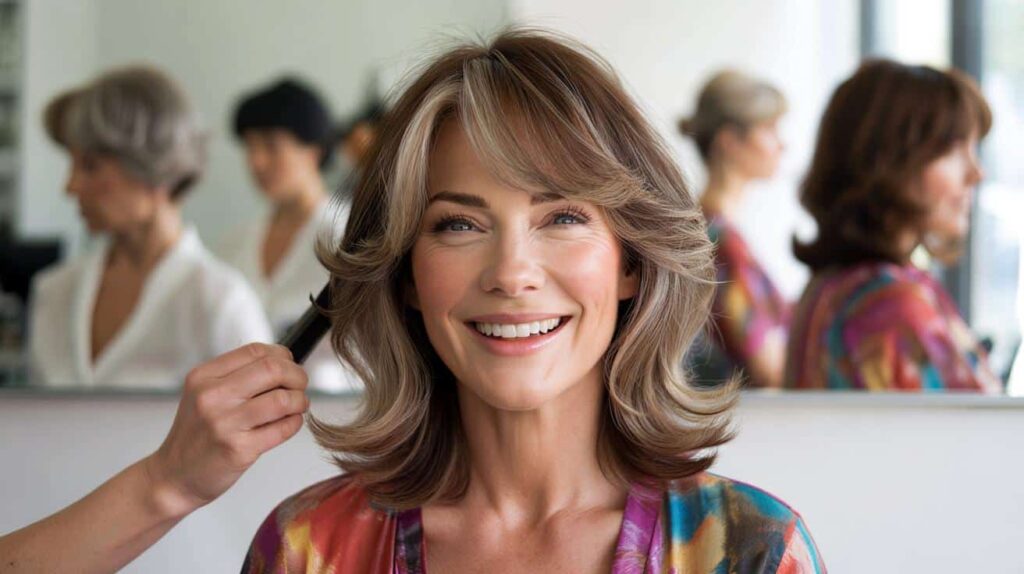
Her hairdresser, Ana, slips behind her and says gently: “You know, your cut is doing you no favors. It’s a bit… granny-style.”
Silence. Then a half-laugh, half-sigh. Claire thought she was playing it safe. Low-maintenance bun, same color for ten years, same fringe since university.

Ana starts listing the styles that instantly add ten years, even on a good skin day.

Some are probably sitting on your head right now.
1. The helmet bob that doesn’t move… at all
You know that short bob that stays exactly in place, even in a storm? The one that’s perfectly rounded, sprayed to death, with not a single strand daring to escape. On paper, it sounds “tidy”. On the face, it stiffens every feature and underlines expression lines like a highlighter pen.
Ana calls it “the helmet head”. A cut that hugs the skull too tightly, too round around the ears, with no movement at the ends. It looks practical, but it freezes the whole face.
As she likes to say: a haircut that doesn’t move makes you look like you don’t move either.
Ana remembers a client, Isabelle, 62, who came in asking to “freshen up” her usual short bob. She had worn the same ultra-structured, rounded cut for nearly fifteen years. Always the same salon, same photo, same result. Her colleagues had started to ask if she had changed her glasses or her cream, because she “looked very tired lately”.
The day Ana softened the line, opened the neck a bit, added texture and less lacquer, the reactions changed overnight. At work, people said she looked “rested”, even though her sleep was as bad as ever.
Nothing else in her life had changed. Just three centimeters of hair… and a lot less stiffness.
When a bob is too round and too perfect, the eye follows that curve instead of your gaze. The skull seems larger, the neck shorter, the features more severe. Past 50, the face often loses volume at the cheeks and temples. If the hair is rigid and voluminous at the wrong places, that contrast shouts “aging” instead of “energy”.
Breaking up the “helmet” with subtle layers and softer movement gives the face breathing room. A slightly irregular line, a side parting, a few flyaways that catch the light: all of that recreates a sense of life, not a wig-on-a-mannequin effect.
*The goal is no longer perfection: it’s vibration.*
2. The tight low bun that pulls everything back (including your mood)
The tight low bun seems like the dream solution: quick, practical, hides everything. You twist, you pin, a bit of gel on the sides, and you’re “presentable”. For many women over 50, it’s the default style on busy days. Or every day.
The problem is that this style irons out all softness around the face. It flattens the roots, stretches the features and emphasizes any hollows around the temples. The hairline suddenly becomes the star of the show, and that’s rarely the goal.
What feels like a chic, minimalist chignon often reads as strict, tired schoolmistress in real life.
Ana talks about Laura, 54, a manager who arrived at the salon with her habitual tight bun. “I have no time, my hair is frizzy, I don’t know what to do, so I tie it all back,” she said. On Instagram, the style looked like polished elegance. In the mirror, with fluorescent office lighting, it felt harsh.
Ana loosened the bun, pulled out two soft strands around the face, curved them slightly with a brush. She also lifted the roots at the crown instead of flattening them. Same woman, same clothes, same bun position. The difference? Her features relaxed, the look softened instantly.
At her next appointment, Laura admitted that her teenage daughter had said: “You look less angry lately, mum.”
When all the hair is pulled back too neatly, the eye goes straight to the forehead lines, drooping eyelids, or small asymmetries. The face looks “naked”, but not in a luminous way. With age, we need controlled softness: a few strands to blur angles, gentle volume around the temples, a curve instead of a straight tension line.
A slightly messy low bun, a ponytail with a bit of root lift, or a loose chignon with a side part can change the whole story. Tension equals severity, and severity rarely screams youth.
Let’s be honest: nobody really redoes a perfect ballerina bun from scratch every single day.
3. The solid block color that looks like a helmet of paint
From 50 onwards, many women panic at the first gray hairs and jump straight to a single, solid color. Often a dark brown or flat blond, the same shade from roots to ends, applied again and again. At first, it covers. Then, with time, the effect hardens. The face loses the contrast it once had, and the hair looks like a plastic shell.
Ana calls this the “block color trap”. No lightening around the face, no subtle dimension, just one uniform tone. Under real-life light, especially neon or winter skies, it can dull the complexion instead of reviving it.
Hair that looks like paint has the strange power to erase facial features instead of supporting them.
One afternoon, a client named Maria, 60, came in clutching a box dye photo. She had been using the same drugstore dark brown for twenty years, every four weeks, religiously. “Otherwise, I feel old,” she told Ana. The problem? The color was now too compact, too opaque, and showed every new gray root like a flashing beacon.
Ana suggested lifting the shade by one level, adding very fine, caramel-toned highlights around the face and at the top. Not streaks, just subtle threads of light. The rest of the hair stayed close to her natural tone. After the appointment, Maria’s friends thought she had changed her skincare routine, not her color.

Less contrast at the root, more delicate contrast in the lengths: the eye reads “fresh”, not “dyed”.
Our skin evolves with age; it loses some of its natural color and luminosity. A harsh block color can fight against that evolution instead of accompanying it. The hair then appears disconnected from the face, like a wig. On the other hand, nuanced tones and light-reflecting strands mimic what the sun used to do naturally in our twenties.
Technically, this can mean: half a shade lighter, a warmer or cooler reflect depending on your undertone, and micro-highlights just around the face. That way, regrowth is softer, and the overall effect is less “helmet”, more “halo”.
Ana repeats to her clients: **color should whisper youth, not shout over your features.**
4. The heavy fringe that sits like a curtain over your eyes
The idea makes sense: “I’ll hide my forehead lines with a thick fringe.” On Pinterest, it looks French, romantic, a bit rock. On a real 55-year-old with fine hair and glasses, the result is often the opposite. A fringe that’s too heavy, too long, or too straight across can cast a shadow on the eyes and make the upper face look weighed down.
Past 50, the eye area already tends to lose some openness. A massive fringe closes it even more, turning natural softness into fatigue. The hairline becomes a horizontal bar that cuts the face in two.
A lighter, perfectly placed fringe can rejuvenate. The wrong one can swallow the whole expression.
Ana remembers Nadia, 58, who arrived at the salon with a solid, straight fringe stopping right at the lashes. She had cut it herself “to hide my wrinkles”. On photos, she always tilted her head back so she could see. Her fringe absorbed light, made her lids appear heavier and highlighted dark circles.
Instead of removing it completely, Ana thinned it out and opened it slightly in the center. She shortened it a few millimeters and softened the sides so they blended into the rest of the hair. Suddenly, Nadia’s eyes looked larger, her crow’s feet less obvious, and her cheekbones lifted. No injection, no miracle cream. Just a fringe that finally worked with her face, not against it.
Sometimes, the difference between “cool fringe” and “curtain of sadness” is literally one centimeter.
What ages the most is not the idea of a fringe, but its weight and line. A straight, thick bar drags the gaze downwards and erases the natural verticality of the face. A wispy, side-swept or slightly split fringe creates vertical openings, guides the light to the irises and softens the forehead without hiding it entirely.
On finer hair, going too heavy often leads to rapid separation, greasy look, and constant rearranging. That nervous gesture of pushing the fringe back every thirty seconds doesn’t exactly radiate confidence.
As Ana likes to remind her clients: **your eyes are your real anti-aging treatment; your fringe should frame them, not imprison them.**
5. The “I gave up” long hair with no shape and no end
There’s also the opposite: hair that has never met a pair of scissors in years. Very long, very straight, the same length all around, sometimes always tied in the same low ponytail. For some women, it’s a security blanket: “If I cut it, I’ll look older.”
Yet past 50, super-long, shapeless hair can drag features down and put all the volume at chest level. The ends get dry, lighter, and thinner. The roots stay flat on the scalp. The result is a visual downward pull that contradicts every lifting cream in the bathroom.
Keeping length isn’t the problem. Keeping it without structure is.
Ana talks about Sophie, 53, who insisted she would “never cut her hair short like a grandma”. Her hair reached the middle of her back, always tied in the same elastic, sometimes even when she slept. The last real cut? “Before the pandemic, I think,” she laughed.
During her appointment, Ana suggested keeping the length below the shoulders, but creating long, subtle layers and trimming the see-through ends. She also cut gentle pieces around the face to frame it and showed Sophie how to dry just the roots for lift.
Two months later, Sophie sent a message: her friends thought she looked “lighter”, and one even asked if she had lost weight. Only the outline of her hair had changed.
When hair has no architecture, the eye sees only the length and the tired ends. There is no support for the jawline, no line following the cheekbones, no movement guiding attention toward the eyes. The mass of hair becomes a weight instead of a frame.
The secret is to adapt the structure to your texture. Strong, thick hair can handle bolder layers; fine hair benefits from softer, more discreet ones but still needs a strategic shape. Even a three-centimeter trim with a few face-framing pieces can transform “bored ponytail” into “chosen style”.
As Ana sums it up in the salon:
“After 50, the game changes. You don’t need more hair, you need smarter haircuts. The right line can erase ten years of bad lighting.”
- Ask your hairdresser to adjust your cut to your facial expression, not just your age.
- Bring a photo of yourself that you like from the past, and one that you like today, to guide the discussion.
- Focus on movement around the face, not drastic changes in length overnight.
- Accept a tiny risk: a few new layers, a lighter fringe, a hint of brightness in the color.
- Give yourself two weeks to “own” any new cut before judging it harshly.
Aging hair, younger energy: where the real shift happens
Past 50, the goal is no longer to copy the hair of a 20-year-old, or to freeze the image of who you were at 35. The hair that truly rejuvenates is the one that tells the truth about who you are now, without harshness, without disguise. That usually means more softness, more movement, more light, and fewer rigid rules.
The five “granny-style” trends Ana points out all have the same blind spot: they try to control, hide, or immobilize. They flatten, tighten, over-darken, or erase. The cuts and colors that lift a face, on the contrary, accept a little imperfection, a strand out of place, a nuance of gray or gold, a fringe that breathes.
Maybe the real question isn’t “Which haircut makes me look younger?” but “Which haircut makes me feel more alive when I see myself in the mirror?” That answer is rarely found in a helmet, a curtain, or a bun pulled to the limit. It’s found in the small courage to change, just enough to recognize yourself again.

| Key point | Detail | Value for the reader |
|---|---|---|
| Soften rigid shapes | Replace helmet bobs and ultra-tight buns with cuts and styles that have gentle movement | Visually lifts features and reduces the “tired” effect without drastic length changes |
| Lighten and nuance color | Move away from flat, uniform shades toward subtle highlights and softer tones | Brings light back to the face and makes regrowth less visible and stressful |
| Frame the face smartly | Use lighter fringes, face-framing pieces, and structured lengths | Draws attention to the eyes and cheekbones, not to lines and tired areas |
FAQ:
- Question 1Can I keep my gray hair without looking older?
Yes. The key is the cut and shine. A modern, structured shape and glossy, well-nourished gray often look fresher than a dull, flat artificial color.- Question 2How often should I change my haircut after 50?
You don’t need a radical change all the time, but a review every 1–2 years with your hairdresser helps adjust to changes in texture, color, and face shape.- Question 3Is short hair always more rejuvenating?
Not necessarily. Very short cuts can harden certain faces. What rejuvenates is harmony: length, volume, and movement that match your features and lifestyle.- Question 4What if my hair is very fine and flat?
Ask for light, strategic layers and a cut slightly shorter at the back than the front, with subtle volume at the crown. Styling products in small doses can also help.- Question 5How do I talk to my hairdresser about “granny-style” looks I want to avoid?
Show photos of styles you don’t like (helmet bobs, heavy fringes, flat colors) and say clearly: “I want movement, softness around the face, and a natural look.” A good hairdresser will translate that into a precise cut and color.
