
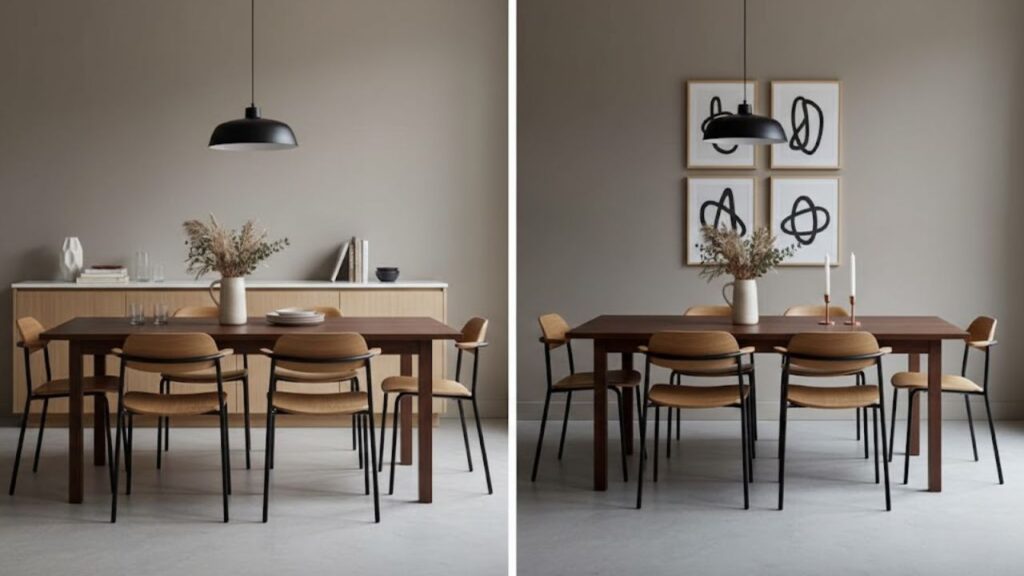
The plates are still there. But at the centre of the room, where a large dining table once stood like a stable, comforting anchor, there is now open space. Or more accurately, a changeable zone. A low platform near the wall, a broad kitchen counter, a soft rug with oversized trays that settle wherever people choose to sit.
One evening in Copenhagen, I watched a family of five share dinner partly on the sofa, partly around a rolling trolley acting as a compact buffet. No one insisted anyone sit properly. People talked, shifted places, came and went. The food followed the family, not the other way around. It felt unfamiliar at first.
But when I left, one thing became clear: the traditional dining table is slowly stepping down from its throne. And this shift is far from accidental.
 People who push in their chair when leaving the table often share these 10 unique personality traits
From Fixed Furniture to Flexible Living Spaces
Step into newly built apartments in Amsterdam, Berlin, or Seoul and something feels absent. The large, formal dining table no longer dominates the room. Instead, you see kitchen islands with stools, padded window ledges, coffee tables that lift and expand, and modular benches packed with hidden storage.

People are still eating together. Just not around a single, immovable slab of wood.
Developers speak of multi-use layouts and compact urban living. In reality, every square metre must earn its place. A dining table used properly only once or twice a day begins to feel excessive. Homes now borrow ideas from cafés, co-working hubs, and even Japanese ryokan: floor seating, mobile furniture, raised counters. The table has not vanished; it has simply lost its fixed form and position.
How Different Cities Are Adapting
In Tokyo, where space is measured in centimetres, many young couples skip the dining table altogether. Meals happen around a lift-top coffee table that doubles as a desk, then lowers again to free the room for yoga or a futon. In Stockholm, oversized kitchen islands are designed to function as prep stations, bars, homework desks, and informal dining spots.
A London interior designer shared that many clients say the same thing: their dining table is rarely used. For some families, it becomes a laundry surface or parcel drop zone. One even admitted they ate around it, not at it. When the table was replaced with a wall bench and a slim extendable surface, the space instantly changed. Children worked there after school, friends gathered with drinks, and weekend meals felt relaxed, almost café-like.
Why Traditional Meal Routines No Longer Fit
The reason feels obvious once noticed. Daily life no longer follows a neat rhythm of breakfast at eight and dinner at seven. Schedules are scattered: late shifts, sports practices, remote work, reheated meals close to midnight. A heavy table designed for synchronized family dining clashes with this reality.
The modern approach suggests letting spaces adapt to real habits rather than idealised routines. Furniture becomes lighter, foldable, and hybrid. Benches open, counters stretch, tables rise and roll. The dining table, once a symbol of order, looks out of place among laptops, yoga mats, and sprawling Lego cities.
What Takes the Place of the Dining Table
For those considering letting go of a large table, the first step is observation, not shopping. Notice where you naturally sit with your coffee, where children leave their books, where guests gather. Spend a week tracking these habits.
From there, choose one primary eating anchor. It could be a kitchen island, a wide windowsill, a large coffee table, or a bench along the wall. Build around it with a simple setup: lightweight trays, washable placemats, and a basket for cutlery and napkins.
The goal is not perfection. It is creating a clear and intentional ritual that makes eating without a formal table feel deliberate rather than improvised.

Flexible Setups in Real Homes
In compact Paris apartments, many young professionals use a three-mode arrangement. Everyday meals happen at the kitchen counter. Relaxed dinners take place around a lift-top coffee table with floor cushions. Larger gatherings rely on a fold-out wall table used only when needed.
On ordinary days, the wall table stays hidden. On birthdays, it unfolds, borrowing chairs from other rooms. In Barcelona, one couple replaced their table with a long bench beneath a window. Storage drawers underneath hold dishes and linens. When guests arrive, a lightweight board and simple trestles appear, then disappear within minutes. Realistically, no one sets up a full dining scene every day.
Keeping Shared Meals Meaningful
Designers following this shift stress one point: removing the table means redefining togetherness. New anchors are essential. This might be a specific lamp switched on at dinner, a familiar playlist, or a wooden tray that signals mealtime.
Without these cues, meals can dissolve into isolated plates and screens. Successful table-free homes borrow from cafés and family-style restaurants: shared dishes, face-to-face seating even on sofas, phones placed aside. The furniture becomes looser, but the intention grows sharper.
Marta, who lives in Lisbon with her partner and two teenagers, explained that losing the dining table brought them closer. Choosing where to eat each evening turned dinner into a shared decision, not a routine taken for granted.
Simple Rules That Prevent Chaos
To keep flexible eating spaces grounded, many households adopt small boundaries. One family in Milan never eats without a large tray at the centre, even for solo meals. A couple in Hamburg treats their kitchen island as a digital-free zone during meals.
- Define one main eating area to avoid a constant picnic atmosphere.
- Invest in one or two hybrid pieces, such as a lift-top table or rolling trolley.
- Keep a ready meal basket with placemats, candles, and napkins.
- Agree on a shared rule, like no laptops or at least one shared dish.
How This Shift May Change Home Life
Letting go of the idea that a proper home needs a formal dining table opens deeper questions. Do we truly enjoy upright, structured dinners, or have we simply inherited them? Are we happier perched at a counter, cross-legged on a rug, or seated closely on a bench?
For some, the answer feels freeing. They feel less burdened by furniture that silently demands perfect schedules. For others, the absence of a table stirs nostalgia for long Sunday lunches and the comforting weight of tradition.
The real question is not whether the dining table is necessary, but where that sense of shared presence now lives. It may be the sofa corner under a warm lamp, the kitchen island crowded with pots, or a low table pulled out only on special nights.
The object can disappear. The need it served remains. As homes grow smaller and lives more fluid, each household invents its own way of gathering. Some keep the old wooden table by choice. Others embrace furniture that folds away. Between these extremes lies a wide field of possibilities, defined not by what is removed, but by the freedom to choose how and where we come together.

Key Alternatives at a Glance
- Kitchen islands as dining hubs: Oversized islands with stools serve cooking, conversation, and meals while saving floor space.
- Lift-top coffee tables: Adjustable tables switch easily between lounging, dining, and work modes.
- Fold-out wall tables: Compact surfaces appear only when needed, ideal for occasional gatherings.
