You organised a picnic, pulled on your trainers, and stepped outside into what felt like another world: heavy black clouds, a sharp wind cutting through your jacket, and thick raindrops splashing across the pavement. Then, just minutes later, it all stopped. The rain vanished without warning. The sky split cleanly in two — storm clouds on one side, bright blue sky on the other — while your weather app still showed the same cheerful sun icon, untouched by reality.
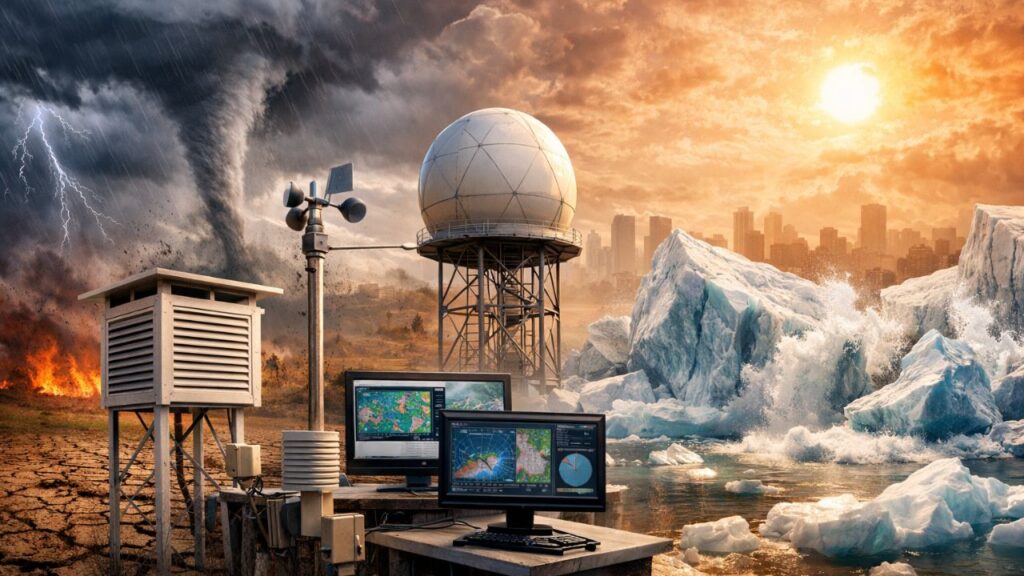
That growing gap between what forecasts promise and what we actually experience is becoming impossible to ignore. Quietly, the era of dependable, reassuring forecasts is slipping away.
Why Forecasts Feel Less Reliable Than Before
Not long ago, a seven-day forecast felt reassuring. You checked it on a Sunday evening, planned your week, and maybe timed your commute or laundry around those familiar rain symbols. Today, that same forecast feels more like a rough suggestion than a guarantee.

Rain icons appear, disappear, then return as thunderstorms within hours. Meteorologists explain that their models are more advanced and their computers faster than ever. Yet for many people, trust is eroding. Technology is accelerating, but confidence is quietly falling behind.

Anyone who works outdoors knows this well. Farmers, builders, delivery riders start their mornings with a forecast, then spend the rest of the day adapting on the fly.
The Rise of Hard-to-Predict Weather Events
In the UK, the Met Office has reported an increase in “high-impact, low-predictability” events — sudden hailstorms, localised flash floods, and violent gusts of wind. In the US, the National Weather Service has recorded more days when storms intensified far faster than models anticipated, particularly in late spring and early autumn.
Online, social media is filled with stories of forecast failures: snow that never arrived, near-certain rain that stayed dry, or heat that exceeded predictions by several degrees. These daily frustrations point to a deeper shift in how the atmosphere behaves.
What’s Changing Inside the Forecast Models
Weather prediction rests on a fragile principle: if we understand the atmosphere’s current state in enough detail, and apply the laws of physics, we can project what comes next. That idea is now under strain from multiple directions.
Warmer oceans, a melting Arctic, and increasingly unstable jet streams are pushing conditions beyond what older models were built to handle. Forecasters are not lost, but the atmosphere is now throwing more surprises, faster than models can fully absorb.
Weather has always been chaotic. What’s different now is that the background rules are shifting while we’re still trying to play by the old ones.
How to Plan When Forecasts Aren’t Certainties
One small mindset change makes a big difference: stop treating forecasts as promises and start reading them as probabilities. Not “it will rain”, but “there’s a 60% chance of rain in this area, during this window”.
When you check your app, look beyond the cartoon cloud. Review the hour-by-hour breakdown, glance at the radar, and note the percentages. A 40% chance of rain from 2pm to 5pm doesn’t just mean “maybe”. It means your picnic could be fine early on and washed out later, making a backup plan a smart move rather than an overreaction.
Practical Ways to Read Forecasts Better
- Look at radar, not just icons — see where rain actually is and how fast it’s moving.
- Use more than one source — disagreement between apps signals instability.
- Watch trends, not snapshots — frequent changes are a warning sign.
- Keep simple backup gear ready — a compact umbrella or light waterproof.
- Plan with flexibility — aim for time windows, not rigid schedules.
Why the Weather Feels More Chaotic Now
Climate scientists often point to a simple explanation: a warming atmosphere holds more moisture and energy. That excess energy has to be released somewhere.
 Say Goodbye to Gray Hair Using a Simple 2 Ingredient Homemade Dye People Are Trying at Home
Instead of gentle weather systems drifting across maps, we now see sharper boundaries, sudden downpours, and storms that intensify in hours rather than days. On the ground, this feels like forecasts promising light showers and delivering a mini-monsoon.
In cities, drains can be overwhelmed within minutes. On farms, weeks of baked-hard soil may be followed by violent rainfall that runs off instead of soaking in.
Rethinking What We Expect From Forecasts
We’ve also raised our expectations. We don’t just want tomorrow’s weather — we want to know the exact minute rain will begin at our precise location, while sitting in traffic with a dying phone battery.
Models can zoom in to neighbourhood scale, but local hills, buildings, coastlines, and trees still shape wind and temperature in unpredictable ways. One side of town may bake in sunshine while the other stays under stubborn cloud.
On a screen, this complexity collapses into a single symbol. In real life, it feels personal when your street doesn’t match the icon.
Living With Uncertainty, Not Fighting It
Meteorologists are candid about these limits. They’re adapting models to a climate that’s shifting beneath them, while facing public expectations for precision where only ranges are possible. Some national services now include confidence levels alongside longer-range forecasts, encouraging a more honest relationship with uncertainty.
Checking that confidence bar now and then won’t become a daily habit for everyone, but it might save a holiday, a harvest, or a weekend barbecue. As the climate continues to warm, that small adjustment could matter more than we expect.
A New Role for the Modern Forecast
We’re entering an era where forecasts are more advanced than ever, yet less able to calm our nerves. The physics remains the same, but the stage has changed: warmer seas, slower jet streams, persistent heat domes.
The old language of fixed outlooks no longer fits a world where a heatwave can transform into a storm system within days. The better question may not be “Why was the forecast wrong?”, but “What did I expect it to do for me?”.
Once, forecasts helped us decide whether to hang washing outside. Now, they help protect cities, guide flights, safeguard crops, and keep vulnerable people safe during heatwaves.
Key Takeaways for Everyday Forecast Reading
- Warming climate, wilder patterns — extra energy and moisture drive sharper, faster events.
- Forecasts reflect probabilities — percentages and confidence matter more than icons.
- Multiple tools give clearer signals — radar and trends reveal uncertainty and local variation.
On a personal level, adapting means building a new rhythm: watching trends instead of clinging to single numbers, leaving buffers in plans, and staying curious about the sky beyond the screen. Forecasts may never feel like old TV promises again, but they can still guide us — as long as we accept that the future of weather is written in probabilities, not certainties.