
The pan is already hot when the argument starts.
In a tiny Lisbon kitchen, a young chef snatches a plastic bottle away from her apprentice like it’s a toy gun. “We cook with olive oil here,” she snaps. “Not that.” The bottle in her hand? Rapeseed oil. Cold-pressed, golden, a supermarket own-brand that costs half the price of her cherished extra virgin.
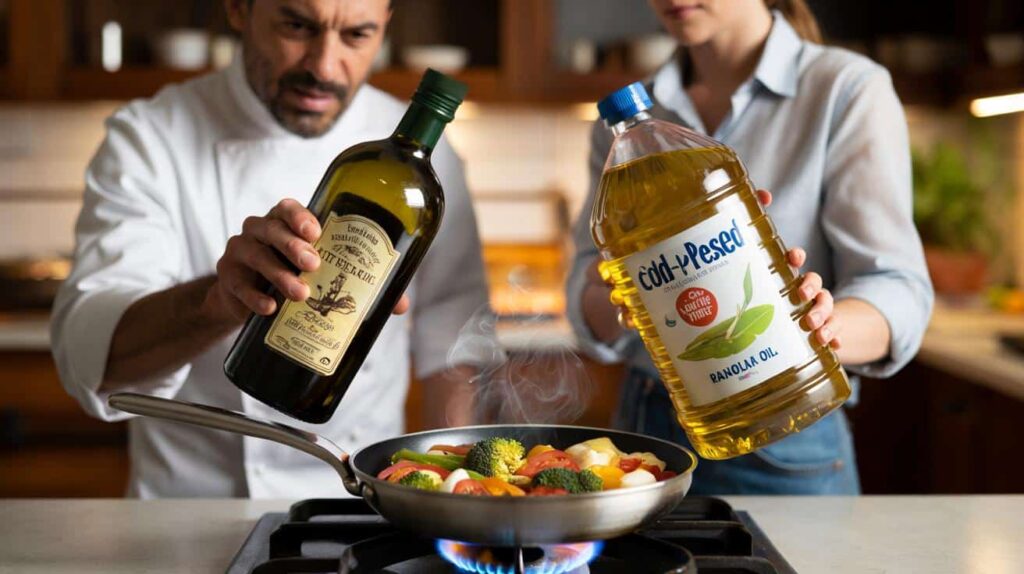
A few thousand miles away, on TikTok and in nutrition podcasts, dietitians are quietly saying the opposite. Use rapeseed oil. Save your olive oil for salads. Your heart will thank you.
Someone is lying, or at least exaggerating.
And more and more people are starting to pick sides.

Olive oil on the defensive – and the cheap bottle nobody saw coming
For years, olive oil has been the unchallenged hero of “healthy eating” Instagram. Shiny drizzle shots, Mediterranean grandma stories, that whole “good fat” halo. Then nutrition scientists began turning up the volume on a different message: if you want long life and a calm cardiologist, you might be better off cooking with something cheaper, lighter, and far less glamorous.
 Understanding body language: what it means when someone doesn’t look you in the eye while talking
That something is rapeseed oil, known as canola in North America.
No romantic myths. No centuries-old groves. Just a pale yellow liquid in a bulky plastic bottle that doesn’t look sexy on anyone’s countertop.
The debate really exploded when a series of heart health reports started comparing common cooking oils. One 2023 meta-analysis highlighted that replacing saturated fats (like butter) with high-monounsaturated oils, including **rapeseed oil**, was linked to lower cardiovascular risk.
On social media, dietitians began posting shocking side-by-side comparisons: two tablespoons of cold-pressed rapeseed oil giving you omega-3s, vitamin E, and a favorable omega-6/omega-3 ratio, while a similar spoonful of some trendy “gourmet” oils did little beyond adding calories. Chefs, meanwhile, shared videos of smoke tests, bragging how olive oil “stands up” in the pan.
It started feeling less like a nutrition debate and more like a cultural war.
Underneath the drama sits a simple, slightly uncomfortable truth. Olive oil is iconic, but it is not magic. Its benefits come mostly from the fact that it’s rich in monounsaturated fat and polyphenols, especially when it’s extra virgin and used cold or on low heat.
Rapeseed oil quietly ticks many of the same boxes.
High in monounsaturated fats, decent omega-3 content, neutral taste, usually lower price, and a smoke point suitable for everyday cooking. From a purely health-focused point of view, many nutritionists see it as a very boring, very efficient workhorse. And boring is not what food culture likes to celebrate.
How to swap oils without losing flavor (or friends)
The trick, according to the heart-health crowd, is not to “cancel” olive oil but to demote it from every-pan hero to weekend-special supporting role. Think of rapeseed oil as your daily driver and olive oil as the vintage convertible you bring out when the sun hits just right.
For sautéing onions, roasting vegetables, or baking, a good quality cold-pressed rapeseed oil holds up nicely. Its neutral taste lets garlic, herbs, and spices do the talking. Keep your **extra virgin olive oil** for finishing touches: a splash over grilled fish, a last-minute swirl into hummus, a drizzle on ripe tomatoes.
The flavor is actually more intense when it isn’t burned in a screaming-hot pan.

A lot of people make the same mistake the first time they buy rapeseed oil: they expect drama in the mouth. They pour it onto bread, taste it like wine, waiting for that grassy punch they get from their favorite Tuscan bottle. Then they’re disappointed.
Rapeseed oil is more of a background actor.
It lets the crusty bread, the flaky salt, the lemon zest lead the scene. This is especially helpful for those trying to eat more vegetables without drowning everything in butter or cream. But chefs who grew up equating olive oil with soul and identity understandably feel like something essential is being watered down.
“We’re not just talking about fat, we’re talking about culture,” sighs Marco, a Rome-born chef now running a small bistro in Berlin. “When a nutritionist tells my customers to cook with rapeseed oil, I hear: ‘Forget your grandmother’s kitchen.’ That hurts.”
- Use rapeseed oil for: everyday frying, roasting, baking, light stir-fries.
- Save olive oil for: dressings, dips, finishing dishes, low-heat cooking.
- Check the label: choose cold-pressed or “extra virgin” styles for both.
- Store both oils in a cool, dark place to protect their benefits.
- Rotate: no single oil has to carry your entire health story.
What this oil war really says about how we want to live
Step back from the shouting, and the whole “goodbye olive oil” drama starts to look like a mirror. On one side, the emotional pull of tradition, family recipes, the fantasy of a sunlit terrace in Crete. On the other, the cool logic of lab results, LDL cholesterol numbers, and food budgets that don’t stretch like they used to.
We’ve all been there, that moment when you stand in the supermarket aisle, holding the pricier glass bottle in one hand and the plain plastic one in the other, trying to buy health, identity, and savings all at once.
Let’s be honest: nobody really does this every single day.
The real “secret” to long life and heart health probably isn’t hiding in a single oil at all. It’s in the pattern: how often you cook at home, how many plants land on your plate, how much ultra-processed food quietly slips into your week. *Choosing rapeseed oil over olive oil won’t save your heart if the rest of your lifestyle is on fire.*
Still, the switch can be a small, meaningful lever. Cheaper oil that still supports heart health means more people can cook with unsaturated fats instead of reaching for cheap margarine or reused frying oil. That’s not glamorous. That’s just quietly powerful.
So maybe the future kitchen doesn’t look like a goodbye to olive oil. More like a negotiation. Olive oil as the personality, rapeseed oil as the pragmatic friend who always shows up on moving day. Chefs will keep defending their liquid gold. Nutritionists will keep posting graphs and long-term cohort data.
Somewhere between these two worlds, ordinary home cooks will do what they always do: improvise, compromise, and choose what fits their real lives, not their Pinterest boards. The bottle on the counter will tell a story, but it won’t be the whole story.

| Key point | Detail | Value for the reader |
|---|---|---|
| Rapeseed oil as daily default | High in monounsaturated fat, omega-3, neutral flavor, affordable | Supports heart health without wrecking your food budget |
| Olive oil as finishing touch | Best used cold or at low heat to preserve polyphenols and flavor | Maximizes both taste and health benefits of **extra virgin** oils |
| Mix, don’t idolize | Rotate healthy fats and focus on overall diet pattern | Less stress about “perfect oil”, more progress toward long-term health |
FAQ:
- Is rapeseed (canola) oil really healthier than olive oil?They’re both healthy choices. Rapeseed oil has more omega-3 and is often better for high-heat cooking, while good olive oil has more polyphenols and a stronger flavor. For heart health, nutrition studies tend to favor patterns that include either, as long as they replace saturated fats.
- Can I fry with extra virgin olive oil?Yes, you can, especially at moderate temperatures. The smoke point is lower than refined oils, though, so for very hot frying many nutritionists and chefs prefer rapeseed or other neutral oils to avoid burning and off-flavors.
- Is cheap supermarket rapeseed oil okay?For most people, yes. Look for cold-pressed or minimally refined versions when possible, and store the bottle away from heat and light. That’s where a lot of the quality is either protected or lost.
- Will switching oils alone improve my cholesterol?It can help, especially if you’re replacing butter, lard, or palm oil with unsaturated oils like rapeseed or olive. The biggest impact comes when this happens alongside more vegetables, whole grains, and fewer ultra-processed foods.
- Do I have to give up olive oil to live longer?Absolutely not. Many long-lived populations use olive oil daily. The shift some nutritionists suggest is about context: use olive oil where it shines most, and use a budget-friendly, heart-healthy oil like rapeseed for the everyday heavy lifting in the pan.
