
The woman in the salon chair kept repeating the same sentence, half amused, half furious: “So… you’re telling me this isn’t my real hair?”
Her roots were silver, her lengths a perfectly blended “smoky brunette” that looked like she’d woken up like that. No line of demarcation. No obvious dye. Just… magic. Or at least that’s what the stylist had promised on Instagram.
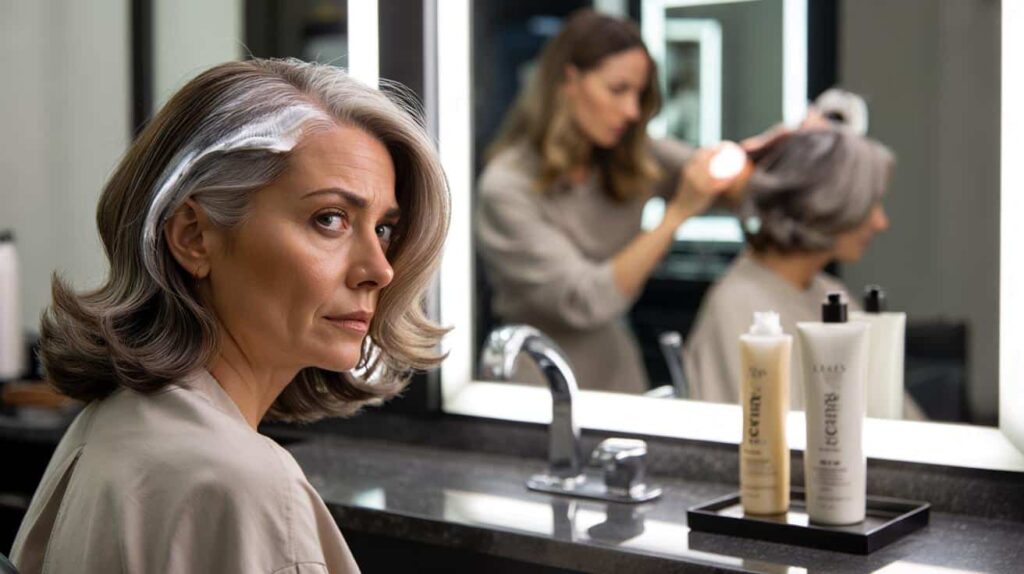
Around us, two other clients were asking for the same thing: a “gray eraser” that would make them look ten years younger without “actual” coloring.
The stylist smiled, shrugged, and whispered, “Technically, it’s not dye, it’s a pigment veil.”
The woman looked at her reflection for a long time.
Then she said quietly: “This feels like cheating, doesn’t it?”
And the room went very still.

When “no dye” suddenly looks a lot like hair dye
Scroll through TikTok or Instagram for five minutes and you’ll see them: those before/after videos where a head of stubborn gray hair turns into a soft, glossy brown or sandy blond, allegedly without “real dye.”
Titles promise miracles: “No chemicals”, “no color”, “zero damage”, just a “youth filter” for your hair.

The phrase that comes back again and again is always the same: “Goodbye hair dye.”
On screen, it feels almost hypnotic.
The model looks fresher, younger, less tired.
The creator smiles, shakes her hair, swears it’s “just a gray blending gloss” or “toning care.”
The comments explode: “Is this real?” “Link, please.” “I need this NOW.”
Take Claire, 49, who hadn’t colored her hair for a year and was getting used to her silver streaks.
One Sunday night she falls on a reel promising “no-dye coverage” thanks to a “bioactive repigmenting foam.” The before photo looks exactly like her. The after looks like her ten years ago.
She orders the product at midnight, 39 euros plus shipping.
The package arrives in a shiny box, with words like “clean”, “vegan pigment”, “anti-aging veil.”
She applies it in the bathroom, timer on her phone, as if she were doing a simple hair mask.
Thirty minutes later, her gray hair has melted into a warm chestnut, her face visibly softened.
She stares at herself, half thrilled, half suspicious.
Her daughter passes by the door and says: “Oh, you dyed your hair again?”
The spell cracks a little.
What’s really happening here is less magical and more technical.
Most of these “no dye” solutions are based on direct pigments, semi-permanent glosses, or tinted care products that wrap the hair like a colored film instead of penetrating it deeply.
They wash out slowly, blend with your natural base, and don’t create that harsh regrowth line.
Brands use words like “veil”, “topcoat”, “filter”, because “dye” sounds scary and old-fashioned.
The marketing plays on that thin line: legally, they’re not always classified as permanent colors, emotionally they promise the same thing — fewer visible grays, a younger look, fast.
And that’s where the controversy starts.
Because some consumers feel duped when they realize their “no color” routine is… a form of coloring.
The new gray-hair hacks everyone’s whispering about
The most talked-about method right now is the “gray blending gloss.”
A transparent base, lightly tinted, that you apply on towel-dried hair like a conditioner.
You leave it on for 10 to 20 minutes, then rinse.
On dark hair, it won’t erase every white strand, but it smudges the contrast and adds shine.
On lighter hair, it can give that expensive “expat in Lisbon” highlight effect people dream about.
The result is softer than a classic dye.
Less “I went to the salon”, more “I slept for three days and drank three liters of water.”
Then there’s the “repigmenting shampoo”, sold as a simple wash routine that “brings back your childhood color.”
Use it twice a week and your gray supposedly “fades” under a chocolate, copper, or blond haze.
The fine print often indicates that the effect is cumulative and depends on your base color.
Sophie, 56, tried one for a month.
At first nothing.
On the third week, her white temples looked slightly beige, then more caramel.
Her colleagues asked if she’d changed her cut.
The problem is that Sophie had stopped coloring to “accept herself as she is.”
She suddenly found herself in a gray zone (literally): she said she was natural, but she was spending 25 euros on a pigmented product every month to “soften” what bothered her.
“I feel like I’m lying a bit,” she admitted one morning, rinsing the foam from her hands.
Behind all these hacks lies a deeper mechanism: our terror of the “all or nothing” choice.
On one side, fully gray, with all the social baggage that still sticks to it.
On the other, regular coloring, money, time, root touch-ups every three weeks, the fear of looking “fake.”
The new wave of products slips precisely into this anxiety gap.
They don’t promise eternal youth, just a slight rewind of the clock.
They use language that sounds soft, safe, almost therapeutic: “care”, “mask”, “gloss.”

From a chemical standpoint, these are often just milder colors with less ammonia or none, low-commitment pigments, or botanically derived dyes.
From a psychological standpoint, they offer a comfortable story: “I’m not really dyeing my hair, I’m just taking care of it.”
*That story reassures us far more than the ingredient list does.*
How to use these “no-dye” tricks without fooling yourself
If you’re tempted, the most honest way to approach these products is to treat them like makeup, not a miracle cure.
You’re not reversing gray hair, you’re disguising it, softening it, playing with it.
Start by asking yourself what truly bothers you.
Is it the first white streaks at the temples? The harsh line between your natural hair and old color? The feeling of looking “tired” in photos?
Once you know that, you can choose the least radical solution: a tinted mask every two weeks, a gloss twice a month, a toning conditioner only around the face.
Think of it as a sliding scale, not a yes/no switch.
Color isn’t a confession, and stopping color isn’t a moral victory.
It’s just hair.
The big trap is pretending you’re “all natural” while secretly chasing perfect coverage.
That’s where shame creeps in, and shame is exhausting.
Be clear with yourself: if seeing your gray bothers you, you have every right to tweak it.
You also have the right to do nothing and live with a wild mix of silver and brown and gold that doesn’t fit any #hairgoals hashtag.
The other common mistake is expecting a tinted shampoo to do the job of a professional colorist.
Let’s be honest: nobody really does this every single day.
People forget applications, use too much, layer products that don’t go together, then complain that the result is patchy.
If you want subtlety, go slowly.
Test on a strand, take before photos, observe the color in daylight.
And if it goes wrong, it’s better to swallow your pride and ask a pro to correct it than to stack three other products on top.
“Clients come in saying, ‘I don’t want dye, I just want that Instagram thing that removes gray,’” laughs Ana, a colorist in Paris.
“Half the time, what they’re talking about is… a dye. Just a softer one. The deception isn’t always from the brands. Sometimes it’s the narrative we build to avoid saying, ‘I color my hair.’”
-
- Ask direct questions at the salon
Is this a color, a gloss, a toner, a care with pigments? How long does it last? Will I get a regrowth line? - Read the fine print on “no-dye” products
Look for words like “coloring agents”, “pigments”, “semi-permanent”. Marketing copy is a story. The back label is reality. - Decide your own red lines
No ammonia? No long-lasting stains? No more than once a month? Setting rules helps avoid sliding into something you didn’t want. - Talk openly about it
- Ask direct questions at the salon
Tell your friends, your kids, your partner what you’re doing. Naming things out loud tends to dissolve the feeling of “deception.”
-
- Accept that results move and fade
These methods are by nature temporary. That’s their charm and their limit. If you want zero gray, you’re back to classic coloring.
Between deception and freedom: what covering gray really says about us
There’s a reason this debate is so charged: gray hair is not just a color, it’s a story about time, desire, visibility.
When a product promises “no dye, just youth”, it’s poking all those sensitive places at once.
Some feel tricked by the language, as if brands were gaslighting them into thinking that a color isn’t a color.
Others feel liberated: at last, something between full-on dye and total surrender.
The same product can feel like empowerment for one person and pure deception for another.
We all know that friend who stopped coloring and suddenly looked fiercer, more herself.
We also know that aunt who got a soft gloss and came back from the salon glowing, like she’d finally recognized the woman in the mirror again.
Neither is more honest than the other.
What if the real turning point wasn’t saying goodbye to hair dye, but goodbye to the idea that there’s one “right” way to age?
That’s the quiet question hidden under every gray strand you catch in the bathroom light.

| Key point | Detail | Value for the reader |
|---|---|---|
| Marketing vs reality | “No-dye” products often contain pigments or mild color agents | Helps you buy with clear eyes and avoid feeling misled |
| Middle-ground options | Glosses, tinted masks and shampoos soften gray without full coverage | Offers flexible ways to look fresher without heavy commitment |
| Personal rules | Defining your own limits around frequency, ingredients and results | Gives you control over your routine and reduces guilt or confusion |
FAQ:
- Question 1Are these “no-dye” gray-covering products really different from classic hair dye?
Some are, some aren’t. Many are semi-permanent or direct pigments that coat the hair instead of penetrating deeply, so they fade faster and create softer regrowth. Others are basically mild dyes with lighter marketing language. Check how long they last, whether they stain the hair shaft, and how often they’re meant to be reapplied.- Question 2Can these methods truly reverse or stop gray hair from appearing?
No. Gray hair is a loss of melanin inside the follicle. No shampoo, mask or gloss can restart that process in a lasting way. What they can do is tint or veil the hair so the gray is less visible, or visually blended with the rest of your color.- Question 3Are “clean” or “natural” gray-covering products safer for my hair?
“Natural” doesn’t always mean gentler, and “chemical” doesn’t automatically mean harsh. Some plant-based dyes can be intense and long-lasting, while some lab-formulated glosses are very mild. The real question is: does it dry your hair, irritate your scalp, or force frequent corrections?- Question 4How often can I use a tinted shampoo or mask without damaging my hair?
Most tinted shampoos and masks are designed for regular use, once or twice a week. The risk is less about pigment and more about dryness from frequent washing or strong surfactants. If your hair starts to feel rough or dull, space out uses and add nourishing care between applications.- Question 5Is it more honest to go fully gray than to keep covering my white hair?
Honesty isn’t in your hair color, it’s in the story you tell yourself. Going gray can feel freeing for some and depressing for others. Coloring can feel like play or like pressure. The most honest choice is the one where you feel aligned, without having to hide or justify what you’re doing.
