
In many places today, the night sky has nearly vanished, swallowed by a pale orange glow and a horizon that never fully darkens. Amateur astronomers pack away their telescopes earlier than they used to. Children learn constellations from apps instead of looking up. Even people who never cared much about stars sense something is off: nights no longer feel like nights.
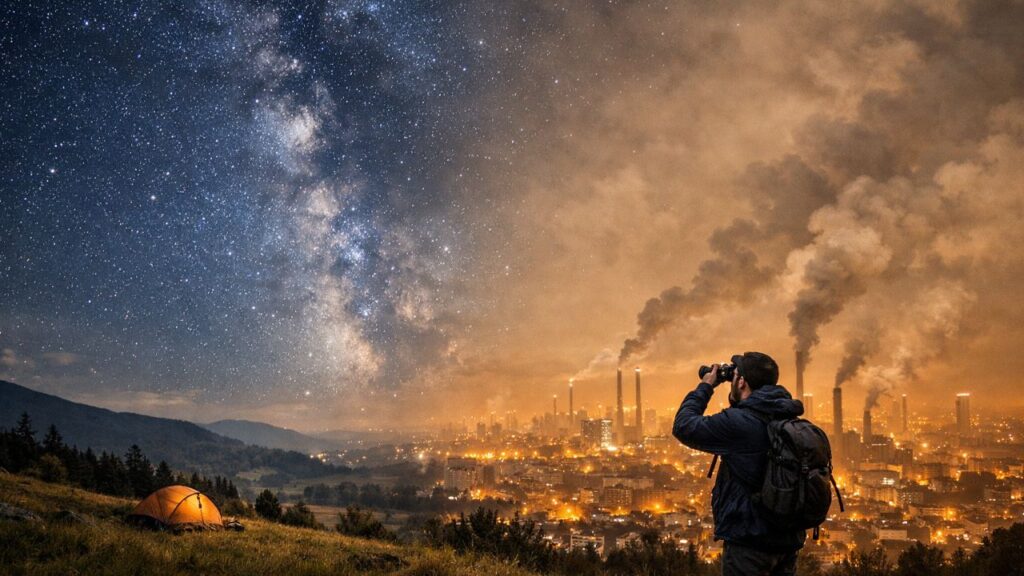
On a cold autumn evening outside a small town, a father sets up a camping chair in what was once his secret stargazing spot. The air carries the smell of woodsmoke and damp leaves. In the distance, cars whisper along a newly built ring road. He remembers childhood summers when the Milky Way tore across the sky, so bright it felt almost loud.
Now he looks up and counts five stars. Maybe seven if he squints. A sodium-orange dome hangs over the horizon where a logistics hub burns through the night. A thin, whitish veil from distant wildfires dulls the sky like dirty glass. The faint galaxies he once chased are simply gone. His daughter looks up and asks, “Is that all?” He doesn’t know how to answer.

Why Truly Dark Nights Are Disappearing
Stand in any growing city and you feel it immediately: the night never fully arrives. Streetlights glare off wet roads. LED billboards flicker and pulse. Window after window glows blue with late-night screens. Above it all, the sky turns a washed-out pastel grey, stripped of depth and contrast.
 Say Goodbye to Gray Hair Using a Simple 2 Ingredient Homemade Dye People Are Trying at Home
Astronomers call this effect skyglow, and it is spreading faster than most people realise. Satellite images and ground measurements show global night-sky brightness rising year after year. Even towns that once promoted themselves as stargazing gateways now sit inside expanding halos of light, where darkness thins like worn fabric.
In Germany, a 2023 analysis using citizen measurements suggested visible night-sky brightness is increasing by around 7–10% each year. That figure sounds small until you extend it across a decade and realise that a child born today may never experience the same sky their parents did. Similar patterns appear across parts of Asia and North America, uneven but just as intense.
Smoke adds another layer. Recent massive wildfires in Canada and Australia didn’t only darken daytime skies. Fine particles drifted high into the atmosphere, scattering light at night as well. Amateur astronomers comparing photos before and after smoke events show once-dense star fields reduced to a few points, like gaps in a familiar smile.
Climate change quietly deepens the problem. Warmer oceans and shifting air currents alter cloud cover and haze in ways scientists are still mapping. Heatwaves trap pollution over cities, turning nights milky. Dust from dried soils and expanding farmland adds a constant soft blur. Even increased water vapour in a warmer atmosphere spreads city light farther into rural skies. None of this is always dramatic, but it is relentless.
Together, these forces turn the issue into more than just excessive lighting. It becomes a complex mix of brighter LEDs that spill light sideways, dirtier and more turbulent air, frequent smoke and dust, and an atmosphere behaving differently as the planet warms. Each factor steals a little contrast from the stars. You don’t notice on a random Tuesday. Then one summer, you realise the Milky Way hasn’t appeared for years.
Finding and Protecting What’s Left of the Night
A perfectly black wilderness sky is out of reach for many people, but that doesn’t mean stargazing is over. The key is to think like a photographer hunting for perfect light, only in reverse. You’re searching for darkness, guided by distance, direction and timing.
Distance helps, but not as much as you might expect. A drive of 20–30 minutes from a city centre can dramatically improve the view. Light pollution maps can reveal nearby darker zones. Once there, direction matters: turn away from the nearest town’s glow and let your eyes adjust. A tree line or low hill blocking streetlights can be more valuable than another ten kilometres on the road.
Timing is the quiet advantage. Aim for nights after a cold front has swept the air clean. Watch the Moon phase, because a new Moon or thin crescent makes a huge difference. Seasonally, winter skies are often clearer and drier than summer ones, even in polluted regions. It may mean dressing warmer, but the stars reward the effort.
In brighter suburbs, adjusting expectations helps. Chasing faint galaxies will only frustrate you. Instead, focus on targets that cut through light pollution: planets, double stars, the Moon’s surface, or passing satellites. Even simple binoculars and a reclining chair can turn an apparently empty sky into something busy and alive.

Consider Tom, a London nurse working night shifts. He can’t drive hours to a dark-sky reserve. On his evenings off, he walks to the edge of a nearby park where oak trees block the worst streetlights. For months, the Milky Way seemed impossible. Then, on an unusually clear night after a storm during a new Moon, a faint, ghostly band appeared. Not perfect, but real enough to take his breath away.
Stories like this are common in big cities where smoke, humidity and LED glare pile up. Many people assume the sky is gone because they look on random hazy nights. The real magic happens on the few rare evenings when the atmosphere cooperates. Learning to recognise those windows makes the loss feel less absolute.
There’s also a mental shift involved. When you expect disappointment, you stop looking. That’s how you miss the crystal-clear nights that still slip through the cracks. Treat clear evenings like a surprise event. Keep warm clothes, binoculars and an offline star app ready. When the forecast, Moon phase and air quality align, you can step outside without hesitation.
What happens on the ground matters too. Shielded outdoor lights, warmer-coloured bulbs, motion sensors instead of all-night floods, and curtains drawn over bright windows can create small islands of darkness. Each change seems minor, but together they make a difference. Let’s be honest: not everyone does this. Yet those who do often inspire neighbours to care as well.
Why Losing the Night Sky Matters More Than We Think
Many astronomers argue the cultural loss of the night sky may outweigh the scientific one. “When a child sees the Milky Way for the first time, something quietly reshapes their sense of scale,” says an astrophysicist involved in dark-sky outreach. “Losing that experience isn’t just about astronomy. It’s about imagination.”
This belief drives local action, even when global climate and pollution challenges feel overwhelming. Communities push for smarter streetlighting, create night-friendly parks, support dark-sky reserves, and contribute data through citizen-science projects. Conversations about the sky happen in schools, neighbourhood meetings and quiet chats with friends who have never escaped the city glow.
For thousands of years, the night sky was humanity’s shared ceiling. Sailors navigated by it. Farmers read seasons in its patterns. Poets and children filled it with stories. Today, in many places, that sky has thinned to a few bright points and a pale smear where the Milky Way once lived.
It’s easy to label this as already lost and move on. Yet the story isn’t that simple. While atmospheric change is real, lighting choices are still ours. We can protect stretches of coast and countryside. We can decide that children deserve more than glowing billboards when they look up.
On rare, transparent nights after storms or power cuts, when the air is scrubbed clean and lights fall dark, people step outside and gasp. Neighbours call to one another. Phones come out, then slip back into pockets as everyone simply stares. On a planet reshaping its own atmosphere, these moments may become the stories we pass on.
Perhaps the question isn’t only how to save stargazing. Perhaps it’s what kind of nights we choose to live under. It’s a question worth asking aloud, before the answer is decided for us.
 Goodbye Reliable Forecasts Why Sudden Climate Shifts Are Breaking Traditional Weather Predictions
Key Takeaways for the Reader
- Atmospheric changes dim the stars: Light pollution, smoke, haze and climate shifts all reduce sky contrast, explaining why familiar constellations appear weaker or disappear.
- Small actions still help: Smarter lighting, better timing and thoughtful location choices can unlock surprisingly good views without moving to remote wilderness.
- A cultural loss is unfolding: Fewer people, especially children, experience truly dark skies, prompting reflection on what we want future generations to inherit.
