
Someone coughed behind a half-open window. A baby began to cry. A man in flip-flops stared with quiet shame at his struggling charcoal barbecue. One sausage slipped clean through the grill bars and vanished toward the street below. Two floors higher, a window slammed shut in irritation. It was the familiar soundtrack of city grilling: too much smoke, too little patience, and neighbours pushed to their limits. In cramped apartments, outdoor cooking often turns into a tense balancing act between craving grilled food and keeping the peace.
A strange crowd gathers under bright lights
Down on the street, the mood was very different. Beneath the harsh glow of a Lidl storefront, people clustered around a sleek, unfamiliar cooking device. There were no open flames, no drifting smoke, just a stainless-steel dome humming softly over perfectly browned skewers. A young couple filmed the scene, whispering the same thought: if this worked, traditional barbecues might be finished. When the demonstrator lifted the lid, a wave of grilled, caramelised aroma rolled out, rich and irresistible, yet the ceiling above remained spotless.
The promise that sounded exaggerated
A bold sign hovered above the display: “The grill that changes everything”. At first glance, it felt like typical retail exaggeration. But as people leaned closer, sniffing the air and watching the food emerge evenly seared, the claim started to feel less ridiculous. No one there yet realised how literally that promise might be taken, or how seriously Lidl’s new appliance would challenge the place of the classic barbecue in everyday life.

Lidl’s appliance that challenges outdoor barbecues
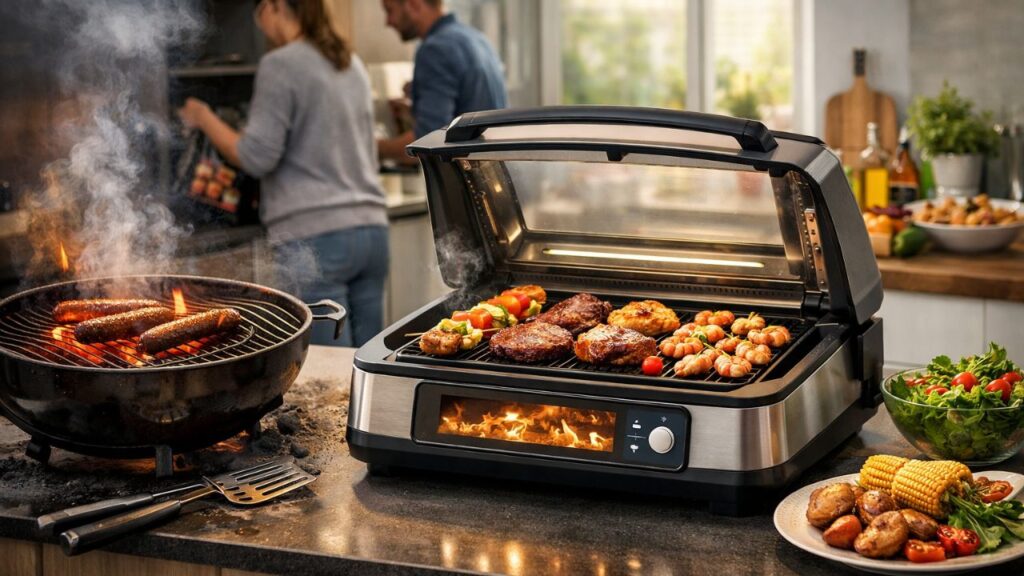
The device itself isn’t designed for culinary show-offs. It’s Lidl’s all-in-one electric grill–oven hybrid, the kind you bring home hoping it will quietly solve dinner. There’s no gas bottle, no charcoal bags, no stubborn firelighters delaying guests at the door. Its rounded, compact body hides a heating system built to recreate the intense, direct heat of a barbecue, with powerful top elements, a ridged grill plate, and a drip tray that captures fat before it smokes.

Why it speaks to apartment life
For people living in cities, the appeal runs deeper than convenience. Many have spent years hearing “no barbecues on balconies,” while friends with gardens post sunny grill photos all summer. Lidl’s promise feels like small revenge: real grill marks, no visible smoke, no angry neighbours. Plug it in, choose a preset, and it rockets from cold to searing heat faster than most ovens, without triggering complaints or fire alarms.
Stories spreading across Europe
Scepticism fades quickly once people try it. A Berlin resident summed it up simply: “I haven’t lit my old barbecue once this year.” Similar stories are emerging across European cities where open flames are restricted. The appliance taps into a shared frustration: the gap between wanting grilled food and living in small, regulated spaces. It turns grilling into something compatible with modern apartments, rather than an activity reserved for gardens and permissive neighbours.
Grilling without stepping outside
Imagine a rainy Sunday in a compact kitchen. Friends crowd around a shaky table, the park outside soaked and uninviting. On the counter, the Lidl grill hums, turning marinated chicken skewers a deep, glossy brown. The host isn’t banished outdoors, eyes stinging with smoke. Instead, they’re pouring wine, chatting, and letting the timer do its work. The indoor grilling setup quietly removes friction from social cooking.
A practical shift in a familiar ritual
This is the subtle change at work. The barbecue, long a symbol of open space and freedom, is being pulled indoors and made practical. Behind the supermarket branding lies clear logic. Traditional barbecues waste heat, demand time, and often burn food outside while leaving it raw inside. Charcoal is messy, gas feels intimidating, and both are awkward in small homes. Lidl’s electric design replaces guesswork with controlled heat and predictable results.
How the electric grill changes the equation
By trapping heat in a closed space, the appliance browns food faster and more evenly. Fat doesn’t drip onto open flames, reducing flare-ups and smoke. It isn’t trying to mimic a macho fire pit. Instead, it’s built for what people actually cook most days: weeknight vegetables, family burgers, delicate fish. Soyons honnêtes : personne ne fait vraiment ça tous les jours avec un gros barbecue dehors.

Using Lidl’s indoor grill effectively
To replace a barbecue properly, it helps to treat this appliance as a hybrid. Preheat it fully on the highest grill setting so the plate is truly hot. That’s where proper searing comes from. Add food only once it reaches temperature. For steaks and burgers, use the centre for intense heat, then slide them aside to finish gently. Closing the lid turns it into a mini-oven, helping thicker cuts cook through without burning.
Common mistakes and easy fixes
Most failures come from treating it like a frying pan. It still needs preheating time and resting space. Food can still burn or dry out if ignored. The difference is forgiveness: no wind, no sudden flare-ups, no dead zones. Overcrowding is the biggest trap. Piling everything on at once creates steam instead of sear. Cooking in small batches brings colour, flavour, and far less stress.
Cleaning that actually happens
Classic barbecues are notorious for postponed cleaning sessions. With this appliance, the grill plate and drip tray can be removed and rinsed while still warm. A soft sponge, a little washing-up liquid, and it’s done. That simplicity explains why people keep using it. As one Manchester resident put it, “I thought it was a summer gadget. Now it’s just the thing that makes everything taste better without wrecking the kitchen.”
The emotional reason it sticks
There’s also a quieter reason behind its popularity. On a tired Tuesday evening, the choice between cooking and ordering in often comes down to effort. Fewer steps, less mess, less waiting. Lidl’s bet is that when grilling feels as easy as toast, people will actually do it. That reduced friction quietly reshapes habits, one midweek meal at a time.
Key tips for better results
- Fully preheat before adding food for proper grilled flavour
- Pat ingredients dry to avoid steam and lost sear
- Use the lid wisely, open for char, closed to cook through
- Clean while warm for easier maintenance
- Start simple with vegetables, sausages, flatbreads, or halloumi
When “barbecue” starts to mean something else
Step back, and this isn’t just about an affordable appliance. It marks the quiet fading of a ritual. The open flame, smoky clothes, and performative moment of tending the grill are being replaced by something calmer and more private. While that feels like a loss to some, it opens grilling to those long excluded by space, health, or regulations. With an indoor electric grill, all you need is a socket.
Why habits change faster than traditions
One rainy season, a few spontaneous weeknight grill dinners, and suddenly the old barbecue feels redundant. That’s how traditions shift: not with announcements, but with convenience. The scene in the Lidl aisle captures it perfectly. People filming, comparing, texting photos home. The device is simple. The change it represents is anything but.

Essential points at a glance
- Smoke-free grilling with controlled electric heat and fat collection
- Hybrid use combining grill and mini-oven functions
- Simplified ritual with instant start, easy cleaning, and no fuel storage
