
The first time I saw it, it was sitting on a friend’s countertop like a tiny spaceship. Touchscreen glowing, chrome sides polished, promising zero oil, zero effort, nine different cooking modes and—this was the real hook—“healthy meals in half the time.” She fed in a tray of marinated chicken, pressed something that looked more like a Netflix menu than a kitchen control, and walked away. No pan, no sizzle, no hovering over the stove.
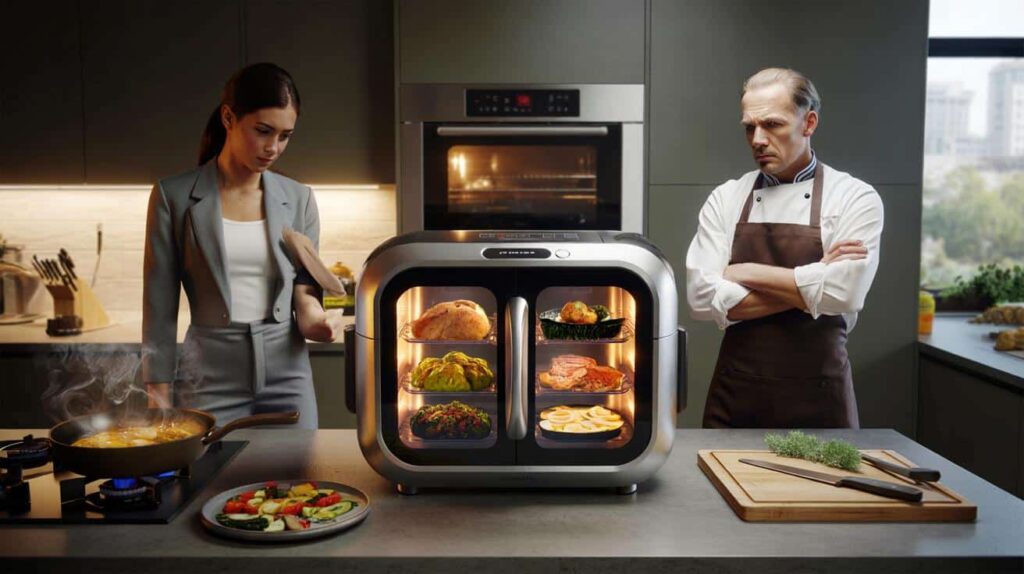
Twenty-five minutes later, the machine beeped and spit out dinner. The chicken looked perfect, the potatoes were crisp, the kitchen was spotless.
She grinned and said, “Honestly, why would I ever use my oven again?”

I laughed. Then I realised I wasn’t entirely sure it was a joke.

From air fryer to “do-everything” box: the gadget that wants your entire kitchen
The air fryer already rewired how a lot of us cook weekday dinners. Throw in frozen fries, a couple of chicken thighs, push a button, walk away. But this new wave of countertop gadgets goes further. They don’t just fry with hot air. They roast, grill, dehydrate, steam, slow cook, toast, reheat, and sometimes even sous-vide in the same compact cube.
Retailers call them “smart multicookers” or “all‑in‑one ovens.” They’re half robot, half oven, sometimes with a built-in thermometer that tells you when your salmon hits 52°C, then keeps it warm without drying it out.
They sit there humming softly, quietly threatening every pan in your cupboard.
One of the bestselling models right now has nine cooking methods in a single device: air fry, bake, roast, grill, steam, slow cook, sauté, dehydrate, and reheat. TikTok is full of videos of people “cooking an entire week’s meals in one machine.” A teacher in Manchester told me she uses it for everything from breakfast granola to Sunday roast. Her oven? Mostly a storage space for baking trays.
Brands pitch this as liberation: less clutter, fewer dirty dishes, no need to “know how to cook.” Just recipes on an app and presets that decide time and temperature for you.
It’s no accident these gadgets look more like smartphones than stoves. They’re designed for swiping, tapping, not for stirring and tasting.
Chefs and health experts are colliding around this shift. On one side, nutritionists celebrate: lower oil, gentler heat, less burnt fat, more vegetables sneaked into everyday meals. On the other, traditional cooks roll their eyes and say, “You’re not actually learning to cook, you’re just operating a device.”
For them, cooking isn’t just the final plate. It’s knife skills, sound, smell, learning to read a pan. They worry a generation raised on “press start and walk away” will never learn what simmering really looks like, or why a steak must rest.
So the debate isn’t just about a shiny gadget. It’s about what we call cooking in the first place.
Healthy hack or shortcut that flattens flavour?
If you talk to dietitians, many quietly love these nine‑in‑one machines. Lower-temperature roasting, controlled air flow, and precise timers mean less burning and less acrylamide, the compound that forms when starchy foods get aggressively crisped. You can cook sweet potato wedges, chickpeas, even breaded fish with a fraction of the oil you’d usually pour into a pan.
One London nutrition coach told me half her clients stopped deep‑frying at home once they bought a multicooker. Their cholesterol changed, but so did their weekday habits. Suddenly, frozen veg and plain chicken breast became an easy, no‑thought dinner rather than a sad compromise.
When switching from an air fryer to a full multicooker, people often start experimenting with steaming and slow cooking, not just crisping everything into oblivion.
Still, there’s a quiet downside that doesn’t fit into marketing campaigns. Many users say every dish starts to taste… similar. The same dry circulating heat, the same metal tray, the same honey‑soy glaze repeated on everything because it “works.” That glorious, smoky, uneven char from a cast‑iron pan or barbecue is hard to fake in a sealed box.

A home cook in Lyon told me she now cooks almost all her vegetables in her multicooker. Yet she admitted she misses “the drama of a pan, the hiss, the surprise.” Her teenage daughter has never flipped a pancake in a skillet; she just pours batter into a preset program that says “Pancakes, 10 minutes.”
Convenience is addictive. It also gently narrows what we expect food to feel like.
Some chefs argue the machine simply moves decisions away from humans and into code. Recipes become “program 3, level medium” instead of “wait until it smells nutty, then turn the heat down.” That’s a different relationship to food. It’s tidier, cleaner, safer, but also more distant.
*Real cooking has always included the risk of getting it wrong.* A slightly burnt edge, a sauce that splits, a steak that’s bloody when you wanted medium—these are tiny lessons written in smoke and flavour. When everything is pre‑timed, pre‑heated, and sensor‑checked, those lessons disappear.
Let’s be honest: nobody really does this every single day. Most of us zigzag between real cooking and survival cooking. The question is whether these nine‑mode gadgets will quietly shift that balance for good.
Living with the nine‑mode machine without losing your soul in the process
There is a way to fold this new gadget into your life without letting it swallow your whole kitchen. One simple approach some cooks use: weekday box, weekend stove. On weeknights, the multicooker handles the “I’m too tired to think” meals—sheet‑pan style dinners, roasted veg, re‑heated leftovers that don’t taste like cardboard.
On weekends, everything slows down. Knives come out, cast iron gets hot, stock bubbles on the back burner. The machine is turned off, even unplugged, almost like a conscious ritual. That small act—choosing not to press the easy button—keeps your hands and senses in the game.
You’re not throwing out convenience. You’re ring‑fencing it.
One trap many new owners fall into is expecting restaurant‑level magic from a box and then blaming themselves when the food tastes a bit flat. These multicookers are incredible, but they aren’t sorcerers. They need help from you: seasoning, marinating, using fresh herbs, finishing with a squeeze of lemon or a drizzle of good olive oil after cooking.
People also overload the basket or tray. Food steams instead of crisps, then they decide the machine “doesn’t work.” A chef told me he always leaves a little space between pieces, cooks in two smaller batches, and gets far better results.
If you feel guilty about “cheating” with presets, you’re not alone. You’re just living at the strange intersection of old‑school pride and new‑school tech.
“I don’t think these gadgets ruin real cooking,” says Sofia Leclerc, a Paris‑based chef who teaches home classes. “People forget the machine doesn’t decide what you buy, how you season, how you plate, or who you share it with. It’s still your dinner. The danger is when you stop tasting and just wait for a beep.”
- Use it as a tool, not a teacher: Follow presets at first, then start tweaking time and temperature based on your own taste.
- Avoid “same‑sauce syndrome”: Rotate between different flavours—citrus, herbs, spices, miso, yoghurt—to keep dishes from blending into one note.
- Keep one ritual purely manual: Maybe it’s Saturday pancakes in a pan or a monthly slow stew. That small anchor protects your cooking confidence.
- Watch one thing, not a video: Take ten minutes once a week to really observe what’s happening inside—texture, colour—so you’re still learning, not only following.
- Share the controls: Let kids or partners choose recipes and press buttons, but still talk about why something tastes good or not.
What happens to “real cooking” when the machine does almost everything?
This nine‑mode gadget sits at the heart of a bigger question that goes way beyond dinner: how much everyday skill are we willing to outsource to devices? First it was calculators for mental maths, sat‑nav for sense of direction, now a touchscreen for reading a pan. For some, that’s progress. For others, it feels like a quiet erasure of know‑how that used to be passed down at the stove, not downloaded from an app.
There isn’t a neat answer. Some families are cooking more vegetables than ever because it’s easy. Some kids are growing up never touching raw ingredients, only tapping presets. Health experts are thrilled about less oil and burnt fat, chefs are mourning lost textures and instincts, and most of us are juggling both realities at once.
The real fault line may not be between “machine cooking” and “real cooking” at all. It might be between cooking as a chore you escape, and cooking as a creative act you protect.

| Key point | Detail | Value for the reader |
|---|---|---|
| Blend old and new | Use the nine‑mode gadget for busy nights, keep at least one weekly meal fully hands‑on | Maintains convenience without losing cooking skills or sensory confidence |
| Work with the machine | Season well, avoid overloading trays, tweak presets over time | Better flavour, texture and satisfaction from the device you already own |
| Stay curious | Observe how food looks, smells and feels, not just what the screen tells you | Continues your learning as a cook, even in a button‑driven kitchen |
FAQ:
- Question 1Does a nine‑in‑one multicooker really replace an oven and an air fryer?
- Question 2Are meals from these gadgets genuinely healthier, or is that just marketing?
- Question 3Will using presets stop me from learning how to cook properly?
- Question 4Can professional‑level food actually come out of a countertop device?
- Question 5How do I stop every dish from tasting the same when I use the gadget all the time?
