
The argument starts over a Sunday roast that never really was.
On one side of the table, there’s a gleaming new nine-in-one “smart cooker”, humming quietly like a parked Tesla. On the other, a slightly resentful oven, a sulking saucepan and a grandmother who’s openly asking why the carrots taste “a bit… plasticky”. Someone pulls out their phone to time the cooking, another is scrolling through recipes on the app, and the teenager is filming a TikTok of the whole thing. No one is actually looking at the food.
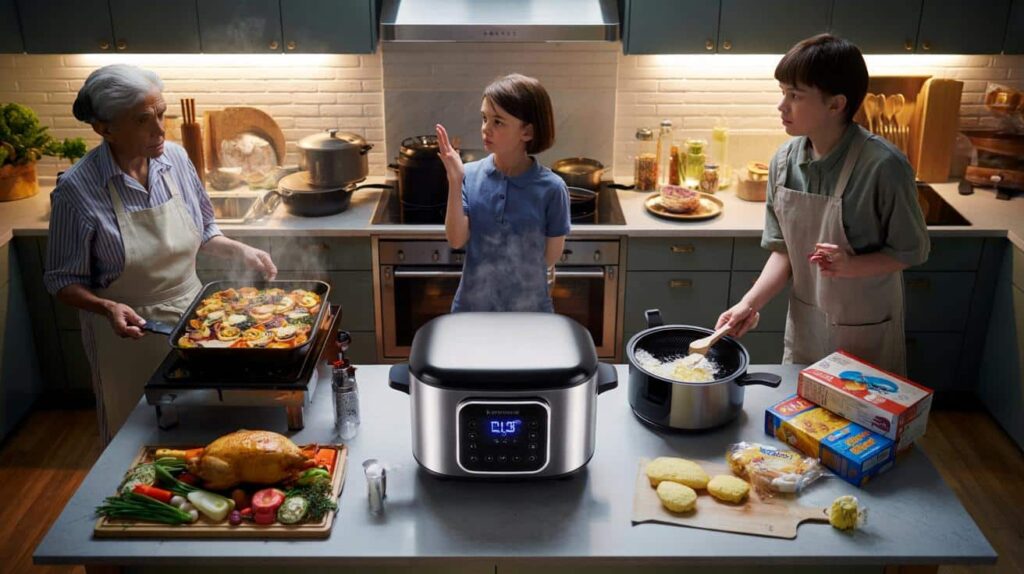
By dessert, the family isn’t debating politics or football. They’re fighting about this machine.
Is it genius, dangerous, or the death of real food?
From miracle box to family battlefield
The nine-in-one gadget arrived in our kitchens with the swagger of a tech start-up promising to “disrupt” dinner. It roasts, steams, slow-cooks, air-fries, pressure-cooks, grills, bakes, reheats and probably sings lullabies if you press the right button.

For many households, it replaced the beloved air fryer in one swift, smug unboxing. That bulky basket suddenly looked old-fashioned next to a touchscreen and a dozen presets. The sales pitch is seductive: less oil, less time, fewer dishes, more health.
 Hygiene after 65 : not once a day, not once a week, shower frequency that keeps you thriving
But the first thing it really cooked was tension.
Take Sophie and Malik, both working long hours, two kids, tiny kitchen. They bought the nine-in-one after a flood of Instagram reels and a 40% “Today Only” discount. The first week felt magical. Frozen salmon in 12 minutes, “crispy” vegetables, yoghurt made overnight while they slept.
Then the cracks showed. Their electricity bill jumped. The kids started refusing anything that didn’t come out of “the robot”. Sophie’s mother complained the chicken had “no smell, no soul”. At a recent family dinner, the new gadget became the main topic: Malik defending the time savings, the grandmother defending “real pots”, the teenagers quietly googling “how safe is pressure cooking every day”.
The roast was fine. The atmosphere wasn’t.
Behind the family comedy, there’s a serious undercurrent. These multi-cookers ride three sensitive nerves at once: money, health, and identity. A basic version can cost a week’s groceries. The higher-end models reach smartphone territory. For some, it feels like an investment; for others, like being shamed into upgrading their kitchen just to keep up.
Then come the health claims: less fat, gentler cooking, more vegetables. Hidden behind glossy content are questions about ultra-processed recipes, non-stick coatings, and the quiet slide into a “just throw it in and press start” mentality.
In the background, something older is dying: the smell of onions softening slowly in a real pan.
Healthy hack or shortcut to ultra-processed living?
Used thoughtfully, these gadgets really can support healthier habits. The pressure-cook and steam functions are brutal on cooking times and surprisingly gentle on nutrients. Lentils in 20 minutes instead of an hour. Wholegrain rice that doesn’t glue itself to the pan. Vegetables that aren’t grey and lifeless.
The best trick many dietitians quietly recommend is simple: put the machine to work on basic, boring things. Batch-cook beans, grains, soups and stews. Use the air-fry function for homemade potato wedges, not just frozen chicken nuggets. Let the slow-cook function handle a bean chilli while you get on with your life.
The gadget becomes useful when it’s a tool for ingredients, not a mascot for shortcuts.
The trap a lot of people fall into is switching one kind of ultra-processed food for another. They proudly retire the deep fryer, then fill the basket with frozen breaded “protein bites” and cheese-stuffed everything. The marketing still says “less oil”, so it feels virtuous.
We’ve all been there, that moment when the day collapses and you throw something beige into the machine because you just can’t face chopping an onion. The danger isn’t that you do it once. It’s that it slowly becomes the default, while the knives and cutting boards gather dust. *You start to “cook” by scanning barcodes and reading instructions on bags instead of recipes.*
That’s when health becomes a story we tell ourselves, not something we actually live.
There’s also the quiet discomfort about what this does to our sense of “real” cooking. Some people feel relieved: less time, less mess, fewer skills required. Others feel almost ashamed, as if a machine is replacing something they were supposed to know how to do.
One nutritionist I spoke to put it bluntly:

“We’re outsourcing not just the work of cooking, but the relationship with food. The risk isn’t the machine. It’s when we forget what real food looks like before it goes in there.”
And beyond that, the arguments almost always circle back to three raw nerves:
- Cost and guilt – “Did we just blow half a paycheck on another gadget that’ll sit in the cupboard?”
- Health confusion – “If it’s air-fried and homemade, does that automatically mean it’s good for us?”
- The death of ritual – “If dinner becomes pressing a button, what happens to the talking, the tasting, the teaching?”
Living with the machine without losing your kitchen soul
There is a way to keep the nine-in-one without letting it run your life. It starts with deciding what role you want it to play. Not what the adverts promise. What you actually need.
One simple method: limit it to three clear missions. For example: weekday grains and beans, reheating leftovers without drying them, and the occasional roast chicken when you’re wiped. Everything else returns to the hob, the oven, the pan. This turns the device from a tiny god into a helpful colleague.
Treat presets as suggestions, not orders. Taste your food midway. Add herbs, a squeeze of lemon, a spoon of butter. Put your own fingerprints back on the recipe.
The biggest mistake isn’t culinary. It’s psychological. People expect the machine to fix their life: their schedule, their diet, their family arguments. It can’t. It can shave minutes off a recipe and hide some chaos on the counter, but it won’t suddenly make kids love broccoli or couples agree on spending.
Let’s be honest: nobody really does this every single day. The meal plan, the perfect homemade stock, the flawless steamed salmon. Real life is messy. Some nights you’ll press “start” and walk away. Other nights you’ll have the bandwidth to chop garlic and toast spices in a real pan. Both can coexist.
Giving yourself permission to be imperfect around food is often healthier than any “smart” programme.
At some point, every household needs the conversation that isn’t in the manual. Who actually wants this thing? Who feels judged by it? What do we miss when the machine does everything?
One home cook I met summed it up in a way that stayed with me:
“I don’t hate the gadget. I hate that it made me feel like my old way of cooking wasn’t good enough.”
If you want to keep the tool but lose the tension, you can try small guardrails:
- One night a week with zero machines, just fire, pans, and hands on food
- Using the gadget only for whole ingredients on certain days: vegetables, pulses, grains, fresh meat or fish
- Letting kids or teens choose one recipe to cook entirely without presets or apps
- Talking openly about cost, energy use and what “healthy” really means for your family
- Allowing yourself “lazy freezer nights” without shame, instead of hiding them behind health claims
Beyond the hype: what kind of kitchen do we really want?
The nine-in-one controversy isn’t really about steel and circuits. It’s about how we picture a good life in a small everyday moment: dinner. Quick or slow. Silent or noisy. Screen-led or handed down between generations.
For some, this gadget unlocks something precious. A parent comes home late and can still get a warm, decent meal on the table. An elderly person cooks safely without juggling five hot pans. A beginner feels brave enough to try beans from scratch. There’s real value in that.
For others, the same object feels like a quiet erasure. Less smell of onions, less crackle from the pan, fewer shared tasks. A meal becomes a countdown on a digital display, and the only story left is “we pressed the button at 19:23”.
Maybe the real question isn’t “air fryer vs nine-in-one” or “machine vs real food”. It’s whether we allow marketing and convenience to dictate how we feed ourselves, or whether we choose, awkwardly and imperfectly, what stays and what goes.
The device might stay on the counter. The air fryer might be sold, or demoted to the garage. The important part lives somewhere else: in the small, stubborn decision to still chop a tomato by hand, to still taste the sauce, to still argue around the table about what “real food” means to you.

| Key point | Detail | Value for the reader |
|---|---|---|
| Define the gadget’s role | Limit it to a few core uses instead of making it the default for every meal | Reduces guilt and helps balance convenience with cooking skills |
| Focus on ingredients, not presets | Use it mainly for whole foods: grains, beans, vegetables, basic proteins | Supports genuine health benefits instead of ultra-processed shortcuts |
| Keep food culture alive | Protect some “no-machine” moments and shared cooking rituals | Preserves family bonds and a sense of identity around meals |
FAQ:
- Question 1Is the nine-in-one gadget really healthier than an air fryer?
- Question 2Does using it every day damage nutrients in food?
- Question 3Are the non-stick coatings and plastics safe long term?
- Question 4How do I know if the cost is actually worth it for my household?
- Question 5Can I rely on this for all my meals without “losing” my cooking skills?
