
A green-brown shape slid under the surface, thick as a tractor tyre, the water bulging around it. Someone whispered “Monster” in Portuguese, someone else shouted a measurement – ten, maybe twelve metres – and the clip cut out just as the head broke the surface.
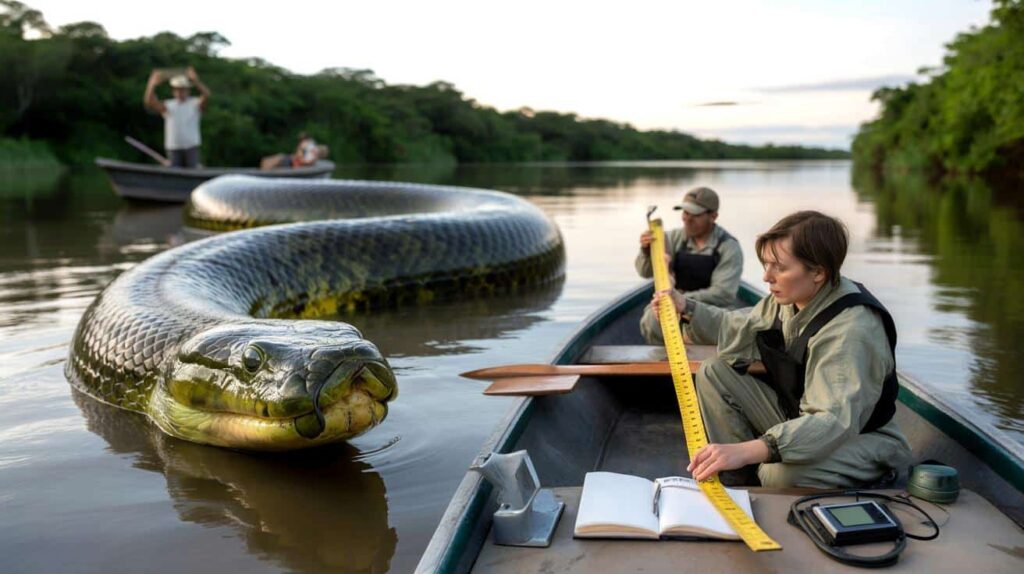
Within hours, headlines were screaming about a “new giant anaconda”, a snake “the size of a bus”, “the biggest ever seen on Earth”. The numbers crept up with every repost. Ten metres became twelve. Twelve became fifteen. On one popular site, it quietly reached a world-record twenty.
Somewhere on the other side of the world, a herpetologist opened the same video, slowed it down, and sighed. She reached for a calculator, not a thesaurus.

Why giant animal stories keep getting bigger online
The first thing that happens when a huge animal hits the internet is that scale disappears. A dark shape in murky water looks enormous when you have nothing solid to compare it with. A wide-angle phone lens stretches the distance. A low camera angle turns a big snake into a mythic one.

Our brains help that illusion along. We want to be impressed, maybe a little scared. We share the clip before we’ve even thought about metres or feet. And every repost adds a little verbal seasoning: “Huge” becomes “massive”, “massive” becomes “record-breaking”.
By the time a newsroom picks up the story, the basic facts are already warped. A social media caption becomes a quote, a guess becomes a “local report”, a blurry still becomes “scientific evidence”. No one’s lying outright. The story is just quietly swelling with every click.
Take the anaconda frenzy that flared after the release of “Pole to Pole” and other recent nature series. Screenshots of the newly filmed “giant” began circulating before the end credits. On one viral tweet, the snake was described as *“at least 20 metres long”*. The actual scientists on the expedition, who had tape-measured the animal while it lay docile in the water, had logged something closer to 6–7 metres.
That gap isn’t a rounding error. It’s the difference between a truly impressive wild snake and a biological impossibility. But once “20 metres” is out there, it sticks. Other outlets repeat it because it sounds better. Readers remember the bigger number. A sober correction from a field biologist gets a few hundred likes; the wild claim gets a few million views.
The same pattern repeats with crocodiles, sharks, even urban foxes caught under security lights. A fisherman stretches his arms a little in a photo. A tour operator mentions “maybe five metres” offhand to spice up a boat trip. A local paper adds a flourish. Somewhere along that chain, the number stops being an estimate and hardens into “fact”. That’s the moment scientists start grinding their teeth.
What’s really going on here is a collision between two logics. The logic of the internet rewards shock, extremity, the sense that something has just broken a record. The logic of science rewards boring things like repeat measurements, error bars and sample sizes. When an animal appears unusually big, those two worlds crash into each other in public, and size becomes a kind of tug-of-war rope.
How scientists actually measure monsters
Field biologists faced with an unusually large snake, shark or croc don’t pull out adjectives first. They reach for standard methods that can be repeated and checked. For anacondas caught in research nets, that’s usually a soft measuring tape stretched along the spine, snout to tail tip, body kept straight, two people calling out the reading together.
That sounds dull. It’s the opposite of the breathless viral clip shot from a trembling boat. But that dullness is why scientists trust it. The number written in a field notebook, next to GPS coordinates and date and water temperature, can be compared to another number taken years later, in another part of the river, by another team.
When they can’t physically handle an animal, researchers switch to tricks most viewers never see. They calibrate the scale of a photo using something in the frame whose size is known: a boat width, a survey pole, even the diameter of a standard fuel barrel on the bank. Then it’s geometry, not vibes, that matters.
One surprisingly robust method is photogrammetry: using multiple photos or video frames from different angles to reconstruct a 3D model of the animal. Shark scientists use it a lot. For a basking shark gliding near a research boat, they’ll film from above, then later align points along the body in software to get length down to the nearest centimetre. No need to haul the animal aboard. No guesswork, no macho storytelling on the dock.
Scientists are also wary of “dead size”. Crocodiles and snakes hung from trees after a hunt look longer than they actually are, because gravity stretches the body. For giants like saltwater crocs, official length records often demand skull measurements instead, which scale more reliably. That’s why proper record lists talk about skull length, mass and verified photos, not just “old stories from the river”.

How to spot a dodgy animal-size claim
There’s a simple mental checklist researchers use, and you can borrow it next time a “giant” animal hits your feed. First: is there a clear reference object in the image? A person standing close, a boat whose model you can Google, a building, a standard truck tyre. If everything in frame is water and leaves, you’re basically guessing.
Next: does anyone mention how the animal was measured? Words like “estimated” or “locals say” are red flags. They don’t mean the story is fake, just that the number is floating free of any method. When you see “measured using laser rangefinder” or “tape-measured by field team”, that’s a much stronger sign someone tried to be precise.
Finally, compare the claim against known records. A quick search will tell you the documented maximum sizes: around 6–7 metres for green anacondas, roughly the same ballpark for reticulated pythons, about 6 metres for the biggest saltwater crocodiles on record. When a headline casually doubles those numbers, it’s probably chasing drama, not truth.
One gesture that helps: slow down before you share. Literally pause, thumb hovering over the “retweet” or “share to stories” button. Ask yourself what in the clip is truly visible, and what’s being supplied by that capitalised caption. On a fast-scrolling screen, that tiny gap between “wow” and “wait a minute” is where critical thinking lives.
Scientists will quietly admit they’re not immune to awe. A biologist who spends a month waist-deep in blackwater to collar anacondas wants the animal to be special. They’re human; they feel the thrill too. The key difference is what happens next. A researcher notes their first wild guess in a notebook, then replaces it with a measured value. Online, we tend to freeze at the guess and skip the correction.
Soyons honnêtes : personne ne fait vraiment ça tous les jours. No one is opening peer‑reviewed papers on their lunch break to double-check that “bus-sized” snake in their timeline. That’s why small habits, not heroic efforts, matter more. You don’t have to become a walking fact-checker; you just need to get a little more allergic to numbers that sound like movie posters.
“Any time you see ‘biggest ever’ and no method next to it, you’re reading a story, not a measurement,” says Dr Rebecca Mason, a herpetologist who’s spent fifteen years wading through Amazonian backwaters with a fabric tape in her pocket.
Here’s a quick mental crib-sheet you can keep in the back of your mind when the next “record-breaking” animal appears:
- Look for a solid size reference in the image, not just adjectives.
- Check if the article explains how the animal was measured.
- Compare the number with known maximums from reputable sources.
- Be wary of big round numbers and neat records (“exactly 20 metres”).
- Notice when a claim traces back to a single social post or unnamed “locals”.
What inflated wildlife does to how we see nature
Once you start noticing the size inflation game, it’s hard to unsee it. The risk isn’t just factual sloppiness; it quietly reshapes how we relate to wild animals. A six‑metre anaconda is genuinely extraordinary. When the internet has trained you to expect a fifteen‑metre leviathan, the real thing suddenly looks “disappointing”. The bar for wonder keeps getting nudged upwards.
There’s a darker side too. Exaggerated monsters feed old fears. Stories of “man‑eating” crocs and “boat‑crushing” snakes make it easier to justify killing them, or draining the swamps they live in. The nuance – that attacks are rare, that habitat loss is usually a bigger threat than any predator – gets lost under the adrenaline rush.
We’ve all lived that moment where we share something wild and bad‑tempered from our feed just to feel part of the shock. *Then we forget the animal, but remember the drama.* What scientists are quietly asking is whether we can tilt that impulse a little. Can a true measurement, a well-documented record, a careful story about a real, living giant feel as shareable as a myth?
The next time a “giant anaconda” makes headlines, there will still be breathless thumbnails and ALL‑CAPS captions. That’s not going away. What can shift is what happens in the minds of the millions watching. A few might start asking, “Measured how?”, or zooming in to spot a paddle, a boot, a boat edge they can use to gauge scale.
In that small act, we move a fraction closer to the way field scientists see the same scene. Not as a blurry monster built from fear and hope, but as a specific animal in a specific place, with a length that can be written down, compared and argued over. Less myth, more reality – and, strangely, the reality turns out to be just as gripping.

| Point clé | Détail | Intérêt pour le lecteur |
|---|---|---|
| Comment les tailles sont gonflées | Angles de caméra trompeurs, absence de repères, reprises médiatiques successives | Permet de repérer instinctivement les images trompeuses |
| Ce que font vraiment les scientifiques | Mesures au ruban, photogrammétrie, comparaison à des records vérifiés | Aide à distinguer un fait mesuré d’un simple récit spectaculaire |
| Réflexes à adopter en tant que lecteur | Chercher le repère, la méthode, et les sources reconnues avant de partager | Donne un pouvoir concret pour limiter la désinformation sur la faune |
FAQ :
- How big can a green anaconda really get?
Verified records put the largest green anacondas at around 6–7 metres long, with a handful of credible but not fully documented reports slightly above that. Anything claimed at 10 metres or more should trigger serious scepticism.- Why do so many photos make animals look bigger than they are?
Wide‑angle lenses, low shooting angles and lack of scale all distort size. A snake held closer to the camera than the handler, or a croc photographed from a crouch at the water’s edge, will always look exaggerated.- Have scientists ever been wrong about a “giant” too?
Yes. Field teams make rough guesses, especially in fast‑moving situations. The difference is those guesses usually get replaced by tape‑measured lengths or calibrated photo estimates before they reach official records.- Are giant predators actually more dangerous to people?
Not necessarily. Most large snakes and crocs avoid humans when they can. Attacks tend to be local, tied to specific conditions like fishing spots or low‑visibility water, rather than the animal’s record size.- How can I fact‑check a viral “monster” without being an expert?
Start with three steps: search for the species’ known maximum size from reputable sources; look for a clear size reference in the image; and see whether any scientist or research institution is quoted about how the measurement was made.
