
The girl at the café never looks up. Her eyes move in tiny diagonal jumps, blue-light reflections flickering in her glasses as her thumbs fly over the glass screen. Next to her oat latte lies a pale pink notebook, spotless, still smelling of the shop, and a ballpoint pen with the cap on. She isn’t ignoring them. She genuinely seems to have forgotten they exist.
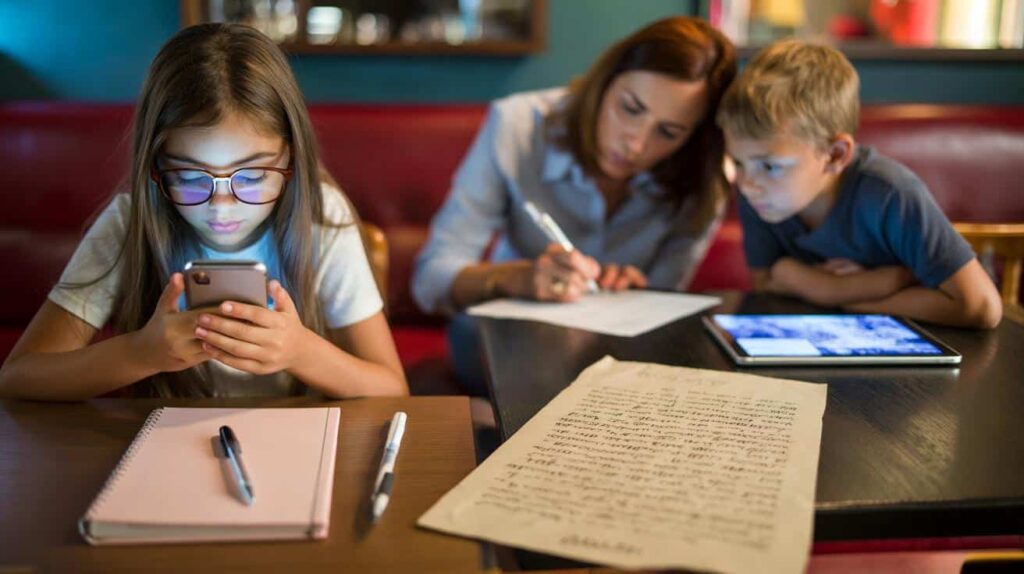
On the next table, a mother is filling out a school form by hand, pressing too hard, letters slightly shaky. Her 14-year-old son leans over and whispers, half amused, half horrified: “You still write like that?”
Two generations, ten inches apart, and a 5,500-year-old human skill sitting unused between them.

Something quiet really is slipping away.

40 percent of Gen Z can’t really write by hand anymore
Scroll through any high school corridor and you’ll see it: laptops open on every desk, phones peeking out of sleeves, stylus pens tapping on tablets. Ask those same teens to write a paragraph in cursive, and many will freeze. Not out of laziness, but out of genuine unfamiliarity.
A recent UK survey suggested **around 40 percent of Gen Z rarely or never writes by hand**, beyond the odd signature or scribbled word. Daily handwriting, the thing older generations practiced for hours, simply doesn’t appear on their radar. They type fast, they voice-note faster, they live in the cloud.
On paper, literally, they’re vanishing.
In one middle school in Texas, a teacher set a “throwback” homework: write a full-page letter by hand to your future self. Not type. Not dictate. Pen. Paper. One boy raised his hand and asked, honestly, “Can I print instead? I never learned that loopy writing.”
Another student turned in a sheet where every line drifted downhill, words getting bigger, letters lopsided. She apologized in the margin: “Sorry, my handwriting is ugly, I usually use Google Docs.” The teacher said later she felt she was reading something fragile, like finding a clumsy love note.
The letters were messy, charming, sometimes illegible. They were also the most personal work she’d seen all semester.
Tech didn’t kill handwriting overnight. It just quietly replaced all the small, daily moments where we used to write. Shopping lists moved to apps. Birthday cards became Instagram stories. Even classrooms – from Norway to New York – swapped notebooks for Chromebooks.
Parents who grew up covered in ink stains now watch their kids glide on glass, and many are torn. On one side: speed, access, spellcheck, the skills of the future. On the other: the slow, bodily act that wires words into memory and feelings into lines. *Losing handwriting isn’t just losing a pretty skill, it’s losing a particular way of thinking with your hands.*
Progress is real. So is the hollow space it sometimes leaves behind.
What we lose when we stop letting our hands think
Neuroscientists love to show those colorful brain scans where different areas light up like a city at night. When kids write by hand, more of that “city” turns on. Motor control, language, memory, attention – they all start talking to each other. Typing mostly repeats the same small movements on a flat grid.
That’s why writing something out, line by line, often feels like “getting it into your head”. It’s not romantic nostalgia; it’s how the brain encodes. When Gen Z abandons handwriting, they aren’t just skipping the cramps, they’re skipping a kind of whole-body learning. The page pushes back in small ways: the drag of the pen, the space running out, the smudge of ink.
Screens stay smooth no matter what you throw at them.
There’s also the human side, the one that doesn’t show up in brain scans. A paper letter carries weight, literally. The pressure of the pen changes on a bad day. The curve of a familiar “g” can make you feel hugged from 500 miles away. We’ve all been there, that moment when you find an old note in a drawer and your chest tightens before you even read it.

Compare that to a wall of regulation-blue text on a phone. Efficient, sure. Sharable, sure. Easy to search and easy to forget. When teens split up now, their “last words” live in chat logs, not on creased, tear-stained paper. There’s no envelope to hold. No ink to blur.
Some parents quietly mourn that their kids may never receive a love letter that looks like it survived a storm.
This isn’t about demonizing keyboards. Gen Z writes more words per day than any generation before them – DMs, comments, captions, school assignments. Their world is hyper-written; it just doesn’t pass through their fingers in the same slow, resistant way.
Yet handwriting seems tied to a kind of vulnerability that digital text struggles to copy. When your hand shakes or your letters trail off, you can’t auto-correct your mood. You leave a little emotional fingerprint behind. That’s why diaries worry some parents more than private chats: they feel raw, unfiltered, “too real”.
Let’s be honest: nobody really writes three-page handwritten journal entries every single day. But when the chance to ever do it at all disappears, something older and softer in us goes quiet.
How parents and teens can keep handwriting alive without turning it into homework
If you ask a teenager to “practice your handwriting for 20 minutes,” you might as well ask them to churn butter. It sounds pointless and vaguely historical. But slip handwriting into things they already enjoy, and the resistance softens.
Start microscopic. A handwritten Post-it on their laptop: “Good luck on the test – Mom.” A sticky note on the fridge: “Borrowed your hoodie – sorry – J.” One dad in Berlin bought a stack of cheap postcards and left them by the door. Every Sunday, his daughter picks one, jots three lines to her grandma, and walks it to the mailbox. No lectures. Just habit.
Handwriting stays alive when it feels like a gesture, not a punishment.
Many parents fall into the same trap: they turn cursive into a moral battlefield. Screens bad, pens good. Kids hear the sermon and tune out. They live in group chats and Google Docs; telling them their world is fake will only push them further into it.
A gentler path is to frame handwriting as a secret power, not a chore. Explain that handwritten notes are harder to screenshot, easier to cherish, more likely to be kept in a box under a bed. Show them your old notebooks, the ones with doodles in the margins and dramatic lyrics. Laugh at your own messy teenage scrawl.
Guilt rarely brings back a lost habit. Curiosity sometimes does.
One 19-year-old student told me, “When I’m really spiraling, I write it out by hand. Typing feels like I’m performing emotions for someone else. On paper, it’s just me and the mess.”
- Pick one analog ritual: a weekly handwritten letter, a paper journal for hard days, or a bedtime gratitude list in a notebook.
- Keep tools visible and inviting: a decent pen on the counter, a stack of simple cards by the front door, a small notebook in the backpack.
- Use handwriting for peak moments: birthday messages, apologies, congratulations, goodbyes, first-day-of-school notes.
- Accept imperfection: ugly handwriting is still incredibly human; teens don’t need calligraphy, they need a way to show up on paper as they are.
- Blend worlds: take a photo of a handwritten note and send it as a message – it travels at digital speed but keeps that inked, uneven soul.
A 5,500-year skill standing at the edge of the touchscreen
Picture a museum 200 years from now. Glass cases hold clay tablets, medieval manuscripts, letters from the front, and, somewhere between them, a lined notebook filled with bubble letters and emo lyrics from 2012. The label says: “Personal writing, now largely replaced by neural text streams.” People lean closer, trying to feel what it was like to drag a pen over paper and hope the words would land right.
We’re not there yet. Pens still roll around car seats. Notebooks still pile up half-filled, abandoned each January and rediscovered every move. Gen Z may type everything, but many still draw in the margins of their math worksheets, still scribble band names on their shoes. There’s room in this glowing, buzzing world for old gestures to survive, if we leave the door open.
Maybe the real question isn’t “Is handwriting dying?” but “What kind of connection do we want to leave behind when the Wi‑Fi cuts out?”

| Key point | Detail | Value for the reader |
|---|---|---|
| Handwriting is quietly disappearing | Roughly 40% of Gen Z rarely writes by hand beyond signatures or short notes | Helps readers understand this isn’t just a feeling, it’s a measurable cultural shift |
| Handwriting changes how we think and feel | Writing by hand activates memory, attention and emotion in ways typing doesn’t | Gives parents and teens a science-backed reason to keep some pen-and-paper moments |
| Small rituals can keep the skill alive | Post-its, postcards, paper diaries for tough days, handwritten messages for big moments | Offers concrete, low-pressure ideas that fit into real, busy digital lives |
FAQ:
- Question 1Is Gen Z really “killing” handwriting, or is that exaggerated?
- Question 2Does handwriting actually help with learning, or is that just nostalgia talking?
- Question 3My teen’s handwriting is terrible. Should I push them to improve it?
- Question 4Can tablets with stylus pens replace traditional handwriting on paper?
- Question 5What’s one simple way to bring more handwriting back into our family without a fight?
