France’s VINCI Group has signed a major agreement in New Zealand that subtly reshapes the balance of power across the Pacific construction sector. The move strengthens VINCI’s position in a region under intense pressure to modernise infrastructure amid climate challenges and population growth. Rather than chasing isolated projects, the group is anchoring itself more deeply in Oceania, signalling a long-term strategy aimed at resilience, scale, and regional influence.
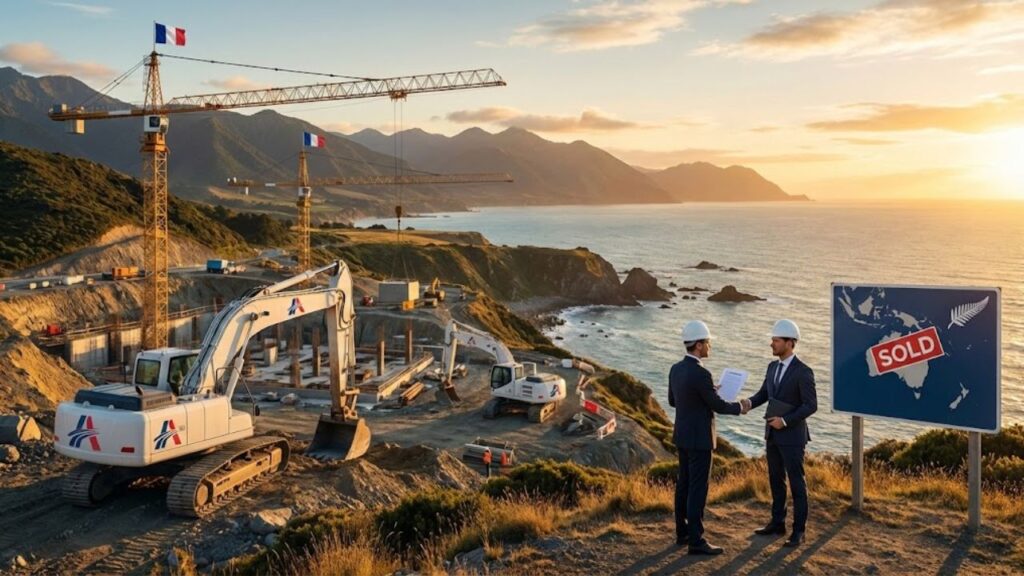
VINCI Commits €183 Million to a Century-Old New Zealand Leader
VINCI has agreed to acquire Fletcher Construction, one of New Zealand’s largest construction and infrastructure companies, for approximately €183 million. This decision reflects a strategy that extends well beyond winning individual contracts in the region.
Founded in 1909, Fletcher Construction employs around 2,300 people and generates close to €630 million in annual revenue within New Zealand. Its portfolio includes roads, bridges, complex buildings, and heavy civil engineering works, alongside operations across several South Pacific islands.
 This world-famous psychologist is now certain: wabi-sabi is the best life philosophy, and here’s why
By acquiring Fletcher, VINCI is not just purchasing contracts but securing more than a century of local expertise and established institutional relationships. Fletcher’s work spans strategic transport routes and major public programmes, often delivered in remote areas, seismic zones, steep terrain, and regions exposed to extreme rainfall. In a country facing earthquakes and increasingly severe storms, this experience is a critical asset.

The acquisition also gives VINCI immediate access to long-standing relationships with government agencies, local councils, and major private clients. These connections, built over decades, would be extremely difficult for an external player to recreate.
New Zealand Emerges as a Real-World Lab for Resilient Infrastructure
New Zealand’s infrastructure sector is entering a period of renewal. Ageing transport networks, pressured ports and rail systems, and flood-prone river basins require major upgrades or full redesigns. Recent destructive cyclones have also prompted stricter climate resilience standards and tougher regulatory expectations.
Across Wellington and regional authorities, priorities include:
- Reinforcing transport corridors linking ports, cities, and rural regions
- Upgrading ports to accommodate larger vessels and evolving trade routes
- Modernising rail networks to shift freight away from roads
- Strengthening dams, flood defences, and stormwater systems after extreme weather
With Fletcher Construction joining HEB Construction, a firm VINCI already controls locally, the group significantly deepens its footprint. VINCI’s New Zealand revenue had already exceeded €900 million before this deal. The acquisition further expands its equipment base, engineering capacity, and skilled workforce, reinforcing New Zealand’s role as a regional production hub rather than a distant outpost.
- 9 old-school habits people in their 60s and 70s refuse to drop and why they’re happier than tech-obsessed youngsters
- $2,000 Direct Deposit for U.S. Citizens in February: eligibility, payment dates, and IRS instructions
- According to psychology, people who disrespect their parents often experienced these 7 childhood patterns
- Hygiene after 60: experts explain why neither daily nor weekly washing is ideal
- Gardeners repeat this common autumn leaf mistake, and experts warn it damages soil health
- Goodbye kitchen islands: the 2026 trend already reshaping modern homes
- Why Créteil Lake stayed frozen at the edges but not the centre this afternoon
- China’s biggest rival targets future rail with the world’s most powerful hydrogen locomotive
Australia Mirrors the Momentum with Major Infrastructure Contracts
Across the Tasman Sea, Australia is experiencing its own infrastructure surge, driven by urban expansion and growing congestion in cities such as Sydney and Melbourne. VINCI operates there primarily through its subsidiary Seymour Whyte, which has recently secured contracts worth a combined €604 million.
Key Australian Projects Strengthening VINCI’s Pipeline
- Eastern Freeway Hoddle–Burke, Melbourne – A joint project valued at roughly €450 million for the alliance, aimed at increasing capacity, adding bus lanes, creating shared cycling and pedestrian paths, and installing noise barriers. Completion is expected around 2028.
- Sydney urban road upgrade – A €154 million design-and-build contract for Transport for New South Wales, focused on reducing congestion, improving safety, and supporting walking and cycling.
- Lower Molonglo wastewater treatment plant, Canberra – A ten-year modernisation programme delivered with VINCI Construction Grands Projets for Icon Water, targeting higher capacity, improved environmental performance, and stronger resilience.
These projects align with Australia’s broader push to unclog major corridors, support denser urban areas, and cut pollution from transport and water systems. They also provide VINCI with a long-term workload extending well into the decade.
Innovation Drives VINCI’s Oceania Expansion
VINCI’s growth in Oceania is not limited to acquisitions. The group is actively deploying digital tools and low-carbon construction methods across its Australian and New Zealand operations.
Local teams participate in projects run through Leonard, VINCI’s innovation platform focused on construction, energy, and mobility. This includes installing sensors on bridges and tunnels, applying data analytics to anticipate maintenance needs, and testing lower-carbon materials.
The rationale is straightforward: predictive maintenance extends asset life, reduces unexpected shutdowns, and lowers costs for both operators and taxpayers.
Engineers on the ground are addressing practical challenges such as:
- Extending bridge lifespans without full closures
- Timing interventions on water and wastewater networks before failures occur
- Reducing heavy truck movements through improved site logistics
- Identifying low-carbon concretes that meet New Zealand’s seismic standards
These capabilities strengthen VINCI’s technical edge when competing for long-term public contracts.
Building a More Balanced Global Presence
VINCI employs more than 280,000 people worldwide, with a historically strong base in Europe, particularly France. That balance is gradually shifting as the group expands in faster-growing regions such as Oceania.
- Europe (including France): approximately 200,000 employees, focused on motorways, high-speed rail, airports, energy, and urban construction
- France: around 102,000 employees, concentrated on road concessions and major rail and urban projects
- Americas: roughly 50,000 employees working on airports, highways, civil works, and power networks
- Africa and the Middle East: about 16,000 employees involved in roads, ports, renewable energy, and basic infrastructure
- Asia-Pacific and Oceania: more than 15,000 employees, a figure that continues to rise, focused on airports, highways, and major projects in Australia and New Zealand
Recent acquisitions, including Cobra IS and now Fletcher Construction, push the share of staff outside Europe beyond 30%. This diversification reduces reliance on mature European markets and spreads risk across regions with differing economic cycles.
Why Oceania Holds Strategic Importance
Although geographically distant for a European group, Oceania offers clear strategic advantages. Political stability, transparent procurement processes, and robust environmental standards favour companies prepared to invest for the long term.
Authorities in Australia and New Zealand often select partners capable of delivering complex projects and operating assets safely over decades, not just constructing them. For VINCI, which already manages toll roads, airports, and water systems elsewhere, this creates opportunities for future concessions and long-term service contracts.
Challenges remain. Construction costs are rising due to tight labour markets and higher material prices, while expectations around emissions and biodiversity protection continue to tighten. Climate-related disruptions, including floods, heatwaves, bushfires, and coastal erosion, also add uncertainty to schedules and budgets.
Looking ahead, a likely scenario is a steady flow of medium- to large-scale projects focused on adaptation: flood protection, slope stabilisation, coastal defences, stronger building codes, and decentralised energy systems. Companies that combine traditional engineering with data-driven tools and carbon-light materials are well positioned to benefit.
Core Concepts Shaping the Strategy
Several key terms help clarify the dynamics behind the deal:
- Design–build contracts place planning and construction under one contractor, accelerating delivery while transferring more risk to the builder.
- Infrastructure resilience describes the ability of assets to continue operating, or recover quickly, after events such as earthquakes or severe storms.
- Maintenance-as-a-service refers to models where companies are paid to maintain performance levels, using data to intervene just before failures occur.
If VINCI successfully integrates Fletcher, applies its innovation platforms effectively, and keeps costs under control on both sides of the Tasman Sea, Oceania could emerge as one of the group’s most dynamic regions, influencing how infrastructure is designed and managed far beyond Australia and New Zealand.