
On a gloomy morning in Stockholm, a Nobel Prize-winning physicist stepped away from the podium and surprised the audience. Instead of discussing particles or equations, he began to speak about something unexpected—weekends. “Your grandchildren,” he said softly, “will probably work less than you. Maybe much less.” Some in the crowd chuckled nervously. Less work sounds like a dream, but it also raises concerns.
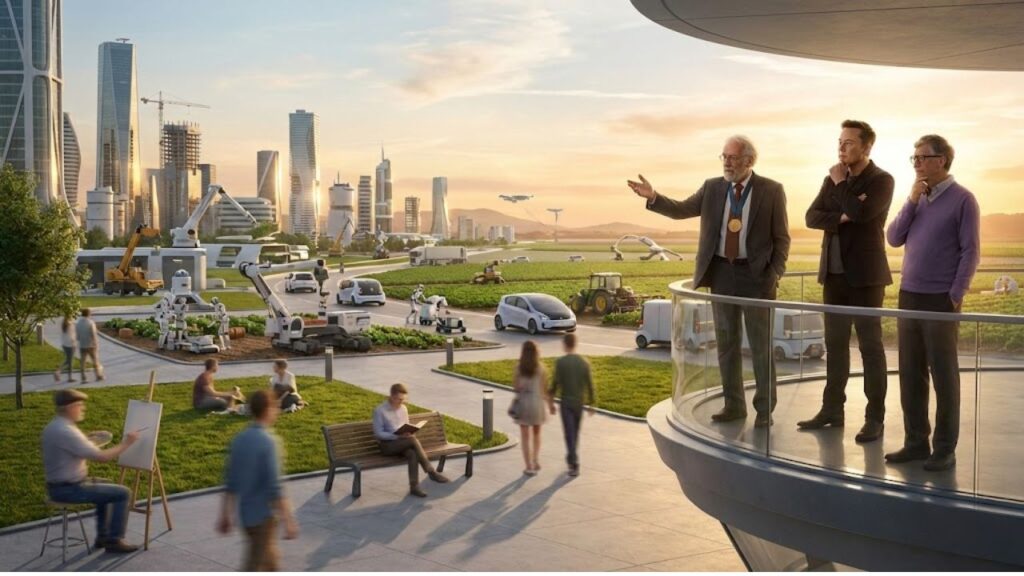
Outside, the world he described was already emerging. An AI chatbot was composing marketing emails in mere seconds. A robot arm in a warehouse lifted boxes tirelessly. A self-driving car cruised through a test track, sensors where a human face should have been.
For years, Elon Musk and Bill Gates have warned about this world.

The Future: More Free Time, Fewer Jobs
The physicist, Giorgio Parisi, didn’t sound like a science fiction writer when he echoed Musk and Gates. He sounded more like a concerned grandfather trying to caution his family without alarming them. The future, he suggested, would blend two strange realities: **more free time** and **fewer traditional jobs**. This isn’t a Hollywood robot uprising. Instead, it’s the slow, unstoppable replacement of human tasks by algorithms and machines.

He’s not alone in this concern. Musk advocates for universal basic income, calling it “necessary.” Gates has suggested a “robot tax” when machines replace workers. While their approaches differ, the underlying fear is the same: the traditional job market can’t support everyone.
You can already sense this tension in everyday moments. A copywriter watches ChatGPT generate a draft in under a minute. A radiologist sees AI tools detecting tumors faster than ever. A call center agent realizes that a virtual assistant can handle 60% of calls before a human needs to get involved.
We’ve all experienced that feeling when a tool starts doing part of our job, a mix of curiosity and unease. It doesn’t mean you’ll be replaced tomorrow, but it does mean the nature of your work is subtly changing. The same goes for your children’s future.
Parisi’s main point is brutally simple: productivity is soaring, but demand for human labor is not. Machines don’t need weekends, coffee breaks, or health insurance. Companies love this equation. In the past, new technologies would eliminate some jobs but create others. This time, however, the scale is different. Generative AI doesn’t just handle physical tasks; it also tackles cognitive work.
When this technology starts affecting factories, offices, design studios, and customer service desks, the old narrative of “technology creates more jobs than it destroys” begins to falter. That’s why the physicist finds himself agreeing with tech billionaires who are usually very different from him.
How to Live in a World That Doesn’t Need Your Job
If Parisi, Musk, and Gates are even partially correct, the real question is no longer “Will robots take my job?” It’s “What do I do with a life that has more free time than work hours?” One practical answer is to treat today like a rehearsal. Use the time you’re still selling by the hour to experiment with time you control.
This doesn’t have to be grand. Block off two evenings a week to pursue activities that aren’t tied to your main job but still help you develop a new skill. Whether it’s long-form writing, coding simple automations, learning video editing, or offering micro-consulting on a niche topic, these are seeds for “second lives” that don’t rely on a boss.

The biggest trap, as Musk often warns, is waiting for governments or corporations to redesign your life for you. Let’s be honest: very few of us do this every day. We tell ourselves we’ll “reskill someday” while binge-watching Netflix. The danger is waking up ten years from now in a labor market that has quietly moved ahead.
Gates tends to frame this differently, suggesting that we should “complement” AI rather than compete with it. The underlying message is the same: don’t cling to your current job title. Focus on the human elements of your work—like trust, judgment, and empathy—and double down on those qualities.
“Technological progress will free humans from many forms of labor,” Parisi said, “but without a social plan, it will not free them from anxiety.”
What to Do Now: Practical Steps to Prepare
Futurists and researchers offer a similar checklist to help you stay ahead:
- Learn how AI works at a basic level so you can use it, not fear it.
- Build a side income stream that isn’t tied to a single employer.
- Invest in relationships and communities, not just resumes.
- Practice living on less money, with slightly more time.
- Follow long-term curiosities with no immediate career payoff… yet.
These aren’t magic solutions. But they’re ways to stay human, adaptable, and less fragile in a labor market that offers no guarantees.
From “What Do You Do?” to “How Do You Live?”
If Musk, Gates, and Parisi are right, the most profound change won’t be robots or chatbots. It will be the social shift that happens when “What do you do?” stops being the first question we ask at parties. Work has always been our identity shortcut. As the 40-hour workweek shrinks—not by choice, but by design—that shortcut will fade away.
Some people will treat their newfound free time like an endless Sunday and drift aimlessly. Others will view it as a brutally honest mirror. What matters to you when no one is paying you by the hour? What does a meaningful day look like when emails no longer dictate your life?
The physicist in Stockholm wasn’t promising utopia, and neither Musk nor Gates is either. They’re pointing to a fork in the road that’s already here—uneven and messy. A world with more free time and fewer traditional jobs can feel like freedom or like exile. The difference, uncomfortably, will lie in the small choices you make today, not in the grand policies still under debate.

Key Takeaways
- See free time as a resource: Use your evenings and weekends to test new skills and projects beyond your main job.
- Shift from job identity to human skills: Focus on qualities like empathy, judgment, creativity, and relationship-building to stay relevant.
- Prepare emotionally, not just technically: Expect anxiety and embrace changes by leaning on your community and adjusting your lifestyle.
