
The woodpile looked perfect. Neatly stacked under the lean-to, cut in identical logs, enough to get through a long winter without flinching. All summer they had passed in front of it with a little quiet pride, the way you glance at a well-filled pantry. Then October arrived, the first cold snap, and with a small bit of excitement they lit the stove.
Two logs. Then four. Then eight. Smoke. Sputtering. A flame that wouldn’t catch, like a lighter running out.
They opened the stove door. The wood hissed softly, as if it were protesting. The room remained cold. Outside, the pile suddenly looked less like security and more like a stubborn, silent misunderstanding.
No one had ever really explained how to do it.
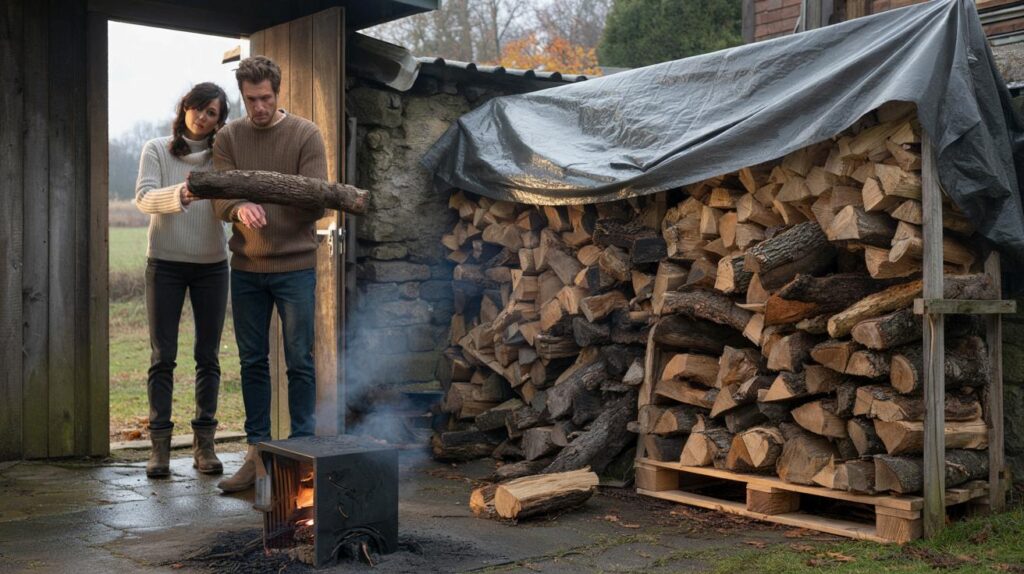
When “well-stored” firewood is secretly doomed from day one
From far away, badly seasoned wood looks exactly like good wood. It’s only when you try to burn it that the truth comes out. The logs are heavy in the hand, the bark seems stuck like glue, and when they hit each other the sound is dull instead of sharp. On the hearth, they smoke, they blacken, they sulk.
From the outside, everything seemed fine: cut at the right length, stacked in a nice tidy wall, covered “to protect it from the rain”. That’s precisely how so many people lose an entire winter’s stock without realizing it.
We think we’ve prepared for the cold. We’ve actually stored months of frustration.
Take Claire and Julien, who moved to a small village in late spring. They were proud to finally have a wood stove, symbol of this slightly idealized country life. A neighbor brought them a trailer full of “already dry” wood. They cut some more themselves and piled everything carefully against an old stone wall, under a wide plastic tarp, “like they’d seen on YouTube”.
The pile looked textbook-perfect in July. By November, almost every log was still wet inside. The tarp had trapped moisture, the bottom rows stayed in contact with the ground, and air never really circulated. Out of three cubic meters, barely one was burnable without cursing.
The rest? Smoke, soot, half-burned logs, and a chimney that needed sweeping in record time.

What went wrong is almost invisible to the naked eye. Wood doesn’t dry the way we intuitively imagine. It doesn’t just “wait” and lose water all by itself. It needs air, movement, sun, and time. A log can look grey and cracked on the outside and still hide a sponge at its core.
Real drying starts with when the tree was cut, how long it was left in large lengths, then how fast it was split. Stored in big rounds, wood dries at a snail’s pace. Split, it suddenly accelerates. Put that same wood on bare soil, squeezed under a heavy tarp, and the process slows down again.
Let’s be honest: almost nobody checks moisture with a meter before winter. We rely on the look, on what we’ve “always heard”, or on the word of a seller who has to empty their yard before the first frost.

The simple gestures that decide if your firewood will burn or sulk
The real turning point happens long before the first fire of the season. It starts the day the wood arrives. First reflex: do not leave it in a heap “for later”. The longer it stays unsplit and compact, the longer it keeps its inner humidity. The best gesture? Split as much as possible while the weather is still mild, into pieces suited to your stove, then stack them immediately.
Think of your pile as a lung. It has to breathe on all sides. Ideally, you raise it off the ground with pallets or crosspieces, leave space between rows, and keep the front and back open to the wind. The roof protects from direct rain, but the sides stay free.
Stored like this from spring, softwood can be ready by winter, and hardwood by the following season. Yes, that means thinking a year ahead.

The big trap is the famous full tarp “for protection”. A tarp directly on the pile is actually like putting your laundry into a plastic bag and expecting it to dry. Condensation builds up, the first showers soak the ground, and the lowest logs swell like a sponge. A light, sloping cover that lets air escape is worth more than any “waterproof cocoon”.
Another classic misunderstanding: buying “ready-to-burn” wood in October. The label reassures, the seller swears it’s dry, and the logs look aged. Yet without a minimum of ventilation at home and a test by sound or moisture meter, disappointment waits inside the stove.
We’ve all been there, that moment when you insist and throw in one more log, as if quantity could compensate for quality. All you get is more smoke and frustration.
“People don’t buy bad wood on purpose,” says Marc, a chimney sweep in a mountainous region. “They buy a promise. I see the same scene every year: beautiful stoves, expensive flues, and wood that simply wasn’t given a chance to dry. The fire is blamed. The stove is blamed. No one blames the pile in the backyard.”
- Raise the pileUse pallets, stones, or beams so the wood never touches the soil directly.
- Split early and fineLogs that are too thick stay wet at the core much longer.
- Ventilate the sidesLeave at least 5–10 cm between rows for air to circulate.
- Protect from rain, not from airRoof above, sides open, tarp only on top, never wrapped tight.
- *Test before winter*A cheap moisture meter or a simple sound test (clear, dry “clack” when struck) can save your season.
When a woodpile becomes a quiet life lesson
Behind a failed fire, there is often more than just a technical mistake. There is our relationship to time, to anticipation, to all these “invisible” tasks that no one really taught us. Drying wood happens on a scale that clashes with our habits: months, even years. It requires thinking about next winter while we’re still in T‑shirts.
A good woodpile is a kind of contract with your future self. The one who will come home frozen, who will count on that first flame to change the whole mood of the evening. A badly stored pile, on the other hand, is a promise we break without meaning to.
The day you finally open the stove and the logs crackle properly, with a clear flame that catches in a few seconds, you understand the difference in your bones. It’s not just warmth. It’s the feeling that, this time, you did the invisible part right.
| Key point | Detail | Value for the reader |
|---|---|---|
| Ventilation is everything | Raised pile, spaced rows, sides open, light cover above | Greatly reduces the risk of unusable, damp firewood |
| Time scale of drying | Split in spring for the following winter, especially for dense hardwoods | Realistic expectations, fewer bad surprises when the cold hits |
| Simple checks before use | Moisture meter, sound test, visual clues (cracks, loose bark, light weight) | Helps avoid smoke, soot, and wasted money on poor-quality fires |
FAQ:
- Question 1How long does firewood really need to dry before it burns properly?
- Question 2Is it bad to store firewood under a plastic tarp all year?
- Question 3How can I tell if my wood is too wet without special tools?
- Question 4Does the type of wood change how I should store it?
- Question 5Can I “save” wood that has been badly stored for months?
