
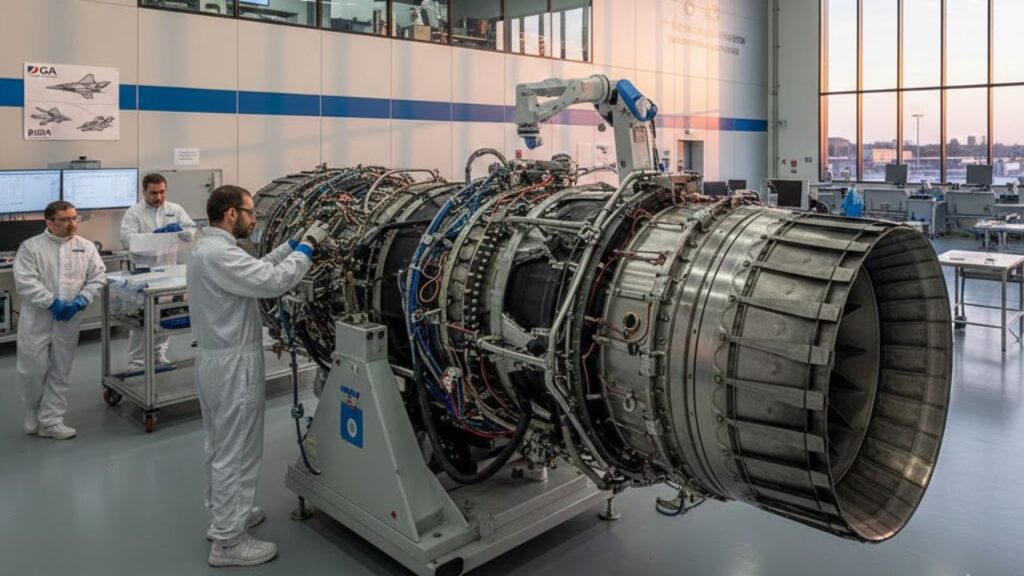
On a dim, overcast morning at the DGA engine test site in Saclay, just beyond Paris, the atmosphere begins to tremble before anything comes into view. Technicians in faded blue coveralls move calmly between cables, consoles, and screens, cups of coffee balanced in practiced hands. Their movements are measured, almost serene, the kind of composure you only find around machines that demand absolute respect. Behind a reinforced glass barrier, a Rafale engine surges awake, locked firmly to a massive test stand. The sound doesn’t simply fill the room; it presses into the chest. One microscopic flaw, one blade slightly off balance, and the entire system could destroy itself in an instant.
Yet fear is absent. What you see instead is intense concentration.
A young engineer steps closer to the glass, eyes fixed on the plume of flame. “Listen carefully,” she says. “This is the only fighter engine in Europe we can produce entirely on our own.” She is talking about France. And about a reality that often goes unnoticed.
 People who push in their chair when leaving the table often share these 10 unique personality traits
France’s Understated Air Power Advantage
From a distance, Europe appears unified and formidable: Airbus dominates civil aviation, multinational fighter programs thrive, and defense budgets are shared across borders. But focus on the most critical component of a combat aircraft—the engine—and the landscape shifts dramatically. France occupies a singular position.

The Rafale’s M88 engine, developed by Safran under constant supervision from the DGA, is the only modern European fighter engine whose entire lifecycle—design, testing, production, and certification—remains fully within one nation’s control. There are no American licenses, no obligatory foreign partners, no external approvals required. Every decision, from digital modeling to the final turbine blade, is made domestically.
This is more than industrial pride. It represents strategic autonomy.
Step inside a DGA test facility and you won’t find polished displays or marketing gloss. Instead, there are thick concrete walls stained by exhaust, aging analog dials beside ultra-high-resolution screens, and disposable coffee cups resting among sensor arrays worth millions. At the center sits a modest-looking silver cylinder: an M88 engine, compact in appearance, overwhelming in presence.
Testing the Limits Where Failure Is Not an Option
During qualification campaigns, engineers intentionally drive the engine far beyond anything a pilot would attempt in flight. Throttle surges are abrupt, bird strike scenarios are simulated, sand and debris are ingested, and temperatures are forced through extreme cycles. High-speed cameras focus on individual turbine blades—mere centimeters long—spinning at tens of thousands of revolutions per minute. If one blade gives way, it isn’t just a component that’s lost. It’s an aircraft, a pilot, a mission, and a nation’s credibility.
This is where the DGA’s role becomes tangible. It is not simply a contracting authority. It acts as the state’s analytical core, defining uncompromising requirements, validating ambitious concepts, and relentlessly pushing prototypes until only the most robust solutions remain. For both the M88 and the future engine of the Franco-German SCAF fighter, DGA laboratories and test benches are indispensable.
Without this infrastructure, Safran would still rank among top engine manufacturers. But France would lose what sets it apart: the ability to command the entire chain—design, materials science, manufacturing, testing, certification, and operational feedback—under full national sovereignty.
This seemingly small distinction—who truly controls the final detail—becomes decisive when global tensions rise.
The Microscopic Precision Behind a Modern Fighter Engine
What makes this capability exceptional lies at the scale of millimeters and microns. A fighter engine is not just about raw thrust. It demands tolerances so precise that a human hair appears massive by comparison. Safran engineers and DGA specialists operate like master watchmakers working with extreme heat.
In one workshop, a technician fine-tunes cooling channels in a turbine blade. Each opening is smaller than a pinhead, laser-drilled into a metal alloy engineered at near-atomic precision to withstand extraordinary heat. The DGA’s task is to define exactly how extreme those conditions may be—and to verify them without compromise.
Here, precision is not optional. It is the reason a pilot can engage full afterburner and trust the engine’s response without hesitation.

Europe boasts world-class engineers, but few nations maintain a fully sovereign industrial chain. The Eurofighter Typhoon’s EJ200 engine, for instance, is the product of multinational collaboration, with responsibilities divided among countries. Powerful, certainly—but not wholly controlled by any single capital.
France deliberately chose a different path. From the Mirage series to the Rafale, the state consistently invested in a national engine capability, even when costs were high and critics argued that cooperation would be cheaper. Through the DGA, France preserved expertise in materials, aerodynamics, digital simulation, and testing facilities that many considered excessive for a mid-sized power.
Why Strategic Independence Now Matters More Than Ever
Recent geopolitical disruptions have brought renewed attention to these long-term decisions. As export controls tighten and supply chains become political tools, reliance on foreign approvals turns into vulnerability. Some European aircraft cannot be sold, upgraded, or even maintained without authorization from outside powers due to a single imported component or line of code.
With the Rafale and its M88 engine, France negotiates directly with partners such as India, Egypt, and Greece. The DGA can authorize modifications, new variants, and sustained support independently. This does not isolate France from allies—it remains deeply engaged with NATO and European partners—but it ensures that ultimate control remains in Paris.
This is the understated, technical definition of sovereignty shaping air power in 2026.
How the DGA Preserves Its Technological Edge
Maintaining this level of mastery requires a continuous loop between research, testing, and real-world operations. Data from Rafale squadrons operating in harsh environments—such as sandy Middle Eastern conditions—feeds directly into DGA analysis units. Engineers then refine test protocols, sometimes adjusting a single software parameter or applying a new protective coating to a blade.
The process never pauses. The DGA acts as both referee and historian, cataloging every anomaly, micro-fracture, and unexpected outcome. When Safran proposes a new alloy or a 3D-printed component, the DGA recreates the most punishing scenarios imaginable to determine exactly how and when it fails.
The objective is clear: no surprises at altitude.
From the outside, this approach can appear rigid. Inside the labs, it feels essential. Engineers recall late-night tests when data spikes and silence fills the room. Those moments reinforce a shared understanding: shortcuts simply do not exist in this field.
The DGA works deliberately to avoid common pitfalls—overreliance on foreign suppliers, neglect of unglamorous test infrastructure, and loss of rare skills through retirement. It funds quiet doctoral research on obscure alloys, maintains decades-old databases, and treats institutional memory as a strategic asset.
A Singular Capability with Broader European Implications
Viewed from afar, the engine beneath a fighter jet is just another component. Seen up close, it becomes an entire ecosystem of expertise. As one DGA engineer puts it, “Stop nurturing this capability for five years, and you no longer build engines—you simply buy them.”
Today, France stands alone in

| Key point | Detail | Value for the reader |
|---|---|---|
| France’s unique capability | The only European country controlling the full fighter engine chain (design to testing) on its own soil | Understand why the Rafale and future French jets enjoy rare strategic independence |
| Central role of the DGA | State actor that defines specs, funds research, runs brutal tests and secures long-term know-how | See how a public institution quietly shapes cutting-edge technology and sovereignty |
| Impact on exports and crises | No critical foreign component needed to sell, upgrade or support engines | Grasp how this technical detail turns into concrete political leverage worldwide |
