
At 7:14 a.m. on a Monday that should have felt like deep winter, the air over a small town in Vermont smelled faintly of thawing earth. No crunch of frost underfoot. No stiff wind biting at fingers. Just a gray sky, a drizzle you’d expect in April, and a street full of people in light jackets, blowing steam from takeaway coffee cups, quietly wondering if they’d misread the calendar. Inside the local weather office, a bigger unease was brewing. On the wall, decades of hand-marked charts and printed maps were being silently contradicted by a lurid splash of red on a new digital model: early February, and the atmosphere was behaving as if someone had nudged the thermostat and walked away.
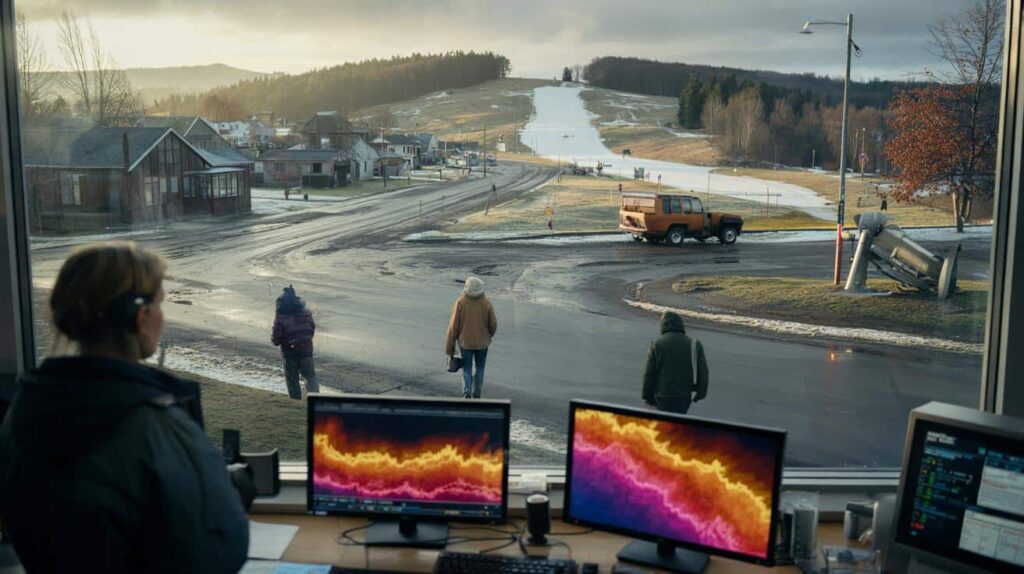
The meteorologists stared, refreshed the data twice, then exchanged the look they reserve for rare patterns.
Something wasn’t just “warmer than usual”. It was off-script.
When February stops acting like February
The first thing forecasters noticed wasn’t a storm or a headline-grabbing blizzard. It was the absence of winter in places where winter usually rules the room. In northern states and much of Western Europe, early February mornings started arriving with temperatures closer to late March. Snow that should have piled up on roofs slid into muddy puddles. Ski resorts turned on their snow cannons at full blast, fighting a losing battle against slush.
 Meteorologists warn early February may trigger an Arctic breakdown with global implications
On satellite images, the telltale bright white of snow cover was shrinking week by week, replaced by dull browns and surprising greens.
The map looked wrong in a way that made seasoned meteorologists lean closer to their screens.

One veteran analyst in Germany described it like watching a movie where the soundtrack didn’t match the scene. He pulled up data from the 1980s, then the 1990s, then the 2000s. Same calendar days, utterly different patterns. In France, early February temperatures leaped 8–10°C above seasonal norms for several days in a row. In parts of the U.S. Midwest, cities broke records that had stood since before color TV.
Farmers reported fruit trees budding in the first week of the month, only to panic at the mention of a potential late-season freeze. Urban planners watched river levels surge early with snowmelt that wasn’t supposed to happen yet. All these small stories pointed toward one big, unsettling question.
Behind the scenes, the explanation starts with a phrase you rarely heard in casual weather chats a decade ago: “climate baseline.” For years, meteorologists have relied on long-term averages to say what’s “normal” for a given place and date. Those baselines are built from 30-year windows of data. But when early February rolls around now, the atmosphere often behaves as if those reference points belong to another era.
Jet streams wobble out of their usual corridors. Polar air masses weaken, stutter, or stay trapped far north. Warm ocean patches feed extra heat into the system. **The result: models trained on yesterday’s climate struggle with today’s weather.** It’s not that the science broke. The stage they’re modeling is changing underneath them.
The quiet breakdown behind the maps
Ask a meteorologist what to watch when the season feels “wrong,” and they won’t point first to your phone’s app. They’ll talk about patterns: the jet stream’s path, the strength of the polar vortex, sea surface temperatures in the North Atlantic and Pacific. Early February used to be a fairly stable chapter in the atmospheric calendar, dominated by sturdy cold pools and consistent snow cover. The new method, they say, is to treat this period like a shifting puzzle.
They overlay multiple models, compare them against both old climatology and the most recent five years, then mentally “correct” for an atmosphere holding more heat. It’s a kind of hybrid forecasting, half data, half lived experience of a climate in transition.
For the rest of us, the mistake is usually the same: we still plan our lives as if the old patterns are guaranteed. Ski vacations booked months in advance around “safe” weeks that used to deliver snow. Municipal salt orders based on average winter conditions from the 1990s. Gardeners and farmers relying on traditional rules of thumb—“don’t expect serious warmth before Valentine’s Day.” Then February turns mild for two weeks, people relax, plants wake up, and a sharp cold snap barrels in later, more damaging than before.
We’ve all been there, that moment when you look outside and think: this season doesn’t feel right, but you go on as usual anyway.

Meteorologists who work on seasonal outlooks are starting to speak in more direct language.
“Early February used to be one of our anchors,” confided a climate scientist from the UK Met Office. “Now, every year, we have to ask: is this still winter as we knew it, or are we entering a new regime? The signals we’re seeing aren’t just noise. They’re the climate system rewriting its own statistics in real time.”
To navigate this shift, many experts now recommend that citizens and local officials watch a short list of signals instead of clinging to old averages:
- Jet stream position for your region (blocking highs mean unusual warmth or prolonged rain).
- Snow cover extent on continental maps, especially in late January and early February.
- Ocean anomalies like marine heatwaves near your coastlines.
- Frequency of “record-breaking” days within a single season.
- Local shifts in plant and animal timing—buds, insects, bird migrations.
Living with a February you can’t fully trust
What does this all mean if you’re not running supercomputers or plotting jet stream meanders? It starts with a tiny change in mindset: treat early February as a wild card, not a fixed chapter. Check not just the daily forecast, but the anomaly maps many weather services now publish—the ones that show how far from “normal” your week is running. If you see bright orange or deep red splashed across your region, that’s your cue.
Shift plans that depend on reliable cold or reliable warmth. Delay pruning that could trigger early budding. Nudge cities and schools to keep flexible snow and heat budgets. Small, local decisions that aren’t locked to an outdated climate script buy breathing room.
There’s a human side to this that often gets lost in technical charts. People who’ve lived decades in the same place carry a mental calendar of the year: the feel of the air, the look of the sky, the smell of the ground at certain dates. When early February behaves like late March, that inner compass falters. Some feel relief—less shoveling, fewer icy roads. Others feel a low-level anxiety, like missing a step on the stairs. Let’s be honest: nobody really tracks long-term anomalies every single day.
What most of us feel is a subtle disconnect between the season we expect and the one outside our window.
*That disconnect is exactly what meteorologists are now trained to notice first.*
They’re logging not only temperature spikes, but the frequency with which February storms shift from snow to heavy rain. Insurance companies quietly plug those trends into risk models. Energy providers recalibrate how often people will need heating versus cooling. And somewhere in a small office, a forecaster updates the “climate normal” database, knowing that the term itself is starting to sound like a relic.
**The breakdown the experts are talking about isn’t just about broken records; it’s about broken expectations.** Early February used to reinforce what we thought we knew about winter. Now, it’s the month that keeps asking if we’re paying attention.

| Key point | Detail | Value for the reader |
|---|---|---|
| Early February signals are shifting | Unusual warmth, erratic snow cover, and record-breaking days are becoming more frequent | Helps you understand why the season “feels off” compared with past decades |
| Old climate baselines are losing reliability | 30-year “normals” no longer match current atmospheric behavior in many regions | Encourages flexible planning instead of relying on outdated seasonal expectations |
| Watching patterns, not just daily forecasts | Tracking jet streams, anomalies, and local nature timing offers deeper clues | Gives you concrete tools to read early February risks in your own life |
FAQ:
- Why are meteorologists so focused on early February now?Because it used to be one of the most seasonally stable windows of winter. Growing temperature swings, rain-on-snow events, and record highs in this period are a strong signal that climate patterns are shifting beyond what decades of past data would predict.
- Does this mean weather forecasts are becoming less accurate?Short-term (1–5 day) forecasts remain highly reliable. The challenge appears more in seasonal expectations and long-term planning based on historic averages. Models are catching up, but the “ground truth” climate is changing faster than before.
- Is an unusually warm early February proof of climate change on its own?No single warm spell proves anything alone. What worries experts is the repeated pattern of warmer, less stable winters, plus the rate at which old records are being broken across many regions over multiple years.
- How should I adapt my daily life to these changing signals?Think in terms of flexibility: avoid planning critical activities strictly around old winter dates, watch anomaly maps when possible, and protect anything sensitive to late cold snaps—like early budding trees, crops, or outdoor structures.
- Will winters disappear completely where I live?Most places won’t lose winter altogether anytime soon. Instead, winters are projected to get shorter, with more erratic cold bursts, more rain instead of snow, and a higher chance of seeing “out of season” temperatures in months like February.
