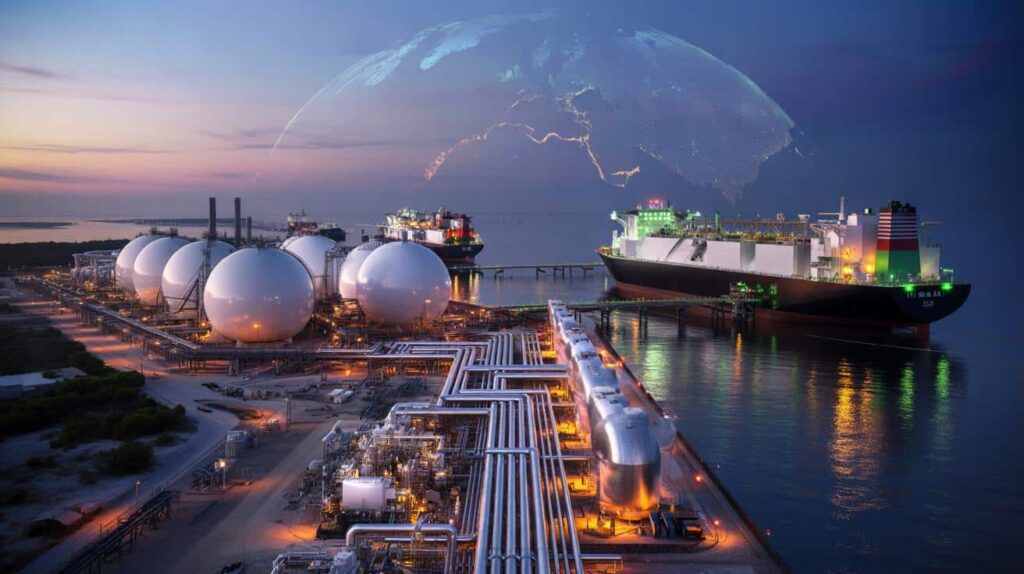
Across a maze of gleaming pipes and roaring compressors, the United States has pushed its liquefied natural gas exports to a level that reshapes both markets and geopolitics, forcing Europe and Asia to rethink how they heat homes and power factories.
A hundred million tonnes that change the balance
The US has become the first country ever to export more than 100 million tonnes of liquefied natural gas (LNG) in a single year.
Converted back into its gaseous form, that flow represents around 150 billion cubic metres of gas.

That is more than the entire annual gas consumption of Europe, estimated at roughly 100 billion cubic metres in pipeline-equivalent imports since the war in Ukraine began.

The US has gone from zero LNG exports to undisputed export champion in just nine years, compressing an energy revolution into less than a decade.
This is not some gentle shift in the background of the energy transition.
It looks more like an industrial sprint, driven by shale gas, aggressive investment, and a willingness to run plants at full throttle.
How the US built an LNG superpower at record speed
The physics of LNG are straightforward, the engineering far less so.
Gas is cooled to around -162°C, shrunk to about 1/600th of its original volume, and loaded onto giant tankers for weeks-long voyages.
In practice, each step relies on vast liquefaction trains, heavy-duty compressors and tank farms the size of city blocks.
Over the past decade, US developers turned cheap shale gas into a global export machine.
A key commercial twist helped: most US cargoes are sold on a “free on board” (FOB) basis.
That means buyers take title at the terminal and organise their own shipping and regasification.
This model makes contracts more flexible, and allows traders to redirect ships quickly to whichever region offers the highest price.
That agility has pushed American terminals to exceptionally high utilisation rates.
Once a new plant starts, it rarely spends long in test mode.
Plaquemines, the project that changed the scale
No single facility illustrates this shift better than the Plaquemines LNG terminal in Louisiana, operated by Venture Global.
Its first cargo sailed only in December 2024.
By the end of 2025, it had already shipped 16.4 million tonnes of LNG, making it the second-largest export terminal in the United States.
The strategy is clear: build big from the start, then fill capacity as fast as the pipes can handle it.
Established players such as Cheniere Energy have followed a similar logic, squeezing more throughput out of their existing assets while bringing new liquefaction trains online.
From the Gulf Coast to global ports, US LNG has become less an experiment and more the backbone of short-term gas security for dozens of countries.
Europe leans hard on American gas
Nowhere is the impact more visible than in Europe.
Since 2022, the continent has slashed pipeline imports from Russia and turned LNG into a central pillar of its energy strategy.
In December 2025 alone, about 9 million tonnes of US LNG crossed the Atlantic to European terminals.
The timing was not accidental.
Winter in the northern hemisphere pushes up heating demand, and governments remain wary of any repeat of the 2022 price shock.
Several European countries now rely on LNG for a large share of their gas supply:
| Country | LNG imports (Mt/year) | Gas equivalent (bcm/year) | Share of gas supplied by LNG |
|---|---|---|---|
| France | ~26 | ~36 | ~45% |
| Spain | ~23 | ~32 | ~60% |
| Italy | ~11 | ~15 | ~30% |
| Netherlands | ~13 | ~18 | ~40% |
| Belgium | ~11 | ~15 | ~50% |
| United Kingdom | ~18 | ~25 | ~35% |
| Portugal | ~7 | ~10 | ~85% |
| Poland | ~6 | ~8 | ~40% |
| Greece | ~5 | ~7 | ~45% |
Some states also act as hubs rather than just end users.
Turkey, for instance, bought around 1.45 million tonnes of US LNG in a single recent month, while simultaneously keeping Russian gas flowing towards parts of Europe.
This kind of juggling shows how gas trade has become a series of overlapping networks, rather than fixed east–west pipelines.
Asia watches prices, weather and Europe
On the other side of the globe, Asian buyers have not disappeared, but their appetite has fluctuated.
In December, LNG shipments from the US to Asian ports dipped to about 1.23 million tonnes, from 1.75 million the previous month.

Several factors shape that kind of swing:
- milder or harsher winters affecting heating demand
- spot gas prices in Europe compared with Asia
- competition from coal and renewables in local power systems
- currency movements that change import costs in domestic terms
When European prices spike, cargoes can be rerouted mid-voyage, and Asia has to pay more or look elsewhere.
Volume, reliability and the next wave of projects
The US export boom also rests on a promise: that shipments will keep coming, with minimal disruption.
That message has landed.
In less than ten years, American suppliers have built a reputation for large volumes, steady deliveries and relatively flexible contracts.
This track record now underpins the next set of mega-projects.
Plaquemines is expected to reach full capacity in 2026, adding more cargoes into an already busy schedule.
Cheniere is ramping up modular expansions at existing sites, increasing output without having to start entirely new complexes from scratch.
Then comes Golden Pass LNG in Texas, a joint venture between QatarEnergy and ExxonMobil.
Its first liquefaction train is planned to start up in the first quarter of 2026.
Forecasts point to roughly 20 million extra tonnes of US LNG export capacity per year in the short term, comparable to several major European terminals combined.
If those projects deliver on time, the US will tighten its grip on a quarter or more of global LNG trade.
When LNG reshapes gas geopolitics
With roughly one in four LNG cargoes leaving US shores, Washington now sits at the centre of gas diplomacy.
Every contract extension, every maintenance shutdown and every new train startup sends ripples through European and Asian energy strategies.
US LNG does not just offset lost Russian volumes.
It also competes head-on with producers such as Qatar and Australia, pushing them to adjust pricing formulas and contract lengths.
For importing countries, the rise of LNG brings both comfort and new headaches.
Flexibility and diversity of supply lower the risk of physical shortages.
At the same time, exposure to spot markets and shipping constraints can make prices far more volatile than long-term pipeline deals ever were.
Key terms readers keep hearing about LNG
Several technical terms now appear regularly in energy debates.
They often sound opaque, but the ideas are quite simple.
- LNG: natural gas cooled into liquid form to ease transport across oceans.
- FOB (free on board): the seller loads the cargo; the buyer takes responsibility once it is on the ship.
- Liquefaction train: an industrial unit that chills and compresses gas into LNG, much like a giant refrigeration line.
- bcm: billion cubic metres, a standard unit to compare gas volumes in their gaseous state.
Understanding these concepts helps explain why the same molecule of gas can fetch very different prices depending on where it is and who has booked the ship.
Scenarios, risks and what could shift the trend
A few scenarios will shape whether this symbolic US export milestone becomes a plateau or just another step upward.
One path sees continued strong demand from Europe, as nuclear retirements and slow renewables deployment keep gas-fired power plants busy for longer than climate goals suggest.
In that case, LNG terminals around the North Sea and the Mediterranean would keep pulling in US cargoes well into the 2030s.
Another path assumes faster energy-saving measures and a bigger swing to solar, wind and storage.
Under that outlook, European gas demand could decline more sharply, forcing US producers to fight harder for market share in Asia and emerging economies.
Several risks hang over all of this:
- shipping bottlenecks or canal restrictions slowing tanker routes
- domestic US debates on methane emissions and climate policy affecting new permits
- accidents or extended outages at major terminals tightening supply overnight
- geopolitical tensions that interrupt key shipping lanes
Each of those shocks could change LNG flows as dramatically as the pivot away from Russian pipeline gas did in 2022.
For now, though, the picture is clear.
A symbolic threshold has fallen, and with more US liquefaction projects about to start up, that counter on the American waterfront may not slow down any time soon.