
The message arrived between two coffee sips, right when the day still felt ordinary. A short alert from a weather bulletin, buried in the flood of notifications: “Unusual Arctic pattern detected. High probability of disruption.” At first glance, it sounded like another technical update only meteorologists would care about.
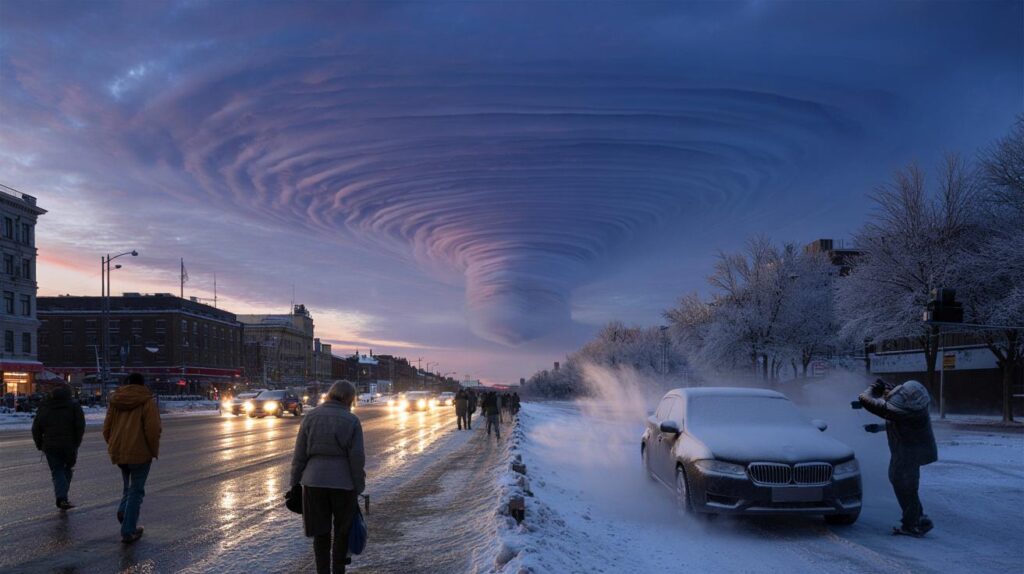
Then you read the next line: “Early February could open with an Arctic collapse.”
Outside, traffic hummed, kids walked to school without hats, and the air felt strangely mild for the season. No hint of chaos. No drama in the sky. Just that nagging sense that something way above our heads was quietly rearranging the rules.

Somewhere over the North Pole, the atmosphere was twisting into a shape we don’t see very often.

And that’s when forecasts start to feel uncomfortably real.
When the Arctic ceiling starts to buckle
Picture the top of our planet as a giant spinning dome of cold air, locked in place by powerful winds. That dome is what meteorologists call the polar vortex, and most winters it behaves like a grumpy but predictable neighbor. It circles the Arctic, holds its cold, and lets the rest of us get on with our lives.
This winter, that neighbor is getting pushed, stretched, almost snapped. High above 30 kilometers in the stratosphere, temperatures have been rising at breakneck speed. Winds that should be howling west to east are slowing down, wobbling, even threatening to reverse. When that happens, the Arctic “ceiling” doesn’t just crack quietly. Pieces of that cold can spill south with a vengeance.
We saw a version of this movie in February 2021. Back then, a major disruption of the polar vortex helped unleash the brutal freeze that paralyzed Texas, burst pipes in uninsulated homes, and left millions without power. Streets in Houston turned into surreal ice rinks, while residents lined up for bottled water as if bracing for a hurricane, not a cold snap.
This time, early data from European and American weather models show another extreme anomaly building in the upper atmosphere. The stratospheric warming event now brewing could be strong enough to weaken or split the vortex yet again. Meteorologists are watching pressure maps like hawks, tracking the telltale signs that Arctic cold may be loading the spring for a February plunge.
The logic behind it is simple, but unsettling. When the vortex weakens, its tight ring of winds becomes ragged. Cold air that normally stays trapped over the pole can droop southward in long, icy tentacles. That’s when cities far from the Arctic circle wake up to snowdrifts, black ice, and temperatures that make car batteries surrender.
➡️ Amazon : A 7.5-metre giant anaconda never seen before is found during a Will Smith documentary shoot
➡️ France ships 500-tonne nuclear ‘colossus’ to power the UK’s new generation III reactor at Hinkley Point C
➡️ New psychology research divides experts as people who clean while they cook are accused of being judgmental and emotionally rigid
➡️ Meteorologists warn early February could mark the beginning of an Arctic destabilization event
➡️ Does closing vents in rooms you don’t use keep your house warmer? What HVAC pros say
➡️ Short hair: this short haircut is the “worst” after 50 according to a hairstylist, the one that makes your look the most “granny”
➡️ “Extremely flattering”: forget short cuts, this rejuvenating hairstyle is ideal after 50 according to a hairstylist
 No vinegar and no baking soda needed: pour half a glass and the drain cleans itself effortlessly
➡️ Neither vinegar nor soap: the surprisingly simple trick that removes limescale from an electric kettle effortlessly
What’s fueling this chaos is a tangled mix of factors: unusual warmth over Siberia, stubborn high-pressure “blocks” over Greenland, and a background climate that’s overall warmer yet somehow capable of sharper extremes. Meteorologists don’t use the term “Arctic collapse” lightly. It’s shorthand for a moment when the usual balance breaks, and winter stops playing by the rules we grew up with.
How to live with a sky that changes its mind
The first reflex when you hear “Arctic collapse” is to imagine something cinematic: ice storms, frozen cities, apocalyptic drone shots. Reality is often quieter, more insidious. The biggest difference is timing. The cold can arrive late, fast, and in waves. One day you’re planning a Sunday walk in a light jacket, the next you’re digging out the car before work.
One method used by people who really follow the weather is simple: watch the 6–15 day forecast like you’d watch the stock market during a shaky week. Not every cold spell is historic, but when multiple models start hinting at the same pattern shift, that’s your signal. That’s when you put the extra blanket on the bed, test the space heater, and move the houseplants away from drafty windows.
We’ve all been there, that moment when a cold snap hits and you realize the only gloves you own are mismatched and buried in a box from three apartments ago. You tell yourself you’ll be more prepared next year, and then life happens.
Let’s be honest: nobody really does this every single day.
Yet meteorologists say that with these extreme atmospheric anomalies becoming more common, “winging it” is getting riskier. The small stuff counts: charging power banks before a possible ice storm, keeping some shelf-stable food, knowing where the manual window scraper is instead of hunting for an old loyalty card to clear the windshield. It’s not panic behavior, it’s just respecting a winter that’s more erratic than before.
Some forecasters have started using less technical language when they go on TV or social media, precisely because the stakes feel closer to home now. They talk about “weather whiplash,” “fake spring,” and “flash freezes” rather than only showing jet stream charts.
“People don’t need to memorize the term ‘sudden stratospheric warming,” a senior European meteorologist told me. “They need to sense when the season is about to flip on them, and have a plan for the next ten days, not just tomorrow morning.”
- Track one trusted forecast source daily during volatile periods.
- Prepare a “cold kit”: gloves, hat, flashlight, batteries, basic meds.
- Think in layers, for your clothing and your home’s insulation.
- Protect vulnerable pipes and pets first; they fail fastest.
- Talk with neighbors, especially the older ones, before the freeze hits.
Living with a future where February is a wild card
The strangest part of these Arctic disturbances is how personal they end up feeling. A pattern shift that starts in the stratosphere, far beyond the reach of any of us, can decide whether a small business loses stock in a power cut, whether a delivery driver spends the night in a truck cab, whether a parent keeps their kid home from school because the sidewalks turned into glass.
*Climate scientists warn that a warmer world doesn’t mean a softer winter, it means a less predictable one.* Mild Decembers can be followed by brutal Februarys. Snow can fall on cities that haven’t budgeted for plows. Pipes can freeze in homes designed for “cool” winters, not deep cold. The line between normal and extreme shifts under our feet, not in a straight line but in jolts.
This coming February, the story isn’t written yet. The Arctic collapse that models are hinting at could miss your region, or it could be the reason you’ll remember this winter by the way your breath hung in the air at noon. The best we seem to have right now is a mix of science, habit, and quiet respect for the atmosphere moving above us.
Readers who grew up with steady seasons often say they feel disoriented, as if the calendar no longer means what it used to. Meteorologists feel a different kind of unease: their maps still work, their physics still hold, but the patterns they once called “rare” now show up on screen a little too often.
There’s room here for a new reflex. Not fear, not denial, but curiosity. Ask what your local forecast is really saying between the lines. Share that knowledge with someone who doesn’t follow the weather as closely. The sky is changing its mind more frequently. The way we live under it will have to adjust, one cold front at a time.

| Key point | Detail | Value for the reader |
|---|---|---|
| Arctic collapse risk in early February | Extreme upper‑atmosphere anomalies may weaken or split the polar vortex, sending cold south | Helps anticipate sudden cold waves after a mild start to winter |
| Weather whiplash and late‑season freezes | Rapid switches from mild to severe cold become more likely in a warming climate | Encourages flexible planning for travel, work, and home heating |
| Practical preparation over panic | Simple steps: tracking 6–15 day forecasts, building a basic “cold kit”, protecting pipes and vulnerable people | Reduces stress and damage when extreme cold events do strike |
FAQ:
- What exactly is an “Arctic collapse”?
It’s an informal way of describing a major disruption of the polar vortex, when cold air usually locked over the Arctic spills south into mid‑latitude regions, often after a sudden warming high in the stratosphere.- Does an Arctic collapse mean it will be cold everywhere?
No. While some regions can experience intense cold, others may stay mild or even warmer than average, depending on how the jet stream bends and where the displaced cold air settles.- Can meteorologists predict these events far in advance?
They can often spot the atmospheric anomalies 1–3 weeks ahead, especially in the stratosphere. The exact timing and location of surface impacts are harder to nail down until closer to the event.- Is climate change making Arctic collapses more frequent?
Research is ongoing, but many studies suggest that a warming Arctic and shifting sea‑ice patterns can destabilize winter circulation, increasing the odds of unusual cold outbreaks and “weather whiplash.”- What should I do differently if a February Arctic blast is forecast?
Follow a reliable local forecast, prepare your home against freezing (pipes, windows, heating), stock a few days of essentials, check on vulnerable neighbors, and adjust travel or outdoor plans to avoid the most dangerous hours of cold and ice.
