
At the dermatologist’s office, the waiting room looked like a mini beauty museum. Serums worth half a rent payment, glass bottles with names you can barely pronounce… and right in the middle of a patient’s tote bag, that small, blue tin plenty of us grew up with: Nivea cream.
The doctor picked it up with a smile. “This one again,” she laughed quietly, weighing it in her hand like an old friend that keeps coming back.
On social media, Nivea is either worshipped like a miracle or dragged as “old-fashioned grease.”
So a group of experts decided to look at it very closely, beyond nostalgia and marketing.
What they found doesn’t quite match the myths.

What experts really see when they look at Nivea cream
The first thing cosmetic chemists say when they open a Nivea tin isn’t “wow” or “ugh”.
It’s “classic formulation.” Thick, white, faintly floral, the texture is almost stubborn. You have to work it between your fingers, warm it up, convince it to sink into the skin.

For many dermatologists, that’s already a clue. A cream that heavy is usually designed as a shield, not a feather-light city moisturizer.
Nivea’s original cream was born in 1911, long before K-beauty routines and 10-step nights. It was built like a winter coat: a mix of water and oils held together so it doesn’t fall apart, then sealed with an occlusive film.
Not fancy. But surprisingly, still relevant.
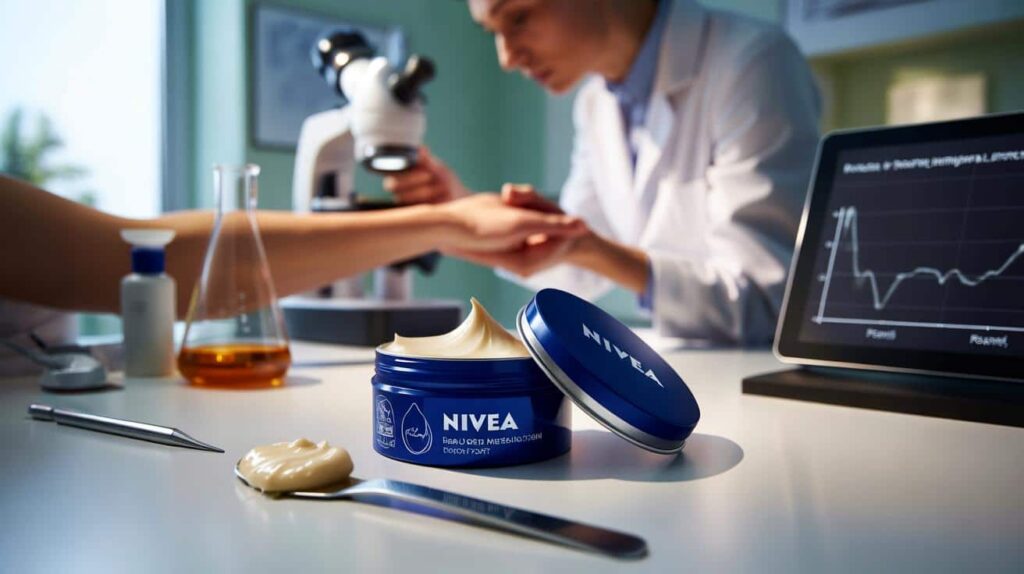
When researchers at a European lab compared famous moisturizers, they slipped Nivea cream into the lineup almost as a joke.
They tracked hydration levels on volunteers’ forearms over several hours, measuring how well the skin kept water in after application.
To their surprise, the little blue tin held its ground against far more expensive formulas.
It didn’t win in elegance — some users reported it felt “heavy” or “greasy” — yet the hydration curve looked solid. The skin stayed moisturized longer than with several trendy gels that vanished in minutes.
One chemist admitted off the record: “If you look only at barrier protection, Nivea behaves like a stubborn old truck. Not glamorous, but it gets the job done.”
Experts mostly agree on why. Nivea cream relies on a thick blend of mineral oil, waxes, and emulsifiers that form a film on top of the skin.
That film slows down water loss, which is exactly what dry, cracked or wind-beaten skin needs. It’s less about “feeding” the skin with magical ingredients, more about not letting your own moisture evaporate.
This is where expectations collide. People want a single cream that brightens, lifts, clears spots, fades wrinkles, and makes coffee.
Nivea doesn’t promise that. The formula is simple, almost brutally so.
*From a chemist’s perspective, that’s both its limit and its strength.*
How to use Nivea cream so it actually works for you
Dermatologists who still recommend Nivea almost never say, “Just slap it all over your face morning and night.”
They see it more like a tool you pull out at the right moment.

One London-based skin specialist suggests the “spot treatment” approach.
Use your usual light moisturizer on the whole face, then dab a pea-sized amount of Nivea on dry patches: sides of the nose, cracked corners of the mouth, flaky cheeks in winter.
On the body, they love it as an overnight mask on feet, hands, elbows, and shins. Shower, gently pat dry, apply a generous layer, put on cotton socks or gloves, and sleep in it.
The next morning, the skin often looks like it belongs to someone who drinks 2 liters of water a day.
We’ve all been there, that moment when your reflection shows dull, tight skin and you panic-buy the fanciest cream on the shelf.
That’s usually when people misuse Nivea too.
They spread a thick coat on sweaty skin in August and then complain of clogged pores. Or they rub it into acne-prone cheeks daily and blame the cream for every new breakout.
Dermatologists repeat the same thing: this formula is **not** designed for oily, congested, or very sensitive acneic skin.
It shines on dry, mature, or weather-damaged areas, and on parts of the body that take a beating — hands that wash dishes all day, legs tortured by shaving and hot showers.
Let’s be honest: nobody really follows the “thin layer” rule every single day, but with Nivea, going light is the difference between glow and grease.
One cosmetic chemist I spoke to summed it up with unusual tenderness:
“People expect magic from skincare, but sometimes all the skin really needs is protection from the cold air, hot water, and our own bad habits. Nivea is one of those products that quietly does that, if you use it where it belongs.”
She shared a simple checklist she gives to her patients when they ask about the iconic blue tin:
- Use it on dry or very dry zones, not on shiny or acneic areas.
- Apply it on slightly damp skin to boost comfort and slip.
- Reserve it for night or cold weather if your skin is combination.
- Think “patches and problem spots”, not full-face marathon every day.
- On kids, keep it for chapped cheeks, knees, and elbows — and stop if redness appears.
The surprisingly emotional life of a little blue tin
When experts talk about Nivea cream, they rarely stay strictly technical for long.
Stories creep in. A grandmother who swore by it for 60 years. A nurse whose hands survived endless handwashing thanks to a tin in her locker. A teenager who used it as a makeshift highlighter on prom night.
There’s a reason a product this simple still fills shelves in 2026.
It’s not just the formula, it’s the role it plays: affordable, easy to find, slightly old-school comfort in a world of complicated routines. Many dermatologists quietly respect that. They wouldn’t use Nivea for everything, and they’re clear about its limits and potential for irritation on some skins.
Yet they also admit: as a basic barrier cream, it’s tougher than its price tag suggests.

| Key point | Detail | Value for the reader |
|---|---|---|
| Understand what Nivea cream actually does | Acts mainly as a barrier to reduce water loss, not as a miracle anti-ageing serum | Helps you set realistic expectations and avoid disappointment or misuse |
| Use it strategically, not blindly | Best for dry patches, hands, feet, and cold-weather protection, less ideal for oily or acne-prone faces | Lets you benefit from its strengths while limiting breakouts and greasy feel |
| Combine it with your existing routine | Layer over lighter hydrators or serums and keep it for targeted zones | Upgrades your routine without needing expensive extra products |
FAQ:
- Is Nivea cream safe to use on the face every day?For dry or normal skin, an occasional thin layer at night is usually fine, especially in winter. For oily, combination, or acne-prone faces, daily use can feel too heavy and may worsen congestion, so keep it for small dry areas only.
- Can Nivea cream cause acne or clogged pores?On some people, yes. Its occlusive, rich texture can trap sweat and sebum, which is a problem on acne-prone zones. Use it mainly on body parts or very dry, non-acneic areas of the face, like the cheeks in cold weather.
- Is Nivea cream good for wrinkles or anti-ageing?It doesn’t contain classic anti-ageing actives like retinol or peptides. What it can do is soften fine lines temporarily by hydrating and reducing water loss, which makes the skin look smoother, but it won’t “erase” wrinkles.
- Can I mix Nivea cream with serums or active ingredients?Experts prefer layering instead of mixing. Apply water-based serums first, let them absorb, then add a very thin layer of Nivea on top to seal in moisture, especially at night or in cold weather.
- Is Nivea cream suitable for children’s skin?On healthy, non-irritated skin, some pediatricians accept it as a barrier cream for chapped areas, like cheeks in winter. If a child has eczema, redness, or sensitive skin, always check with a doctor before using any fragranced cream.
