
The team’s first warning was not scales or a coiled body, but the unnatural sway of the grass. As dawn fog thinned over a flooded plain in northern Mozambique, reeds bent and rose in a slow, weighted rhythm, as though something massive was shifting beneath the surface. One herpetologist lifted a hand. Everyone stopped. Even the insect noise suddenly felt too loud for the moment.
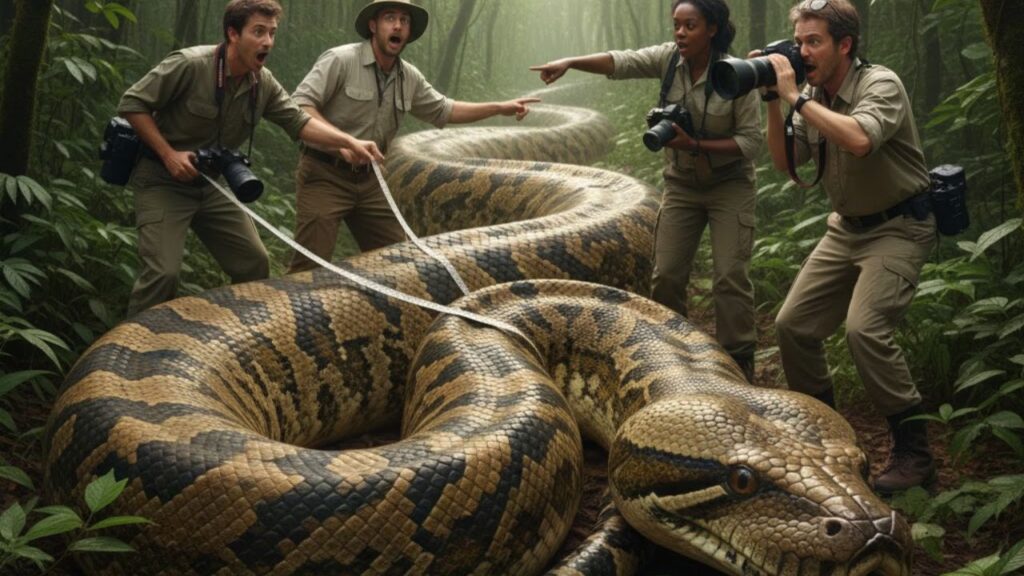
When the python’s head finally surfaced—wide, shovel-shaped, and slick with moisture—the researcher filming could only murmur, “No way.” The group had come prepared to find large snakes. What emerged from the reeds went far beyond their expectations.
An African giant that forces scientists to rethink size limits
The animal confirmed during this certified field expedition was extraordinary by any serious measure. An African rock python lay coiled beside a seasonal pool, its length so extreme that the team had to reposition their measuring tape twice. Sunlight revealed dark brown and olive markings across its back, a natural camouflage shaped to blend into mud, leaves, and shallow water.

The real shock was not only how long it was, but how thick. Its body matched the width of a man’s thigh, narrowing gradually into a tail that seemed endless. One researcher later admitted that even veteran snake specialists went silent when the scale of the animal truly registered.

Why this single snake matters scientifically
On record, African rock pythons (Python sebae) already rank among the world’s largest snakes, with verified lengths beyond six meters. This individual, however, presses against the very top of that range. To avoid exaggeration, the team followed strict protocols: multiple observers, duplicate tools, and detailed field notes designed to eliminate guesswork.
Images with scale markers, GPS data, and body measurements were reviewed by independent herpetologists in three different countries. What might have become a fleeting viral story instead turned into a reliable scientific data point, now discussed with equal parts excitement and caution within research circles.
How scientists officially verify a giant python
The researchers were not casual observers. They were conducting a structured herpetological survey under permit, with clear procedures for documenting unusual finds. That meant patience over spectacle: no rushed photos, no risky handling, and no assumptions shouted in the heat of the moment.
The first priority was safety—for both people and snake. Large pythons can deliver serious bites if stressed, and stress itself can harm the animal. The team moved slowly, watched breathing patterns and posture, and waited until the python settled before approaching with measuring equipment.
- Why child development experts avoid time-outs and what works better
- A magnetic force powerful enough to lift an aircraft carrier: future energy myths and facts
- Driving age limits settled: what truly matters according to the highway code
- This doctor highlights a canned fish packed with benefits you didn’t expect
- If you still do these nine things between 65 and 80, you’re truly rare
- The ideal age gap for long-lasting relationships
- Why aluminium foil is appearing on windows and what engineers really say
- Why Switzerland invests more in mountain tunnels than housing
Once conditions were stable, the team measured the snake segment by segment, photographing each section with reference markers. Forcing a massive snake to straighten is dangerous and unethical, so they used gentle guidance, allowing its natural movements to align parts of the body for accurate estimates.
Excitement can tempt anyone to rush. Here, training prevailed. The result was clean data, clear photographs, and measurements that colleagues back home could confidently assess.
From field notes to peer review
After the encounter, the work shifted from wetland to workstation. Expedition metadata—location, timing, climate conditions, girth, and head width—was uploaded to shared databases. Independent experts examined the images, checking for perspective tricks or distortions.
As one validator explained, skepticism is now standard. Claims of record-breaking animals rarely earn trust at first glance. Only after repeated checks did researchers feel comfortable describing the python as “exceptionally large” without hesitation.

The approach used here is becoming a template for handling extraordinary wildlife reports. Whether researcher, guide, or serious eco-tourist, the principle is simple: slow down, document carefully, and leave ego aside. That’s often the difference between a campfire tale and a citable record.
Sharing space with a predator of this scale
For nearby communities, a six-meter snake is not an abstract concept. It can take livestock, frighten families, and pose risks near rivers or fields at dusk. Coexistence becomes a set of daily, practical decisions: where to walk, how to pen animals, and what children learn to notice in the grass.
The expedition team spent time listening to villagers’ accounts. Some stories stretched the truth, others rang with hard-earned accuracy, all centered on “the big one” that occasionally emptied a livestock pen overnight.
Conservation advice often sounds tidy on paper. Reality is rougher. Power is unreliable, distances are long, and wildlife officers may be hours away. The researchers acknowledged this honestly, stressing risk reduction rather than false reassurance.
Small practices that lower risk
- Clear tall grass along narrow paths between homes and water sources.
- Use raised or fenced pens for small livestock at night.
- Teach children to retreat slowly and alert adults if they see tracks or shed skins.
- Report repeated sightings near homes to local authorities or conservation groups.
- Avoid provoking or handling large snakes for photos or videos.
These steps are modest, not magical. They don’t erase danger, but they make room for a creature that doesn’t fit neatly into modern life.
What one giant python suggests about the future
This snake alone will not reshape the world. It will return to its wetland, hunting quietly and vanishing for weeks beneath roots and mud. Still, its confirmation is already influencing grant proposals, species profiles, and late-night debates about what “maximum size” really means.
For such an animal to exist, there must still be space, prey, and time. That hints at pockets of Africa where ecosystems remain functional enough to raise giants slowly. It’s a fragile kind of hope, coiled in muscle and patience.
Stories like this split reactions. Some feel fear and avoidance. Others feel awe and curiosity. Both responses are human. A world without risk is also a world without giants, and without the wonder they inspire. Comfort and wildness rarely peak together.
The python is measured, logged, and filed in databases. Yet it also lingers in imagination—the weight of its body, the calm turn of its head, the ancient stillness in its eyes—reminding us that the planet can still surprise those willing to look closely.

Key takeaways
- Certified giant python: An exceptionally large African rock python confirmed through strict scientific protocols, proving the claim is credible.
- Verification process: Careful segmented measurements, scale-referenced photos, and independent expert review ensured accuracy.
- Human–wildlife coexistence: Practical insights into daily life alongside massive predators where giants still survive.
