
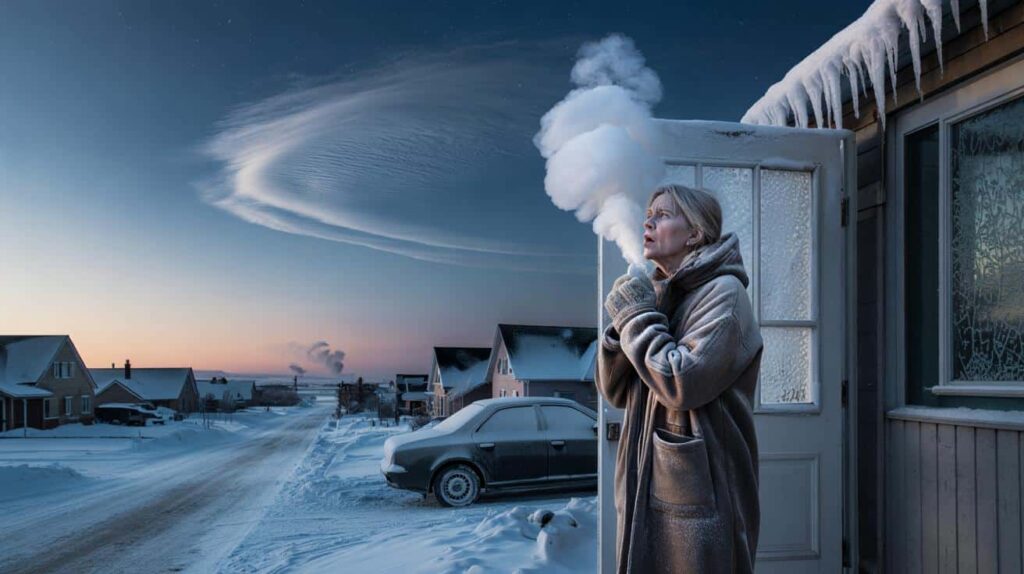
The first hint was the silence. No birdsong, no distant drip of melting snow, just a hard, metallic cold settling over a sleepy suburb as dawn crept in. A woman in Ohio opened her front door in early February, expecting the usual winter bite, and instead stepped into air that felt ripped from the Arctic itself. Her breath froze in a dense cloud as the wind sliced across her cheeks, sharp enough to hurt.
Inside, the weather app on her phone flashed an angry violet blob, plunging across North America from a fractured polar vortex. The words “historic anomaly” blinked at the bottom of the screen.
She stood there for a moment, half-awake, realizing this didn’t feel like the winters she grew up with.

Meteorologists say that’s not a coincidence.
 He’s the world’s richest king : 17,000 homes, 38 private jets, 300 cars and 52 luxury yachts
Early February’s strange cold: a warning shot from the Arctic
Across weather centers from Washington to Berlin, forecasters are circling the same dates on their maps: the first and second weeks of February. Models keep converging on the same, unnerving pattern – a potential Arctic breakdown unlike anything seen in modern climate records.
Instead of the polar cold staying neatly “locked” around the North Pole, it starts to unravel, sending jagged tongues of deep-freeze air crashing much farther south than usual. The result on the ground is brutally simple. One city wakes up 15°C below its seasonal norm, another is shivering under freezing rain where it should be seeing mild drizzle.
From a distance, the satellite images look almost artistic. Up close, it’s roofs caving under snow and pipes bursting in people’s kitchens.
In 2021, Texas got a taste of this kind of chaos when a disrupted polar vortex sent Arctic air barreling into a state more used to air conditioning than ice storms. Power grids failed. Water treatment plants froze. People burned furniture in their fireplaces just to stay warm.
What forecasters are watching now isn’t a repeat of that specific event. It’s the scale. Several research groups tracking the stratosphere – the high layer of air where the polar vortex spins – are flagging rare signals of a “sudden stratospheric warming” that could twist the jet stream out of shape for weeks.
When that happens, Arctic air doesn’t just pay a short visit. It can linger, stall, and return in waves. That’s where the word “breakdown” starts appearing in quietly worried internal memos.
Climate scientists are blunt about one thing: the background rules of winter are changing. The Arctic is warming roughly four times faster than the rest of the planet, chewing away at the temperature contrast that once kept the polar vortex neatly stacked over the pole.
Think of it like a spinning top on a table. When the top has lots of energy, it stays upright and stable. As it loses energy and the surface beneath it becomes uneven, it starts to wobble and lurch sideways. Our atmosphere is doing a version of that wobble.
The paradox is unsettling. A warmer planet can still deliver brutal cold snaps, but with a more erratic, less predictable rhythm. That’s exactly what early February might be about to showcase, live, over millions of homes.

How to live through an Arctic breakdown without losing your mind
The first practical step has nothing to do with panic and everything to do with preparation. Before the cold hits, people who’ve been through this kind of deep freeze swear by a simple ritual: walk through your home as if the power just went out.
What would you reach for in the first five minutes? Where are the flashlights, the extra blankets, the portable battery for your phone? Do you have a way to boil water without electricity?
Running that mental drill for ten quiet minutes on a Sunday afternoon might feel over the top. Then the grid flickers off on a Tuesday night, and that little exercise suddenly feels like the smartest thing you did all winter.
A lot of us rely on the forecast like a promise instead of a probability. We see “-3°C and cloudy” and plan our week as if the numbers can’t budge. When a polar outbreak shifts by 300 kilometers overnight, those neat icons on the app start to look a lot less solid.
This is where meteorologists quietly urge people to look beyond the main temperature line. The words “pattern change”, “blocking high”, or “polar air mass” in a local forecast discussion are early flags that something bigger is coming.
Let’s be honest: nobody really scrolls through the technical forecast discussion every single day. Yet when cold like this is on the table, spending two extra minutes reading the “boring” part can be the difference between a mild inconvenience and a serious emergency.
“From a climate perspective, what we’re seeing in early February is a boundary event,” says a European climate researcher who has been tracking Arctic data for 20 years. “The models are struggling because the atmosphere itself is entering territory they haven’t been trained on. That’s what makes this so unsettling – we’re watching the rulebook rewrite itself in real time.”
- Stock layers, not just coats
Thin base layers, wool socks, and hats often matter more than one massive jacket when the real Arctic air arrives. - Think about water before it freezes
Dripping taps, insulating pipes, or filling a few extra containers can save a lot of misery if infrastructure fails. - Back up your heat, even a little
A small gas stove, a safe indoor heater, or simply one room you can seal and warm with bodies and blankets can be a lifeline. - Stay alert to language shifts in forecasts
When your local meteorologist starts using phrases like “high-impact cold” or “prolonged event”, that’s your cue to nudge your plans. - Check on people quietly at risk
Elderly neighbors, friends in poorly insulated rentals, people living alone – a quick message or knock can mean they don’t face the Arctic breakdown in silence.
The bigger question behind the cold: what kind of winters are we heading into?
Once the storm passes and the snowbanks shrink into dirty piles by the roadside, life will go on. Kids will go back to school, commute times will settle, and radiators will stop clanking through the night. Yet something about a winter like this tends to lodge in memory.
We trade stories: “Do you remember that February when the pipes froze across half the city?” “That week when the sea smoked with cold and the harbor turned to slush?” These aren’t just anecdotes, they’re the first drafts of how societies remember a changing climate.
*Somewhere between the charts and the chaos, we start to sense that our shared idea of ‘normal winter’ is slipping out of reach.* The Arctic breakdown meteorologists are warning about in early February is more than just a weather event. It’s a kind of quiet question: how do we adapt, emotionally and practically, to a world where the familiar seasons are learning new tricks?

| Key point | Detail | Value for the reader |
|---|---|---|
| Arctic breakdown signals | Sudden stratospheric warming, wobbling jet stream, and polar air surges tracked by global models | Helps you recognize when a “normal cold spell” may become a high-impact event |
| Real-life impacts | Power grid stress, frozen infrastructure, disrupted transport and everyday routines | Allows you to plan work, travel, and home prep around realistic worst-case scenarios |
| Personal resilience moves | Home walk-through, backup heat and water, reading deeper forecast notes, checking on others | Turns abstract climate news into concrete steps that protect you and your community |
FAQ:
- What exactly is an “Arctic breakdown” in weather terms?
It’s a loose phrase meteorologists use when the usual containment of Arctic air around the pole weakens, letting intense cold spill south in unusual patterns or for longer than typical. It often involves a disrupted polar vortex and a distorted jet stream.- Does an Arctic breakdown mean climate change is getting “better” because it’s colder?
No. A single cold outbreak doesn’t cancel long-term warming trends. Many scientists see these erratic extremes as a symptom of a warmer Arctic, not a sign that the planet is cooling.- Which regions are most at risk in early February?
Forecasts are still evolving, but mid-latitude regions in North America, Europe, and parts of Asia that usually sit under milder winter air masses are being watched closely, especially where infrastructure isn’t built for deep freeze.- How far ahead can meteorologists see an event like this coming?
Signals in the stratosphere can appear 1–3 weeks in advance, but translating those into exact locations and temperatures near the ground is tricky. Confidence usually climbs sharply within 5–7 days of the main cold surge.- What are the simplest preparations an ordinary household can take?
Have a few days of food that doesn’t need cooking, extra water, layered clothing, a backup light source, a way to stay warm in one room, and a habit of checking trusted local forecasts rather than social media rumors.
