If your dog gently places a paw on you, it may look like a playful trick, but animal behavior experts say it often means much more. In the United States, dog owners are increasingly curious about everyday canine gestures and what they truly signal. Paw-giving is one of those behaviors that feels friendly on the surface but usually carries emotional or instinctive meaning underneath. From seeking comfort to expressing stress, this small action can reveal a lot about your dog’s inner state, especially when it happens outside of obvious playtime or training moments.
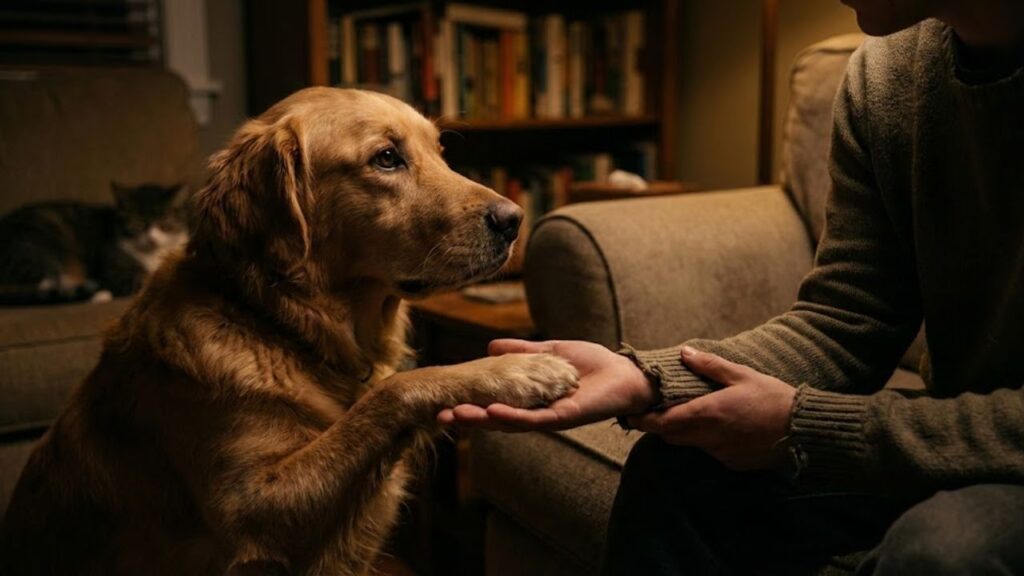
Dog giving paw behavior often signals emotional needs
When a dog offers its paw unexpectedly, it is often responding to an emotional urge rather than a learned trick. Many dogs use touch as a way to self-soothe or seek reassurance from humans they trust. This behavior commonly appears during moments of uncertainty or mild stress, acting as a calming mechanism. Experts link it to emotional reassurance, comfort seeking, and social bonding cues rather than playfulness. Some dogs also use the gesture to gently interrupt their owner’s attention, relying on physical contact signals instead of barking or whining. Over time, dogs learn that pawing brings a predictable, calming response.
Why dogs give their paw to communicate stress or control
Animal behaviorists note that pawing can be a subtle way dogs attempt to manage situations they find overwhelming. During loud noises, tense interactions, or unfamiliar environments, a dog may place a paw on its owner to regain a sense of control. This gesture reflects stress communication signs and conflict avoidance behavior rather than affection alone. It may also function as attention regulation, helping the dog redirect human focus away from perceived threats. In some cases, repeated pawing can indicate low-level anxiety markers, especially if paired with lip licking or yawning.
Dog paw gesture meaning linked to learned human responses
Over time, dogs associate certain actions with predictable outcomes, and paw-giving is no exception. If placing a paw consistently earns petting, treats, or soothing words, the behavior becomes reinforced. This doesn’t make it meaningless; instead, it reflects reinforced interaction habits shaped by daily routines. Dogs are highly observant and rely on human response patterns to decide what works. In many households, pawing becomes a polite alternative to jumping or barking, serving as behavior substitution and a form of learned communication behavior.
What experts say about interpreting paw-giving correctly
Understanding why a dog offers its paw requires looking at context, frequency, and body language together. Experts caution against assuming every paw is affectionate, emphasizing contextual behavior reading and whole-body signals. A relaxed dog with soft eyes sends a different message than one pawing during tension. Observing patterns helps owners respond appropriately, reinforcing calm behavior without encouraging anxiety-driven habits. Ultimately, paw-giving reflects the dog’s attempt to communicate within a human-centered world, using adaptive canine communication and human-dog interaction cues developed through daily life.
| Paw-Giving Context | Likely Meaning | Recommended Owner Response |
|---|---|---|
| During loud noises | Seeking reassurance | Stay calm and comforting |
| While owner is busy | Requesting attention | Acknowledge without reinforcing anxiety |
| Before stressful events | Stress communication | Reduce triggers if possible |
| After positive interaction | Learned behavior | Respond consistently |
Frequently Asked Questions (FAQs)
1. Is giving a paw always a sign of affection?
No, it often reflects emotional needs or learned communication rather than pure affection.
2. Should I stop my dog from giving its paw?
Not necessarily, but understanding the reason helps you respond appropriately.
3. Can pawing indicate anxiety?
Yes, frequent pawing combined with other signals may suggest mild stress.
4. Does training influence this behavior?
Yes, dogs often repeat pawing because past human reactions reinforced it.