At an astonishing depth of 2,670 meters below sea level, a record-breaking underwater find has drawn global attention and sparked fresh debate among historians. In India, military-led ocean exploration has uncovered structures that challenge long-held assumptions about ancient human activity beneath the sea. Using advanced submersible technology, the mission revealed evidence that appears far older and more complex than expected. While investigations are still ongoing, early observations suggest this discovery could reshape how archaeologists understand submerged civilizations and the role modern defense forces now play in scientific exploration.
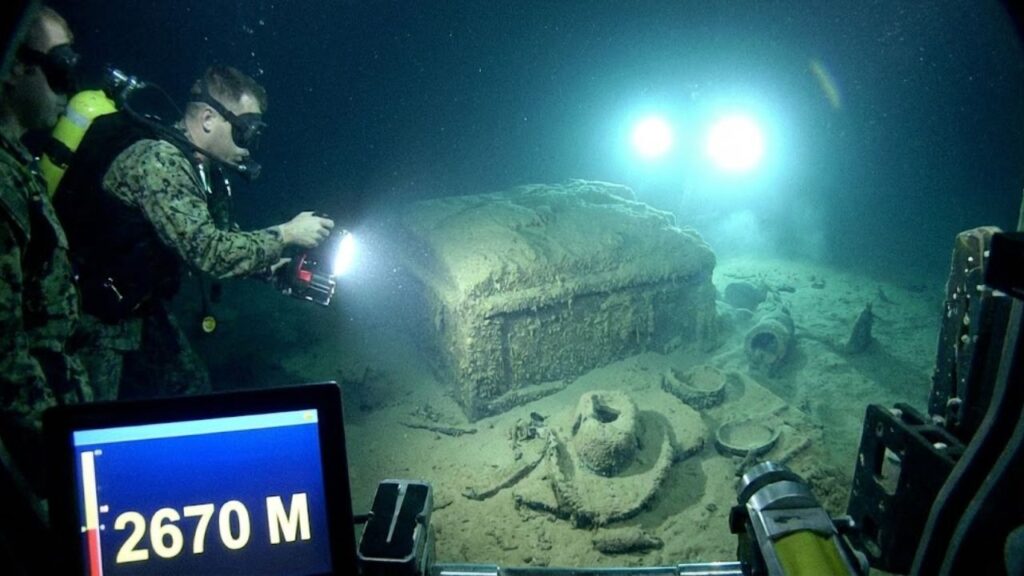
Record-breaking deep-sea discovery by the military
The discovery stands out not only for its depth but also for how it was found. Operating in extreme pressure zones, the military team relied on deep-sea mapping, high-resolution sonar, and robotic arms to document the site. Initial scans revealed stone-like formations arranged in patterns that do not appear natural. Experts point to precision geometry and erosion marks that suggest long-term submersion. What makes this more compelling is the unprecedented depth involved, far deeper than most known archaeological sites. The operation itself marks a technological milestone, proving that modern naval capabilities can open doors to parts of history previously thought unreachable.
How the underwater military find reshapes archaeology
Archaeologists are particularly intrigued by how this find may rewrite existing timelines. The structures suggest early human presence in regions now submerged, challenging coastal settlement theories. Researchers are examining whether these remains indicate lost maritime cultures that adapted to rising sea levels. The collaboration between scientists and defense experts has enabled data-rich surveys that traditional expeditions could not achieve. If verified, the site may become a historical turning point, forcing scholars to reconsider migration routes and technological capabilities of ancient societies that once thrived near today’s ocean floors.

Military archaeology missions at extreme ocean depths
This mission highlights a growing trend where armed forces contribute to scientific discovery. With access to specialized submersibles and classified navigation systems, military teams can reach hostile environments that are otherwise inaccessible. In this case, the discovery also raises questions about preservation, as fragile relics must be studied without disturbance. Authorities stress that the operation followed controlled research protocols to ensure accuracy. Beyond national interest, the find has global significance, encouraging international experts to collaborate on understanding what may be one of the deepest archaeological discoveries ever recorded.

What this discovery could mean for future research
As analysis continues, the discovery may influence both science and policy. Governments could invest more in oceanic research programs, recognizing the value of submerged heritage. The site also underscores the need for international cooperation when discoveries cross academic boundaries. For archaeology, it opens doors to new research models that blend defense technology with historical study. While conclusions will take time, the find already represents a paradigm shift, reminding the world that vast chapters of human history may still lie hidden beneath the oceans.
| Aspect | Details |
|---|---|
| Discovery Depth | 2,670 meters below sea level |
| Leading Authority | Military research unit |
| Primary Tools | Sonar and robotic submersibles |
| Archaeological Impact | Challenges existing timelines |
| Current Status | Under scientific analysis |
Frequently Asked Questions (FAQs)
1. Where was the discovery made?
The find was located on the ocean floor at a depth of 2,670 meters.
 A Pool Noodle Will Change Your Life in the Kitchen: Here’s Why It Will Revolutionize Everything
2. Who led the underwater mission?
The exploration was conducted by a military-led research team.
3. Why is this discovery important?
It may reshape archaeological understanding of ancient human activity.
4. Is further research planned?
Yes, detailed studies and international collaboration are expected.