
The realization surfaced in the most ordinary place: a supermarket aisle, wedged between plastic-wrapped lettuce and discounted carrots. A young father was urging his toddler to choose any vegetable at all, while the child enthusiastically pointed at the broccoli. Laughing, the dad replied, “Not that one — that’s not the same as cauliflower.” An older woman nearby leaned in, half amused and half instructional, and said, “You know they’re basically the same plant, right?” He paused mid-motion, hand on the cart, staring at the broccoli. The idea sounded impossible. And yet, once you hear it, it’s almost impossible to forget.
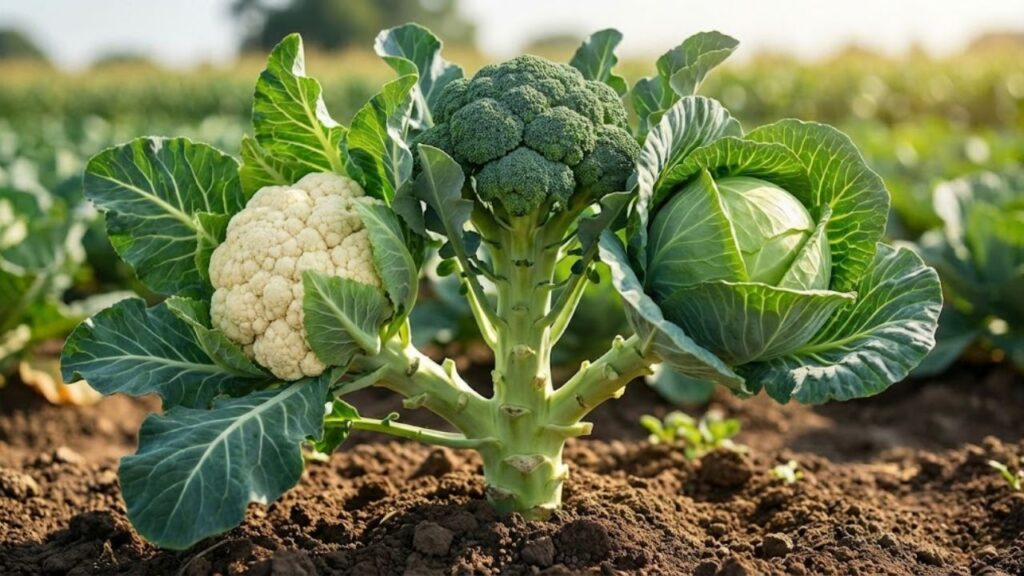
One plant showing up as many familiar vegetables
Most people grow up assuming cauliflower, broccoli, and cabbage are only loosely related. They look different, taste different, and inspire wildly different reactions at the dinner table. Broccoli is praised as the healthy option, cauliflower is seen as mild and pale, and cabbage often carries memories of overcooked school lunches.
Then a botanist casually explains they’re all variations of one species: Brassica oleracea. It can feel like discovering that three classmates with nothing in common are actually triplets.

Chefs like to tell a story about first-day culinary students. A teacher lays out green cabbage, red cabbage, curly kale, knobbly kohlrabi, tight white cauliflower, and familiar broccoli. “Name the species,” the instructor says. Students guess again and again. Finally, the teacher writes a single name on the board: Brassica oleracea. The room falls quiet as people realize how deceptive everyday vegetables can be.

Botanically, all of these come from one wild coastal plant shaped over thousands of years. Without labs or gene editing, humans simply saved seeds from plants with larger leaves, thicker stems, or tighter buds. Over generations, those tiny choices created distinct forms: cabbage for dense leaves, broccoli for flowering heads, cauliflower for its compact white curd. We see many vegetables; nature sees one plant, guided in different directions.
What this hidden connection means for everyday cooking
Once you understand that these vegetables are variations on a single theme, cooking becomes less complicated. When a recipe calls for one, you can often substitute another from the same family. Roasted cabbage wedges can become cauliflower steaks. Broccoli stems can stand in for coleslaw cabbage.
They react in similar ways to heat, salt, and fat. That shared structure means roasting, stir-frying, steaming, or grilling works across all of them, with only small timing adjustments.
- According to psychology, people who grew up in the 60s and 70s developed 9 mental strengths that are now rare
- Psychology says people who clean as they cook are secretly judging you: 8 traits that divide opinion
- How science shows sweet potatoes and regular potatoes are barely related, and why that divides opinion
- Windows: the clever Scandinavian method to block icy air
- 7 phrases people over 65 use that sound out of touch to younger generations
- A basic household product poured down drains restored perfect flow, stunning repair workers
- This baked pasta looks simple, but the flavors run surprisingly deep
- Psychology suggests people who reverse into parking spots often share eight traits tied to long-term success
We’ve all faced that familiar evening moment: opening the fridge at 7 p.m., exhausted, hoping dinner appears on its own. Inside sits half a cabbage, a slightly yellowing broccoli, and a lone cauliflower pushed to the back. It feels like three separate problems, so the door closes and takeout wins.
From a plant’s perspective, though, it’s one single toolkit. Chop everything into florets and shreds, toss with oil and salt, maybe add smoked paprika, spread it on a tray, and roast until the edges char. Three ingredients turn into one solution.
The science explains why this works. Because they share the same species, broccoli, cauliflower, and cabbage also share similar fibers, sugars, and sulfur compounds. Those elements create strong smells when overcooked and deep sweetness when browned correctly. Once you recognize they play the same flavor game, recipes become flexible guides rather than rigid rules.
You also worry less about mistakes. The plant already understands heat; you’re just helping it along.

Small adjustments that make these vegetables enjoyable
One of the most useful habits is simple: increase the heat and reduce the cooking time. Much of the dislike for broccoli and cabbage comes from long, low boiling that destroys texture and amplifies unpleasant aromas. Instead, cut them into bite-sized pieces, spread them out, and roast at high heat until some edges look nearly too dark.
That light char is where everything changes. The shared sugars in Brassica oleracea caramelize, sulfur notes soften, and the flavor becomes nutty and rich rather than reminiscent of a cafeteria.
Many people feel guilty about not eating enough vegetables, yet few are told that technique matters more than discipline. Steaming broccoli until it turns dull green and limp almost guarantees disappointment. Same plant, entirely different outcome.
When experiments fail, be kind to yourself. Maybe a raw cauliflower salad felt too crunchy, or a cabbage stir-fry released too much water. That doesn’t mean you can’t cook. It usually means this one plant needed higher heat, sharper acid, or thinner slices. Learning happens gradually, plate by plate.
Sometimes the gap between “I hate broccoli” and “I could eat this weekly” is just five extra minutes in a hot pan and a squeeze of lemon.
- Start with high heat: oven at 220°C / 430°F or a very hot pan
- Cut evenly so cabbage, broccoli, and cauliflower cook at the same pace
- Season smartly: salt early, acid like lemon or vinegar at the end
- Use enough fat: olive oil, butter, or tahini soften bitterness
- Combine the family: roast different forms together for varied textures
One species quietly shaping what’s on your plate
When you start seeing cauliflower, broccoli, and cabbage as expressions of the same plant, the produce aisle changes. You notice shared veins, sturdy stalks, and a faint floral scent when they’re cut. The variety is really a record of human patience, shaped by centuries of small agricultural choices.
There’s something grounding about that. Amid constant noise, one humble plant keeps reinventing itself for us.
The next time you cook, your cutting board might look different. Not three separate vegetables, but one adaptable companion showing multiple faces. Maybe raw cabbage becomes a salad with roasted broccoli mixed in, or leftover cauliflower and stems turn into a smooth soup base. Or maybe everything gets roasted together and dinner stays simple.
Either way, that supermarket exchange may echo again. One plant, many lives. And suddenly, the plate in front of you feels a little more curious, and a little more alive.

Key takeaways
- Shared species: Cauliflower, broccoli, and cabbage are all forms of Brassica oleracea, changing how you view everyday vegetables
- Cooking flexibility: Their similar structure allows easy substitutions, reducing stress and food waste
- Flavor potential: High heat and proper seasoning turn overlooked brassicas into meals worth repeating
