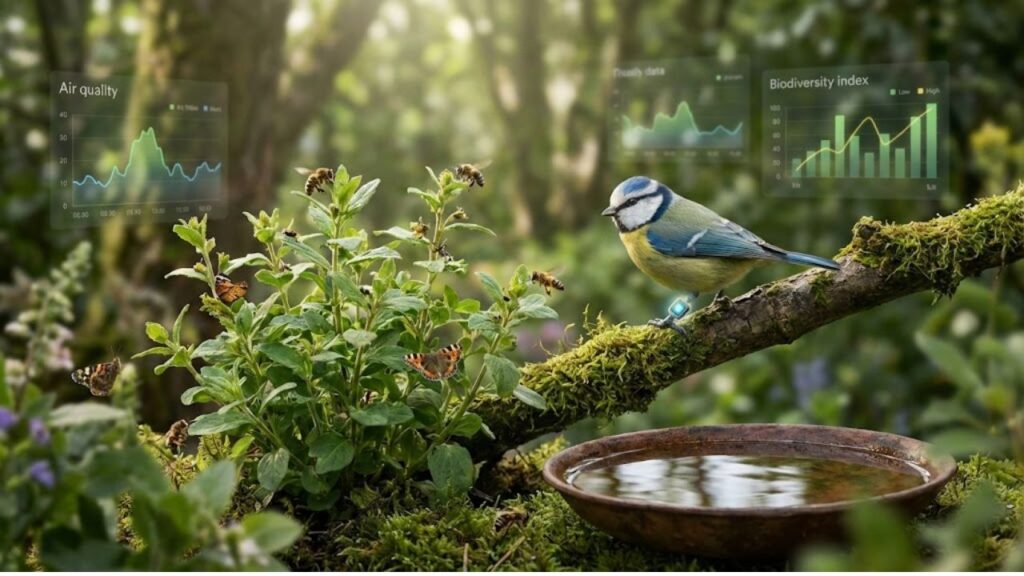
With their restless movements and sharp calls, garden tits do more than decorate a fence or feeder. Their presence, population size, and behaviour offer clear signals about the condition of the surrounding environment, reflecting factors such as pesticide use, air quality, habitat stability, and climate change.
Why tits are such reliable ecological indicators
Across Europe and North America, species like the great tit and blue tit are among the most intensively studied birds. Scientists value them because they respond quickly to even subtle changes in their surroundings. In many ways, a tit functions as a living environmental sensor, continuously reflecting the state of a garden’s ecosystem.
Unlike larger birds that range widely, tits depend on a small, consistent territory. They nest in cavities or boxes, forage for insects on nearby trees and shrubs, and often return to the same garden year after year. When conditions worsen, food becomes scarce, breeding success drops, and winter survival declines. These changes show up rapidly in population numbers.

Because tits are common, visible, and comfortable around feeders, their trends are easier to observe than those of rarer species. This makes them valuable to researchers and a practical reference point for everyday gardeners.

What frequent tit visits say about your garden
If tits regularly visit or nest in your garden, it usually signals a healthy balance. Their continued presence suggests three essentials are in place: reliable food, suitable shelter, and relative safety.
- Food: A steady supply of insects, larvae, spiders, seeds, and nuts throughout the year.
- Shelter: Trees, hedges, shrubs, or nest boxes that offer nesting sites and protection.
- Low disturbance: Minimal pesticide use, fewer loud disruptions, and manageable predator pressure.
Studies consistently show that gardens with native plants and limited chemical use support more tits and higher nesting success. When insecticides are introduced heavily, tit numbers often fall within one or two seasons as insect prey disappears.
If tits suddenly abandon a once-active feeder, it may point to a broader environmental issue, not just a lack of seed.
Sharp declines across a street or village often reflect changes in land management, such as hedgerow removal, altered farming practices, or climate-driven drops in insect populations.
Tits within the wider European bird decline
The broader picture across Europe is concerning. Overall bird populations have declined by roughly 25% over the past four decades. Farmland species have been hit hardest, with losses in some areas reaching around 60%.
While tits are not among the most endangered species, their population trends closely mirror these pressures. In landscapes where hedgerows, orchards, and small woodlands have been replaced by intensive monoculture, tit numbers often thin as nesting sites and insect-rich feeding grounds disappear.
Urban development adds further strain. Glass-heavy buildings, manicured lawns, and uniform planting reduce habitat quality. In contrast, areas that adopt wilder verges, flowering shrubs, and reduced chemical use often see tit populations stabilise or increase.
Reading the signals tits provide
When tit populations are thriving
Multiple nesting pairs, frequent feeder visits, and loud spring activity usually indicate a healthy local ecosystem.
- Several tit species present: Suggests diverse habitats and varied vegetation structure.
- Adults carrying caterpillars in late spring: Points to abundant insect life and good breeding conditions.
- Mixed winter flocks: Indicates sufficient food and shelter to support birds through colder months.
When warning signs appear
Long-term changes matter more than isolated events. A single harsh season can reduce numbers briefly, but a sustained decline usually signals deeper problems.
- Fewer chicks fledging: Often linked to reduced insect availability during breeding.
- Sudden disappearance: May follow habitat loss, tree removal, or new disturbances.
- Repeated nest failures: Can indicate predation pressure, poor food quality, or prolonged bad weather.
These patterns rarely reflect just one garden. Tits reveal trends that play out across entire neighbourhoods.

Using your garden as an ecological measure
Feeders can help, especially in winter, but the underlying habitat matters far more. Long-term tit presence depends on the living structure of your garden.
- Maintain a mix of trees, hedges, and dense shrubs.
- Leave some leaf litter and dead wood to support insects.
- Choose native plants that host local caterpillars.
- Avoid or minimise insecticide use.
A garden full of feeders but poor in insects may support adults through winter while still showing weak breeding success. Watching fledgling numbers provides a clearer signal than winter counts alone.
Nest boxes as informal monitoring tools
Well-placed nest boxes act like small observation stations. Over time, gardeners can note annual use, approximate clutch sizes, and fledging success. Simple records, even brief notes with dates, often reveal long-term trends that align with wider scientific findings.
What researchers track in tit populations
Scientists study tits to understand environmental change by measuring nest timing, egg size, chick growth, and survival rates. As springs warm earlier, caterpillar peaks may occur before chicks hatch, forcing parents to work harder and reducing survival.
Even shifts of a few days in breeding schedules can reveal how climate change is altering local food webs.
Urban research also compares tit health across city centres, suburbs, and rural areas. Pollutants, traffic noise, and artificial night lighting leave measurable effects on feathers, stress levels, and behaviour, informing planning and environmental policy.
Key terms gardeners often encounter
An indicator species is one whose condition reflects the health of its environment. Tits fit this role because they respond quickly to habitat changes and are easy to observe.
Biodiversity refers to the range of living organisms in an area. Gardens rich in plants, insects, and soil life tend to support more tits, while tit presence reflects that diversity back to the observer.
Seeing your garden as part of a wider network
Each garden functions as one patch in a larger landscape. A single wildlife-friendly space helps, but when entire streets support trees, hedges, and chemical-free corners, tits can move safely between them and maintain stronger populations.
Over years, changes such as lawn paving, woodland clearance, or altered council practices leave visible traces in tit numbers. Watching those rises and falls offers a practical way to read environmental change without specialised equipment.
Simple steps for any outdoor space
Even a balcony can play a role. A small feeder, a native shrub in a pot, and minimal chemical use can attract visiting tits. Regular appearances indicate that your space connects to the surrounding ecological network.
For larger gardens, combining nest boxes, varied planting, and citizen-science participation turns the tit from a pleasant visitor into a reliable guide. Its presence, absence, and seasonal behaviour already form a working barometer. Learning to read it is the final step.