
The last time daytime turned strangely blue above your head, you probably remember where you were. Maybe someone shouted from an office window, maybe school paused, maybe traffic slowed as people stepped out, phones raised, cardboard glasses half slipping off their noses. The light felt thinner, like the world was suddenly under a dimmer switch no one warned you about.
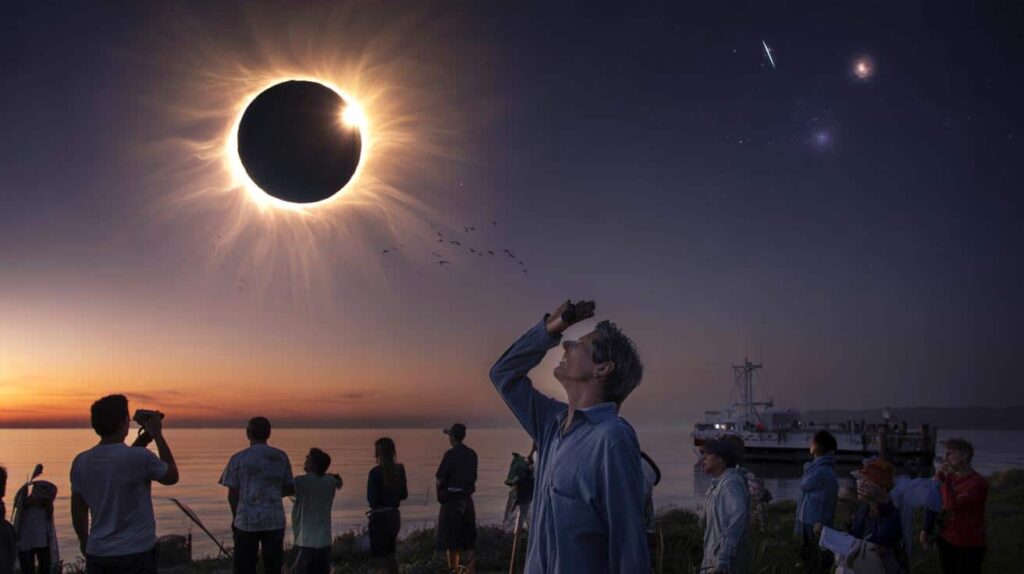
Now imagine that feeling not for a few fleeting seconds… but for nearly **seven full minutes**.
Astronomers already know the date, the path, the cities that will tip into shadow. The longest solar eclipse of the 21st century is on the calendar, and what’s really unsettling scientists isn’t just where it will happen.

It’s how long the Sun will disappear.

The day the Sun lingers in the dark
On 16 July 2186, somewhere over the Atlantic and northern South America, the sky will do something no living person has ever seen. Midday will fade into a deep, eerie twilight and just stay there. The Moon’s shadow will crawl across the Earth, then slow down enough that totality – that pure, breathtaking darkness – will stretch for close to seven minutes in some spots.
For astronomers, that duration is almost decadent. For anyone on the ground, it’ll feel like time itself has hesitated.
If that sounds abstract, try this. Picture standing in a small town in northern Brazil or offshore on a research vessel, watching the light collapse. Birds fall silent. Streetlights flicker on, confused. Your watch says it’s early afternoon, but your eyes insist it’s late evening.
During the 2009 total solar eclipse, the longest of our century so far, totality lasted up to 6 minutes 39 seconds over the Pacific. People who were there still talk about it like a dream. Now scientists are staring at 2186 and whispering the same thing: this one breaks the record.
Why so long? It comes down to celestial geometry. The Sun, Moon and Earth will line up in a way that’s unusually “perfect”. The Moon will be just about at perigee – closer to Earth – so it appears slightly larger in the sky and blocks the Sun more decisively. The Earth will be near aphelion, a bit farther from the Sun, making the Sun appear a touch smaller.
That subtle size difference means the Moon’s shadow covers us more fully and for longer. Add the way Earth rotates and the specific path of the shadow across the equator, where the ground speed under the shadow is slower, and you get this record-breaking darkness that makes scientists stare twice at their simulations.
How to truly experience a once-in-a-century eclipse
No one reading this will be alive in 2186 unless human longevity takes a wild leap. Still, long eclipses aren’t just a story for people centuries from now. The next decades are packed with impressive events, and this “longest eclipse of the century” is already changing how professionals tell the rest of us to live those few minutes under the Moon’s shadow.
The first tip is almost too simple: decide in advance that you won’t spend totality behind a screen. Plan your photos and videos for the partial phases. When totality arrives, step back, drop your phone, and let your eyes and skin do the recording.
We’ve all been there, that moment when a rare event happens and we only really saw it through a cracked phone case. During the 2017 eclipse over the United States, people admitted afterward they barely looked up; they were too busy switching camera apps. Astronomers who have chased dozens of eclipses say the same thing: the memory that stays is not the photo, it’s the way the light tasted, the sudden chill, the crowd’s gasp.
 Emergency declared in Greenland as researchers spot orcas breaching near melting ice shelves
Let’s be honest: nobody really does this every single day. Most of us rush, we multitask, we “capture” instead of feel. A long eclipse is one of the few moments when time slows down enough to catch us in the act.
The second piece of advice sounds more technical but it’s actually about care. Protecting your eyes with certified eclipse glasses during the partial phases is non‑negotiable, even if clouds seem to soften the Sun. *Your retinas don’t have pain sensors; damage can happen quietly, and only show up later.*
Scientists are already mapping where the 2186 eclipse will be most spectacular, and this is shaping a new kind of “eclipse tourism” playbook. They warn against three classic mistakes: traveling to the wrong part of the path, underestimating weather patterns, and trusting cheap, fake solar viewers.
“A long eclipse isn’t just more of the same,” says one astrophysicist involved in long-term eclipse modeling. “It changes how people behave. They think they have time. Then it starts, and they realize they don’t.”
- Check you’re in the path of **total** eclipse, not just partial coverage.
- Study typical cloud cover for that date, not just average sunshine hours.
- Buy ISO‑certified solar viewers from trusted organizations months in advance.
- Plan how you’ll spend the actual minutes of totality: look, listen, breathe, not just record.
- Leave room for emotion: tears, silence, even fear are absolutely normal.
A shadow that stretches beyond our lifetime
There’s something strangely humbling about an event that’s already calculated down to the second for a year none of us will see. The 16 July 2186 eclipse exists today as lines on maps, precise tables in obscure PDFs, colored corridors on simulation software. A future generation will stand exactly where those lines cross and look up.
By then, cities will be different. Coastlines may have shifted. Languages, technology, maybe even the way we tell time could have changed. The shadow will still fall in the same place. The same hush will spread as the Sun winks out behind a familiar, indifferent Moon.
Scientists say such extreme eclipses are becoming rarer over tens of thousands of years as the Moon slowly drifts away from Earth – about 3.8 centimeters per year. One day, far beyond human planning, there will be no more total solar eclipses at all, only near misses, bright rings of light around a too‑small Moon.
So this longest eclipse of the 22nd century is more than a record in a textbook. It’s a kind of milestone in our cosmic relationship: proof that, right now, the sizes and distances line up in a way that lets us see the universe doing something theatrical, precise, and intensely emotional.
You might watch a shorter eclipse in your own lifetime. You might step out of an office, hold up a piece of tinted plastic, and feel the air turn chilly while people around you go oddly quiet. Somewhere in the back of your mind, you’ll know that, decades after you’re gone, the same trick of light and shadow will unfold again, for longer, for someone else.
They’ll stand there, maybe holding glasses printed with some sponsor’s logo, watching day slip into night and linger. And they won’t think about you, or us, or the 2009 or 2017 or 2024 eclipses. They’ll just be in the dark, listening to the world hold its breath. That’s the quiet power of knowing the future sky is already written.

| Key point | Detail | Value for the reader |
|---|---|---|
| Record duration | 16 July 2186 eclipse expected to reach nearly seven minutes of totality | Gives context for shorter but still rare eclipses you can experience yourself |
| Celestial geometry | Unusual alignment: Moon near perigee, Earth near aphelion, path near equator | Helps you understand why some eclipses feel dramatically longer and darker |
| Experience over capture | Plan to protect your eyes, travel into totality, and be present during darkness | Improves the way you live any future eclipse, not just read about it |
FAQ:
- Will anyone alive today see the 16 July 2186 eclipse?Extremely unlikely with current life expectancy, though babies born in the late 2100s could. For us, it’s more a window into how precisely we can predict the sky.
- How long can a total solar eclipse theoretically last?Under ideal conditions, models suggest a bit over 7 minutes 30 seconds. The 2186 event, close to seven minutes, pushes right up against that practical limit.
- Why are scientists so interested in longer eclipses?Longer totality gives more time to study the Sun’s corona, test instruments, and observe how Earth’s atmosphere and wildlife respond to sudden darkness.
- Are total solar eclipses becoming rarer?Total eclipses will still occur for millions of years, but the maximum duration slowly shrinks as the Moon drifts away, changing how neatly it covers the Sun.
- What can I do now to prepare for eclipses in my lifetime?Check upcoming eclipse maps for your region, learn the difference between partial and total, invest in proper viewers, and start thinking less about photos and more about presence.
