
The light starts to feel wrong before anyone can explain why. Colors turn slightly metallic, like a filter has slipped over the world, and birds go quiet in the middle of their own song. In a small town on the edge of the path of totality, people spill out of offices and kitchens, holding cardboard eclipse glasses and half-finished coffees, staring up at a sun that suddenly looks smaller, bitten from one side.
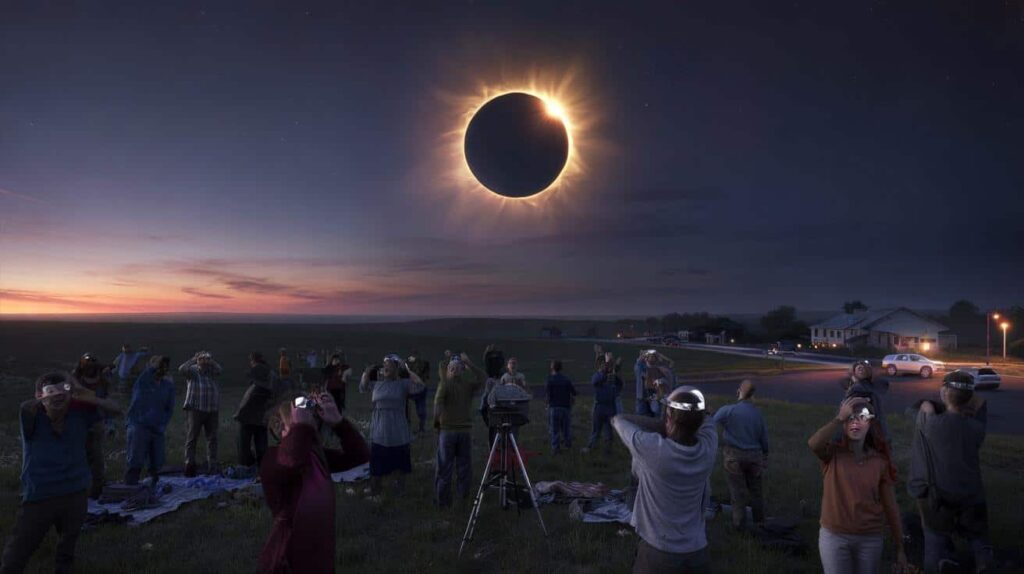
Cars pull over on the highway. A dog whines at the sky. Someone swears softly under their breath.
Nobody says it out loud, but you can feel it in the air: something enormous is about to happen.

The slow arrival of an unnatural night
At first, the change is almost shy. The sun still shines, the day is technically bright, yet the light starts to flatten, like a scene on a fading movie screen. Shadows sharpen into razor-thin outlines. Temperatures drop a few degrees, enough for people to fold their arms across their chests without really knowing why.

Then the bite in the sun grows, creeping inward as the moon glides across. You can see it through safe lenses like a silent clock counting down. People who promised they wouldn’t care suddenly find themselves staring, whispering, “Is this it? Is it starting?”
In one coastal city, officials expect parks and rooftops to be packed shoulder to shoulder. Hotels along the eclipse path have been booked out for months, some since last year, with prices that tripled overnight. Airlines quietly added flights; tourism boards rebranded the week as “Eclipse Week” and printed glossy posters.
NASA scientists will spread out with mobile observatories and cameras, chasing data as the moon’s shadow rushes across land at more than 1,500 km/h. Amateur astronomers have drawn maps and circled tiny villages the way surfers circle secret beaches. For a few precious minutes, quiet backroads and schoolyards will feel like the center of the universe.
When the eclipse finally reaches totality, day doesn’t just “turn to night.” It transforms. The sky slides into a deep twilight blue, streetlights flicker on, and the sun’s blazing disk vanishes, leaving a ghostly white corona hanging in the dark.
Scientists call this the longest total solar eclipse of the century for a reason. Those extra heartbeats of darkness give instruments more time to capture high-resolution images of the corona, measure temperature changes in the atmosphere, and track how animals react when their world goes off-script. *The universe runs on precise mechanics, but the feeling on the ground is pure magic.*
How to truly experience this eclipse (and not just glance at it)
If you want more than a shrug-and-scroll experience, you need a small ritual. Start by choosing your spot well before the big day: a clear horizon, as few buildings as possible, somewhere you won’t be dodging traffic or fighting for elbow room.

Arrive early. Let your eyes and body feel the slow descent of the strange light, not just the climax. Have proper eclipse glasses ready, from a trusted seller that follows ISO 12312-2 standards, and a cheap paper pair as backup in your pocket.
Then put your phone away for at least part of totality. The sky will not repeat this exact show again in your lifetime.
People tend to underestimate how disorienting the moment can be. They spend weeks planning, then spend the actual eclipse fiddling with camera settings, arguing over filters, or refreshing social feeds to see someone else’s view. Let’s be honest: nobody really does this every single day.
If you’re with kids, talk about what’s going to happen before the shadow arrives, so the sudden darkness feels like a story they’re inside, not a scare. If you’re alone, that’s fine too. Bring a small notebook or just your thoughts. When the air cools and the birds fall silent, let yourself notice the goosebumps without judging them.
During the 2017 eclipse across the United States, solar physicist Angela Speck described the crowd’s reaction in one word: “Primal.” People screamed, cried, laughed, or went completely quiet, as if something ancient in their brain recognized this sky from a time before cities and screens.
- Before the eclipse
Check the exact local timetable: first contact, start of totality, end of totality, last contact. - **During partial phases**
Only look at the sun with certified eclipse glasses or a solar filter on your telescope or camera. - At totality only
You can briefly remove your glasses and see the corona with the naked eye, as long as the sun is fully covered. - Gear checklist
Glasses, backup glasses, hat, layers for the temperature drop, tripod if you insist on photos, water, snacks. - After the shadow passes
Write down what you felt, not just what you saw. That’s the piece your future self will care about.
What this rare darkness reveals about us
When the shadow moves on and daylight slowly returns, people rarely just shrug and walk away. Conversations break out between strangers who would normally stare at their shoes. Someone passes around a thermos of coffee. A child asks why the birds looked confused, and an adult suddenly remembers a science lesson from decades ago.
This is the quiet power of an eclipse: it bends our routine just enough to let wonder slip through the cracks. We’ve all been there, that moment when you look up and realize your problems are tiny compared to a moon casually blocking a star 150 million kilometers away.

| Key point | Detail | Value for the reader |
|---|---|---|
| Longest totality of the century | The moon’s shadow will linger for several unforgettable minutes along a narrow path | Gives you a once-in-a-lifetime chance to feel and observe extended midday darkness |
| Safe viewing matters | Certified eclipse glasses and simple planning prevent eye damage and stress | Lets you enjoy the spectacle fully without fear or last-minute panic |
| Emotional and social impact | Shared awe can turn parks, rooftops, and sidewalks into temporary communities | Offers you a rare chance to feel connected—to the sky, and to the people around you |
FAQ:
- Question 1How long will this total solar eclipse actually last?
- Question 2Is it safe to look at the sun during any part of the eclipse?
- Question 3Do I need special equipment, or are eclipse glasses enough?
- Question 4What if I’m not in the path of totality — is it still worth watching?
- Question 5Why do animals and birds act strangely when day turns to night like this?
