
At first, no one in the café took the news seriously. A quiet buzz spread from table to table, the kind of ripple you get when everyone’s phone pings at once with a storm warning. “Longest solar eclipse of the century,” someone read aloud, frowning at their screen. Outside, the sky was blank and pale, offering no clues. Inside, conversations turned quickly to dates, maps, and rumors about where the shadow would touch ground.
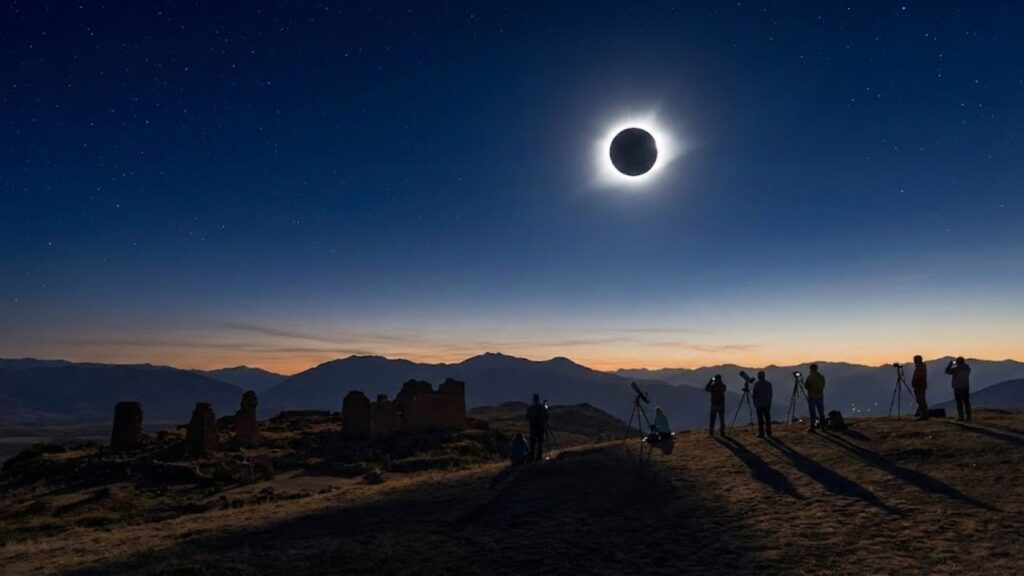
Someone half-laughed, “So… the day’s actually going to turn into night?”
The barista didn’t answer, just stared out the window. An ordinary afternoon now had a deadline. And the sky, this time, had an appointment none of us could reschedule.

Slowly, the Sky Prepares to Vanish
The confirmed date has triggered a quiet rush across astronomy circles and everyday calendars alike. This isn’t your typical blink-and-you’ll-miss-it eclipse. It’s being described as the longest total solar eclipse of the century, where complete darkness will stretch across parts of the Earth for an unsettling length of time.
 The return of the aircraft carrier Truman, a signal badly received by the US Navy facing future wars
In the path of totality, the Moon will cover the Sun so perfectly that midday will fade into a cool, silver dusk. Birds might head to roost. The air could turn crisp. Streetlights may flicker on while lunch is still being served. For a few surreal minutes, the world will feel dimmed down, like someone lowered the brightness on reality.
Looking Back to See What’s Coming
To understand what’s ahead, think back to 2017, when the United States experienced a major total eclipse. Traffic backed up on rural roads. Farmers climbed barn roofs. Office workers slipped out wearing borrowed eclipse glasses. And the most remembered moment? A sudden hush. Dogs stopped barking. People whispered instinctively. The air stood still.
This time, that strange silence will last longer, and more people will be inside it.
What Makes This Eclipse Truly Rare
Astronomers are calling this eclipse exceptional for two main reasons: its length and how many people it will reach. Long total eclipses are rare enough. But for one to last this long and cross so many populated areas? That’s even rarer.
The geometry is unforgiving: the Moon must be at just the right distance from Earth, the Earth in the perfect part of its orbit, and the alignment precise enough to stretch darkness along a wide track. That track is now mapped down to the kilometer.
For millions, this won’t be a video clip—it will be the sky, live, switching off at noon.
How to Truly Experience the Eclipse
The first real step? Find out where you’ll be when the shadow arrives. The “path of totality” is the only area where the Sun completely disappears. Outside that narrow band, you’ll only see a partial eclipse—no matter how good your glasses are.
Use the Tools Available
Space agencies have released interactive maps. Tap your city, and it’ll tell you exactly how many seconds of totality you’ll experience—or if you’re outside the main zone altogether. That small difference changes everything about how you’ll remember the day.

Prepare Before the Crowd Does
Once you know where the eclipse will pass, the next reality hits: you won’t be the only one chasing it. Hotels are already fielding calls for that exact date. Small towns are bracing for crowds armed with cameras and telescopes.
Many will assume they can just drive to “somewhere on the line” that morning. But if traffic or clouds interfere, you might miss it entirely. A backup plan—another location, an earlier start—can make all the difference.
Protecting Your Eyes Is Non-Negotiable
This part isn’t optional: only certified eclipse glasses or a proper projection method will do. Regular sunglasses, camera lenses, tinted glass—none of those are safe.
“Sunlight gets even more dangerous during an eclipse,” one solar physicist warns. “You’re more tempted to look, and it can damage your eyes in seconds.”
Checklist for Eclipse Day
- Check your region’s path of totality map
- Book accommodation early if traveling
- Purchase certified glasses only
- Prepare a pinhole projector as backup
- Arrive early at your viewing spot—hours ahead
This Eclipse Asks Something Unusual of Us
There’s something grounding about circling a day on your calendar that has nothing to do with work, exams, or errands. This moment isn’t made by us—it’s written by orbital physics.
Wherever you are that day, the Sun, Moon, and Earth will align perfectly, with or without your permission.
A Shared Pause in the Sky
We all know that feeling—when nature gently reminds you how small your own schedule is. This eclipse will do just that. Whether on a city rooftop or a lonely field, you’ll stand beside strangers, all staring at the same vanishing light.
It’s being labeled the longest eclipse of the century. But for most of us, its real value will be simpler: a moment of shared awe. You’ll feel it in the chill in the air, the blurring of your shadow, and the sudden stars overhead at lunchtime.
Some will plan road trips. Others will slip outside an office for five minutes. But no matter how you experience it, the day will hold a story that feels almost unreal—the moment when noon became night, and the world paused under one sky.

| Key point | Detail | Value for the reader |
|---|---|---|
| Record duration | Longest total solar eclipse of the century, with extended minutes of darkness along the path of totality | Signals a once‑in‑a‑lifetime experience worth planning around |
| Rare visibility | Shadow crosses densely populated regions, not just remote oceans | Greatly increases your chances of seeing it without extreme travel |
| Preparation window | Official date and maps already published by major observatories | Gives you time to book stays, buy safe viewing gear, and choose your spot |
