
At seven-thirty on a winter morning, the waiting room of a small clinic in the suburbs is already full. Coats on knees, scarves still wrapped around necks, a dozen people over 65 sit quietly, hands folded, eyes on their phones or the floor. The doctor opens the door, calls a name, then glances at the row of chairs. “Who walked here today?” she asks with a half-smile. Only one hand goes up.
The others hesitate, then shrug. “I don’t really go out unless I need to.” “My daughter drives me everywhere.” “I sit a lot, but I’m tired, so…”
Nobody mentions it, but that *tiny* decision made each morning – move or stay put – is quietly setting the rhythm of their blood.

And the consequences reach much further than stiff legs.

The daily decision that shapes your circulation after 65
Most people think blood circulation is ruled by age, genes, and medication. Those matter, yes, but from 65 onward, something far more ordinary often plays the starring role. It’s the choice you make every single day when you wake up, sit on the edge of the bed, and ask yourself: “Am I going to move… or stay in this chair?”
That decision to stay mostly seated or to stand and walk, even a little, quietly rewrites how your heart and vessels behave. The body doesn’t shout about it. It whispers through cold feet, heavy legs, and that weird fatigue that arrives before lunch.
Over time, this “I’ll just sit a bit longer” becomes a full-time lifestyle.
Think of a man I met in a cardiology ward, 72 years old, retired electrician. He used to walk to work every day, climb ladders, carry tools. When he stopped working, his steps disappeared almost overnight. “My world shrank to the sofa, the TV, and the kitchen,” he told me, slightly embarrassed.
In three years, he gained eight kilos, his blood pressure climbed, and his legs started to swell. He felt breathless walking from the car to the supermarket entrance. His exams showed circulation slowing down, especially in his legs. Nothing dramatic in one single day. But stacked day after day, it built a very clear picture.
The nurses didn’t tell him to run a marathon. They told him to stand up every 30 to 45 minutes.
The logic is brutally simple. Our veins, especially in the legs, rely on movement to push blood back up to the heart. When you walk, the calf muscles contract and act like a pump. When you sit for hours, that pump goes silent. Blood tends to pool in the lower limbs, pressure shifts, and the vessel walls get lazy.
With age, vessels are already less elastic and the heart has to work harder. Add long periods of sitting and you give gravity the upper hand. That’s where you start hearing words like “venous insufficiency”, “edema”, and “higher risk of clots”.
The twist? This isn’t about heroic exercise. It’s about how much of your day is spent motionless.
Small moves that change the whole picture
Circulation after 65 loves tiny, regular movements. The kind that barely raise your heart rate but keep the blood from falling asleep in your legs. Think of your day as a long line of little breaks from sitting.
Stand during phone calls. March on the spot while the kettle boils. Walk the corridor during TV commercials. Do ten heel raises at the sink while brushing your teeth. These acts look ridiculous on their own. Stacked over a day, they wake up your calf muscles and ankles dozens of times.
For many doctors, a simple rule is becoming a quiet revolution: stand up and move a bit at least every 30 minutes.
There’s a woman in her late 60s who lives on the fourth floor of a building with an elevator. For years she took the lift for everything: mail, groceries, quick chats with neighbors. One day, her daughter suggested a small pact: elevator up, stairs down. That’s it.

The first week, her thighs burned, and she clung to the rail. By the third week, she noticed something unexpected: her hands and feet weren’t icy in the evenings. Her socks didn’t leave such deep marks on her ankles. She slept better, too, without fully understanding why.
Her cardiologist smiled when she told him. “You’ve just given your blood vessels a daily gym,” he said.
Let’s be honest: nobody really counts steps or stretches every single day at 72. Fatigue, pain, bad weather, appointments – life is messy. The point isn’t perfection. The point is not letting the chair win completely. Each time you interrupt a long sitting spell, you send a signal: “Keep the blood moving.”
Your heart loves rhythm, not heroic performances twice a year. Ten two-minute walks scattered through the day beat one exhausting, painful session that you abandon after a week. There’s also a psychological shift when movement blends into your normal life instead of feeling like a punishment.
That’s when small habits quietly turn into protection for your arteries and veins.
How to turn “I’ll sit a bit” into “I’ll move a bit”
One of the easiest methods is to tie movement to fixed daily anchors you already have. You don’t need apps or trackers. Just choose 3–5 moments that never fail: after breakfast, after lunch, mid-afternoon, after dinner, before bed.
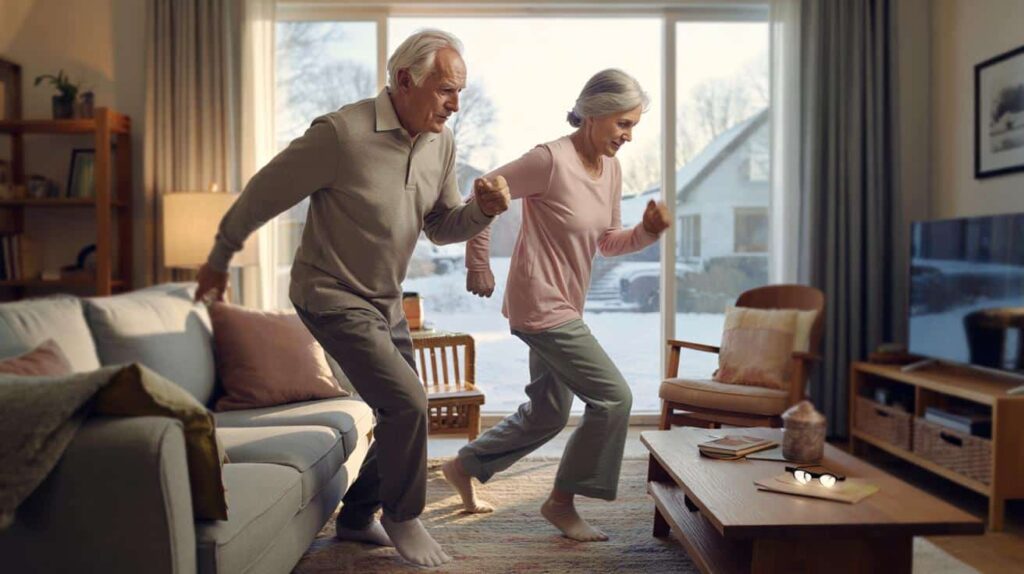
After breakfast, walk around your home for three minutes, even if it’s just circles in the living room. After lunch, do a slow lap up and down your street or corridor. Mid-afternoon, flex and extend your ankles twenty times while standing at a chair. After dinner, put on one song you like and walk or sway gently until it ends.
You’re not “working out”. You’re just refusing to stay locked in one position.
Many people over 65 fall into two traps. The first is thinking, “If I can’t do a real workout, there’s no point in doing anything.” The second is the opposite: doing too much on a “motivated day”, then spending the next two days recovering on the sofa, exhausted and discouraged. Both patterns quietly harm circulation.
Your vessels adore modest, predictable movement. Thirty seconds of ankle rotations every hour beats one painful 45-minute walk that leaves you limping. If you have balance issues, do your moves sitting or holding onto a chair or countertop. There’s no shame in adapting; there’s wisdom in it.
You’re not competing with your younger self. You’re negotiating with your body today.
A geriatric nurse told me something that stayed with me: “Every time someone over 65 stands up when they didn’t feel like it, that’s a tiny victory for their circulation.” It sounded exaggerated at first, then I watched her at work. She’d gently coax patients to stand for 30 seconds, walk three steps, then sit again. Week after week, their legs changed. Their mood, too.
- Stand every 30–45 minutes: even for one minute, to wake up the leg pump.
- Use routines you already have: meals, TV shows, phone calls as movement triggers.
- Mix sitting and standing: alternate positions during reading, TV, or hobbies.
- Protect your veins: avoid crossing legs for long periods, prefer loose socks over tight bands.
- Talk to your doctor first if you’ve had clots, heart failure, or severe pain when walking.
When daily choices quietly rewrite the story of aging
There’s a quiet power in realizing that circulation isn’t only a matter of fate, pills, or hospital corridors. It’s also hidden in those tiny crossroads of the day: remote on the coffee table or short walk to the kitchen, stairs or elevator, armchair or a few steps on the balcony. None of those choices feel monumental in the moment. Together, they draw the map of how your blood travels through an aging body.
We’ve all been there, that moment when the sofa seems to pull harder than the idea of walking to the mailbox. On some days, rest is exactly what you need. On others, that extra effort to stand, stretch, or stroll for three minutes is a quiet declaration: “I’m still in charge of how I move through my own life.”
*Circulation is not just a medical word; it’s the everyday story of how you inhabit your body after 65, one decision at a time.*

| Key point | Detail | Value for the reader |
|---|---|---|
| Short sitting breaks | Stand and move 1–2 minutes every 30–45 minutes | Reduces pooling of blood in legs, supports heart and veins |
| Micro-movements | Heel raises, ankle circles, short indoor walks | Easy to do at home, even with low energy or bad weather |
| Routine pairing | Attach movement to meals, TV, phone calls | Makes healthy circulation habits automatic and sustainable |
FAQ:
- Question 1How many minutes a day should I move to help my circulation after 65?
- Question 2Is walking at home enough, or do I need to go outside?
- Question 3What if I have arthritis or joint pain and walking hurts?
- Question 4Can sitting too long really increase the risk of blood clots?
- Question 5When should I talk to a doctor about my circulation?
