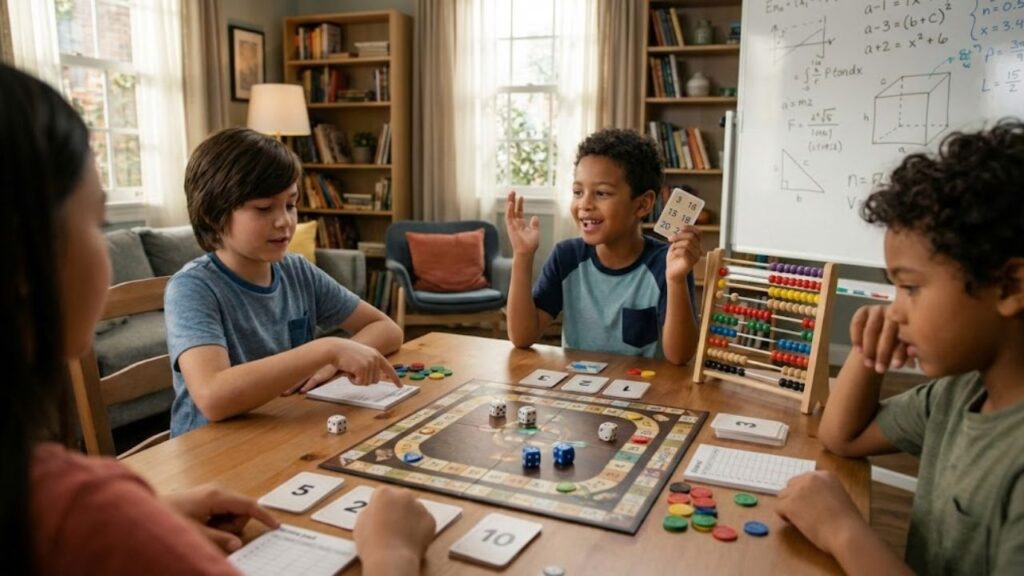
Across nurseries and primary schools, simple games with dice and numbered tracks are quietly reshaping how children understand numbers, without worksheets or screens in sight. These games are proving to be far more than just entertainment—they help build foundational math skills.
Research Reveals the Power of Games
A large review conducted by the HEDCO Institute at the University of Oregon has highlighted something many educators have suspected: board games, when played regularly with adults, help enhance key mathematical abilities in young children.
The study reviewed 18 research projects focusing on children aged from preschool to about seven years old. Each project observed the effects of structured, number-based games played for short, repeated sessions.

Just a few ten-minute sessions with the right kind of board game can significantly improve early math skills, leaving a measurable and lasting impact.

What is “Numeracy”?
These improvements are categorized under “numeracy,” which refers to a child’s ability to understand and manipulate numbers in everyday situations. This includes recognizing digits, counting in order, and associating numbers with real-world quantities, like understanding that “5” means five actual objects.
How Simple Board Games Sharpen Number Sense
Why Linear Board Games Work
The research points to the effectiveness of a very familiar game format: the linear board game. These games feature a track made up of numbered squares, where children roll a die and move a pawn forward.
Each turn engages children in several core skills:
- Counting aloud in sequence while moving a piece
- Matching spoken numbers with printed numerals on the track
- Estimating how far the pawn has traveled and how far it still has to go
- Comparing positions: “I’m on 8, you’re on 12, you’re ahead”
All of this occurs in under a minute, wrapped in the excitement of a game. For a four-year-old, these small moments of repetition can happen dozens of times in a single session.
Linear games subtly encourage children to coordinate their eyes, voice, and hands around numbers, all without feeling like a lesson.
The Importance of Coordination
This coordination is crucial. The research suggests that when numbers appear in a clear left-to-right order, children can more easily develop a mental “number line.” This internal map is fundamental for later skills like addition, subtraction, and estimation.
Repetition without Boredom
Traditional drills can quickly become dull for young children. However, board games sneak in the same repetition under the guise of fun. Every roll of the die presents another opportunity to count, compare, and analyze the board.
According to a meta-analysis published in the Review of Educational Research, children who engage with structured number-based games consistently outperform their peers, especially in early counting and quantity recognition tasks.
Importantly, these games don’t require long sessions. Many studies found that just ten-minute sessions, repeated over a few weeks, were enough to make a noticeable difference. Consistency, coupled with the cycle of play—roll, move, count, react—is key.
The Role of Adults in Learning
Why Adults Matter
Research highlights that children benefit the most when an adult plays alongside them, subtly guiding their attention to numbers. This doesn’t turn playtime into a formal lesson, but it does weave mathematics into the action.
A simple prompt, like “You’re on 6, and I’m on 9. Who’s ahead?” can turn an ordinary move into a small mathematical challenge.
What Makes a Board Game “Maths-Friendly”?
Not all board games are equally beneficial. The review identifies certain design features that enhance learning:

- Numbered, ordered track – Supports counting in sequence and builds a mental number line.
- Small, regular jumps (1-6 spaces) – Aligns with early counting skills and prevents overwhelming children.
- Visible numerals on each space – Links spoken numbers with written digits.
- Frequent turns – Offers many repeated counting opportunities.
- Clear start and finish – Helps understand concepts like “more,” “less,” “ahead,” and “behind.”
Games focusing on luck, pictures, or colors without any counting elements may build social skills, but they are less effective for numeracy.
From Classroom to Kitchen Table
One of the reasons board games are gaining attention is their seamless integration into everyday life. No need for tablets, apps, or complicated lesson plans. A simple board, a die, and a few tokens are all that’s required.
Ten minutes before dinner or after school can be enough to lay the groundwork for strong mathematical habits.
Teachers can incorporate these games during short transitions in the school day, while parents can pull them out on rainy weekends or as a bedtime wind-down activity.
Affordable Tools with Wide Reach
Board games are also appealing because they are affordable. Many number-based games are inexpensive or can even be created at home with a few supplies.
This accessibility means that children from all backgrounds, including those with limited access to tutoring or educational tech, can benefit. A single game can be enjoyed by multiple children and adapted for years of development.
What “Numeracy” Means for Young Children
For researchers, “numeracy” encompasses a range of abilities. For a five-year-old, it includes:
- Knowing the count sequence: “one, two, three…” in the correct order.
- Recognizing written numerals, at least from 0 to 10.
- Understanding that “four” represents four real objects, not just a word.
- Recognizing that numbers have order and size: 7 is more than 5.
- Beginning to grasp that quantities can combine or separate (early addition and subtraction).
The studies suggest that regular board game play accelerates these skills simultaneously. Children are not just memorizing numbers—they are physically interacting with them, counting, and observing the consequences on the board.
Practical Ways Families Can Use Board Games for Maths
Parents can use simple tweaks to transform any game into a math booster without sacrificing fun:
- Choose games with clearly numbered spaces from start to finish.
- Ask your child to move the pawn one space at a time, counting aloud.
- When they land, say the number together and point to it on the board.
- Occasionally pause and ask, “Who is closer to the finish?” or “How many spaces do you need to catch up?”
- For older children, let them add or subtract moves for extra challenges.
Incorporating small bits of “maths talk” can help build a child’s confidence with numbers.
Board Games as a Complement to Formal Lessons
While board games are not a replacement for formal math lessons, they complement them beautifully. They reinforce concepts children encounter at school in a low-pressure, relaxed environment.
Used alongside storybooks, counting songs, and everyday tasks like shopping, these games can create a rich mathematical environment. A child who counts spaces on a board is more likely to count apples into a bag or steps on the way to the park.
However, it’s important to choose age-appropriate games. Games with complex rules or long durations may overwhelm younger children.
Conclusion: A Simple Tool with Big Benefits
For families balancing work, screens, and school demands, the research suggests that pulling out a basic counting board game a few times a week isn’t just nostalgic—it’s a meaningful way to strengthen a child’s early relationship with numbers, one dice roll at a time.