Psychologists suggest that an overflowing chair can signal much more than a postponed folding job. Beneath that stack of fabric lie subtle patterns tied to daily habits, personality tendencies, and how people handle mental load and everyday stress.
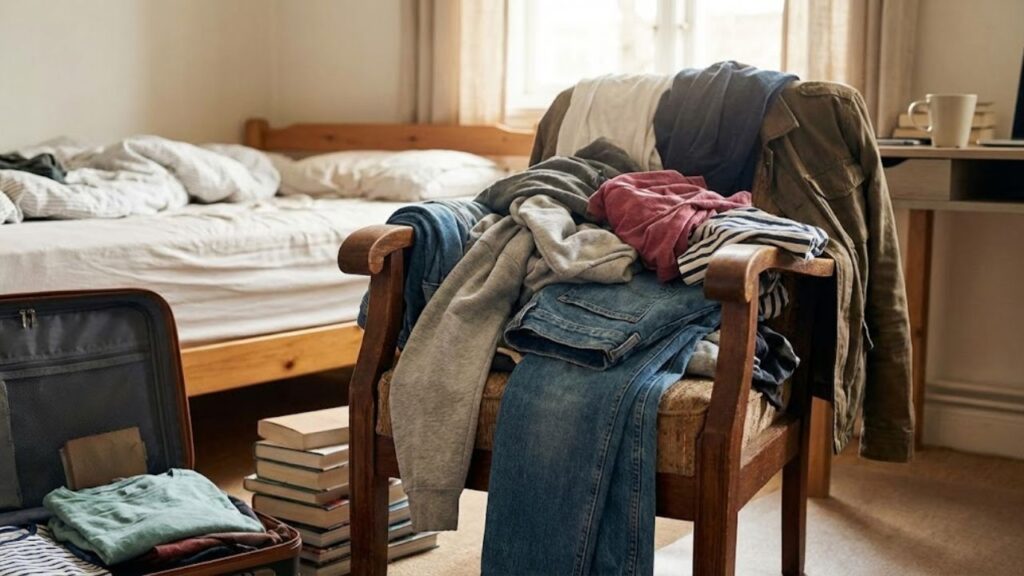
The chair that’s more than simple clutter
Lightly worn shirts, jeans that feel too clean for laundry but too used for the wardrobe, and jumpers caught in limbo often end up in the same place. Many dismiss this as a harmless routine. However, research published in Current Psychology suggests it can quietly reflect how individuals manage time, space, and decision-making.
The so-called clothes chair is rarely about laziness. Instead, it often reflects how people balance comfort, control, and mental effort in daily life.

The study examined everyday clutter habits and connected them to traits like procrastination, tolerance for disorder, and flexible thinking. Each item placed on the chair represents a repeated micro-decision: deal with it later, but not indefinitely.

The subtle influence of procrastination
Leaving clothes on a chair is rarely a deliberate rejection of housework. More often, it’s a quiet, automatic delay of a small task. After a long day, folding and storing clothes can feel out of proportion to the effort required. The chair becomes a convenient compromise that saves energy in the moment.
Psychologists refer to this as task postponement. The brain ranks wardrobe organisation as a low priority and shifts it aside to conserve energy for rest or recovery.
Over time, the chair becomes a visible to-do list: a reminder that the task has been delayed, not abandoned. Clothes aren’t thrown on the floor but stacked in a semi-orderly way, preserving a sense of control. This middle ground is typical of everyday procrastination—tasks are deferred, not refused.
What the pile may reveal about personality
Researchers and therapists who study living spaces observe recurring patterns. People who rely on a clothes chair often share certain psychological tendencies, though none are absolute. These are best understood as general inclinations, not fixed labels.
- Heated dispute over effortless patio cleaning: the ‘miracle’ method for blackened slabs that some call genius and others call irresponsible
- No vinegar or baking soda needed: the trick to cleaning car seats and removing stubborn stains
- If you feel responsible for keeping the peace, psychology explains how that role formed
- How bananas stay fresh and yellow for up to two weeks with one household item
- Bad news for a retiree who lent land to a beekeeper and must now pay agricultural tax
- This simple home airflow trick improves comfort without adjusting the thermostat
- Bad people often reveal themselves through five specific behaviours
- “I feel tired of being strong”: psychology explains emotional endurance
Common traits linked to the clothes chair habit
- High tolerance for mild disorder – the space feels acceptable even if not perfectly tidy.
- Flexible, intuitive organisation – personal logic replaces rigid systems.
- Energy preservation – minor tasks are postponed during periods of fatigue.
- Short-term comfort focus – immediate ease outweighs future effort in low-stakes areas.
- Situational procrastination – structure at work may coexist with relaxed domestic habits.
This pattern does not imply disorganisation across all areas of life. Many highly structured, successful individuals still have a chair layered with outfits from a demanding week. The key difference lies in how much the pile grows and how long it remains.
The chair as a personal buffer zone
Environmental psychology describes buffer zones as spaces that sit between order and chaos. The clothes chair fits this concept precisely.
It acts as a transition area—a temporary holding space for garments that don’t yet belong in the wardrobe or laundry. These items occupy an in-between category, and the chair becomes their waiting room.
Functioning as a psychological buffer, the chair eases pressure to maintain perfect order while avoiding complete disarray. It reflects how people manage daily friction by creating practical compromises that match real energy levels, not ideal standards.
What your chair system says about you
No two clothes chairs are the same. The way items are stacked or spread can hint at different thinking and planning styles.
- Neat, compact stack – generally organised, temporarily busy, still aiming for order.
- Layered but searchable pile – relies on memory and visual cues, comfortable with light clutter.
- Overflowing pile – potential overload, unresolved decisions, stress reflected in the space.
- Weekday-only use – routine-based delay, with tasks resolved once time or calm returns.
Researchers caution against reading too much into a single detail. Still, habits that persist over months often echo deeper patterns in how people manage decisions and discomfort.

Mental load, control, and postponed decisions
The clothes chair is closely tied to mental load—the constant background effort of tracking tasks, responsibilities, and obligations.
When the mind is already juggling numerous demands, folding clothes can feel like the final strain. The chair becomes a pressure-release point, offering a temporary escape from completing the full cycle of sorting and storing.
Some therapists view this as a self-protective strategy. By cutting corners where consequences are low, people conserve energy. The concern arises only when every small task is deferred, and the environment begins to mirror a deeper sense of overwhelm.
When the chair points to a larger challenge
A single chair covered in clothes is not a diagnosis. However, for individuals dealing with anxiety, low mood, or attention difficulties, it may form part of a broader pattern.
Signs such as:
- multiple surfaces holding “in-between” items
- ongoing trouble finishing simple household tasks
- feelings of shame about others seeing the space
can indicate challenges with starting, prioritising, or completing tasks. In these cases, professional support can be more effective than repeated attempts at motivational fixes.
Small habit shifts that make a difference
Psychologists often suggest approaching the clothes chair as a low-pressure habit experiment. The goal isn’t a complete lifestyle overhaul, but a small adjustment to observe what changes.
- apply a three-item rule: once three pieces land on the chair, they must be sorted
- add a separate hook or rail for “worn once, still clean” clothing
- link hanging clothes to an existing habit, like brushing teeth
These minor changes test how essential the chair is as a buffer zone. Strong resistance can itself reveal how one relates to order, rules, and end-of-day effort.
Two ideas that explain the mess
Two psychological concepts help clarify why this habit is so common.
“Good enough” living involves accepting realistic standards rather than perfection. The clothes chair often fits this approach, allowing functionality while tolerating small imperfections.
Decision fatigue describes the decline in decision-making ability after too many choices. By evening, deciding where each item belongs can feel draining. The chair delays that decision. Recognising this can lead to simplified wardrobes, fewer options, or planned outfits.
The next time that familiar pile catches your eye, it may help to see it not just as clutter, but as a reflection of how you manage energy, expectations, and the quiet compromises made at the end of each day.