Beijing’s futuristic J-36 stealth fighter, still officially shrouded in secrecy, is now at the centre of a bold research effort: making sure it can land safely on a moving aircraft carrier in rough seas using an advanced control system usually seen in high-end robotics, not combat jets.
A radical design built for future carrier battles
The J-36 is not just another Chinese fighter project. It represents an attempt to leap ahead in naval aviation rather than simply catching up with US or European designs.
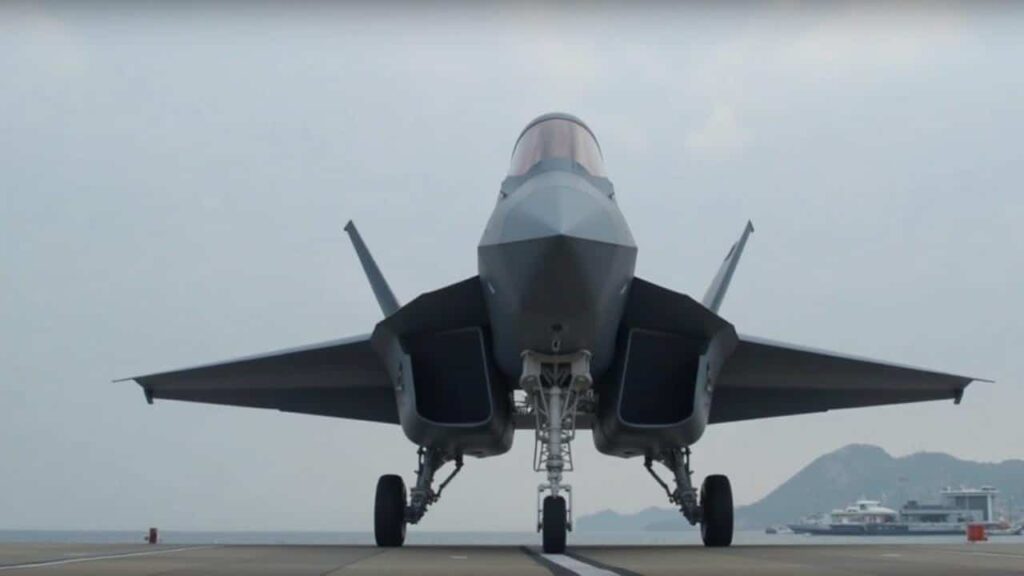
Early imagery and analysis suggest an unusual “flying wing” layout, with no traditional tail at the rear. This blended shape reduces the number of surfaces that can bounce radar waves back to enemy sensors.
 According To Psychology, People Who Talk To Their Pets Like Humans Often Share These 8 Traits
For naval combat, shrinking the radar signature matters. A stealthier aircraft can approach carrier groups, coastal bases or surveillance assets with less warning time for defenders.

Another striking feature is the reported use of three engines, a configuration rarely seen on modern fighters. Analysts read this as a sign of strong thrust, high endurance and heavy payload capacity, which are all valuable for long maritime patrols or deep strike missions launched from carriers far from China’s shores.
The J-36’s combination of flying-wing stealth and multi-engine power points to a long-range, carrier-based strike role that goes beyond current Chinese fighters.
With an estimated length of over 20 metres and a weight above that of the J-20, China’s current flagship stealth fighter, the J-36 appears tailored for the demanding environment of blue-water carrier operations. Beijing’s growing carrier fleet gives this project a clear strategic context: defend contested waters, threaten adversary fleets and project power across the Western Pacific and beyond.
Why carrier landings are the J-36’s biggest headache
Landing on a carrier is one of the toughest tasks in military aviation. The runway is short, the ship is moving, and the sea rarely cooperates.
On a calm day, pilots must guide several tonnes of metal onto a deck barely longer than a modest airstrip. In heavy swell, that same deck pitches and rolls, tilting and rising like an elevator. Strong crosswinds and gusts add more uncertainty.
For a conventional fighter with a tail, the rear stabilisers and vertical fin give precious extra control authority at low speed. The pilot can trim the aircraft, damp oscillations and hold a stable glideslope to the deck.
The J-36’s flying-wing layout complicates this. Without a tail, stability at low speed becomes harder to manage. The margin between “under control” and “on the edge” narrows. During the last seconds of approach, a small disturbance can quickly grow into a dangerous pitch or roll movement.
On top of that, the carrier itself creates disturbed air. As the ship ploughs forward, it leaves behind a messy wake not just in the water but in the atmosphere above the deck. Turbulent vortices swirl in unpredictable patterns, ready to smack a descending aircraft at exactly the wrong moment.
Chinese engineers see the final seconds before touchdown as the most hazardous phase for a radical stealth design like the J-36, especially when the sea is rough and the air is unstable.
Standard flight-control aids, designed for more conventional fighters, start to show their limits under these conditions. That is where Chinese researchers say a different kind of control technology comes in.
Direct force control: a robotic brain for a carrier fighter
To tame the J-36’s carrier landings, Chinese teams are experimenting with what they call “direct force control”. The idea is to stop thinking like a traditional pilot and start thinking like a robotics engineer.
Instead of only adjusting the aircraft’s attitude — nose up, nose down, roll left or right — the system attempts to command the actual forces acting on the jet in real time. It treats the aircraft almost like a robot arm dealing with random disturbances.
How the new system works
According to technical descriptions and local reporting, the process looks roughly like this:
- Sensors feed the onboard computer detailed data on speed, position, wind and carrier motion.
- The control algorithm predicts how the aircraft will move in the next fraction of a second.
- It calculates tiny corrections to lift, drag and thrust instead of just changing pitch and roll angles.
- Those corrections are distributed across multiple moving surfaces on the wing and through rapid engine thrust changes.
- The pilot still flies the approach but receives a constant stream of “hidden” assistance smoothing out sudden jolts.
The approach borrows from high-end robotics and advanced drones, which often must stay stable while interacting with unpredictable environments. Rather than relying purely on pre-set aerodynamic models, the system adapts to actual conditions and learns from them on the fly.

Direct force control aims to let a stealthy, tailless aircraft ride out turbulent air and deck motion as smoothly as a robot keeps its balance on uneven ground.
Stress-testing the J-36 in digital storms
Chinese research teams have already run computer simulations of brutal sea states. In these trials, waves up to six metres high slam into the carrier hull, creating sharp vertical and lateral movements. Strong gusts and crosswinds throw additional chaos into the landing path.
Within these models, the J-36, equipped with direct force control, manages to maintain a precise glidepath and achieve a stable touchdown window. Simulations are still a long way from real operations, but they show the concept can cope with aggressive inputs that would normally push pilots and conventional systems to their limits.
If such performance translates to sea trials, China could operate stealth fighters from carriers during rougher weather, extending flight windows and reducing downtime while rival navies keep decks closed.
Why this matters for future naval warfare
If a stealth fighter like the J-36 can reliably operate from carriers in difficult conditions, it reshapes several aspects of maritime strategy.
| Aspect | Potential impact of J-36 technology |
|---|---|
| Strike range | Longer-range, stealthy missions against ships and land targets from carriers operating far from home waters. |
| Survivability | Reduced radar signature gives opposing ships and aircraft less time to track and engage the fighter. |
| Sea state limits | Improved landing control could allow flight operations in rougher seas than current norms. |
| Deterrence | Adversaries must assume a Chinese carrier group can launch stealth attacks even in challenging weather. |
For the US and its allies, including the UK and Japan, such a capability would add complexity to already tense maritime planning around disputed regions like the South China Sea and near Taiwan.
Air defence ships might need more persistent radar coverage and more capable sensors to detect low-signature aircraft that can appear from unexpected angles and at awkward times of day and weather.
Risks, challenges and what could go wrong
Advanced control systems do not come free of risk. By shifting more of the workload from pilot to algorithm, designers create new points of failure.
A software bug, cyber vulnerability or sensor malfunction during the last seconds of a carrier landing could be catastrophic. Testing must cover a vast range of conditions, from salt corrosion on sensors to electromagnetic interference from shipboard systems.
Pilots also need confidence that they can override or work with the assistance, not fight it. Finding the right balance between automation and manual authority is already a live issue in civilian aviation. A cutting-edge stealth fighter trying to trap aboard a moving deck adds another layer of complexity.
Key terms worth unpacking
Two technical concepts sit at the heart of the J-36 story and are likely to show up more often as future fighters emerge.
Flying wing
A flying-wing aircraft concentrates most of its structure into one large, blended wing without a clear fuselage and tail. This shape reduces drag and radar reflections but complicates stability, especially at low speed and high angles of attack.
To keep such aircraft controllable, designers rely heavily on digital flight-control systems that constantly adjust control surfaces to maintain balance.
Direct force control
Direct force control is a method of flight management where the system tries to command forces and moments directly rather than only ordering changes in angle or position.
In practice, this means reacting quicker to external disturbances, such as gusts over a carrier deck, by computing and applying very small, rapid corrections distributed across the aircraft’s surfaces and engines. The aim is not to make the aircraft perfectly smooth, but to keep its motion predictable and within safe limits for the pilot and arresting gear.
As navies invest in more sophisticated carriers, drones and manned-unmanned teaming concepts, technologies like those tested on the J-36 could spread. Future decks may host swarms of autonomous or semi-autonomous aircraft, all relying on similarly advanced control laws to land safely in seas that would once have shut operations down.