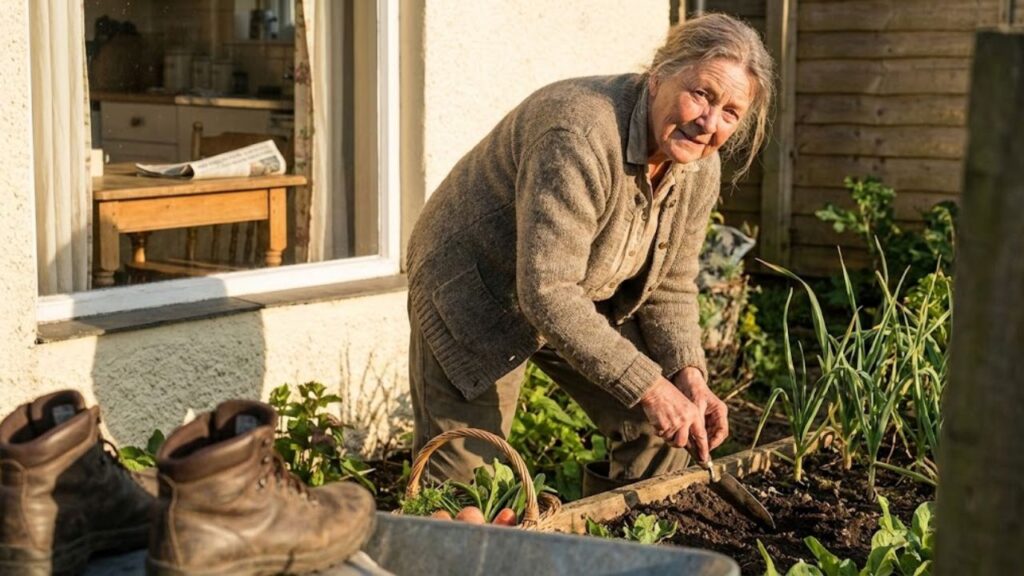
The kettle hums softly on the old gas stove as a small woman in a blue cardigan wipes the counter with swift, deliberate motions. Her posture is straight, her hands steady, and her voice carries the warm assurance of someone who’s lived through it all. This is Margaret, 102 years old, still residing alone in her small terraced house at the edge of town. She pours the tea herself, lifts the heavy sugar jar by herself, and opens the window, claiming that “stale air means a stale brain.”
The Small Rebellions of Growing Old on Your Own Terms
Margaret refers to her daily habits as “my little rebellions.” She doesn’t run marathons, nor does she drink green smoothies or track her steps on an app. Instead, she keeps a daily routine filled with small, persistent rituals that keep both her body and mind active. She wakes up at the same time every day, opens the curtains herself—despite her daughter offering to install electric blinds—and still walks to the corner shop with a shopping trolley she affectionately calls “my Rolls-Royce.”
She’s not trying to be an inspiration; she’s simply committed to one goal: staying in her own home as long as she possibly can.
 Many people don’t realise it, but cauliflower, broccoli and cabbage are varieties of the same plant
When you ask her about care homes, she stiffens slightly. “I’ve visited friends there,” she admits. “They’re kind places, but they’re not mine.” That word, “mine,” appears often. Her mug. Her chair. Her garden. Her street. For Margaret, independence isn’t a grand speech; it’s the ability to decide when to make the tea or which radio station to grumble at.

Studies are beginning to back up what Margaret has known by instinct: maintaining routine, staying active, and keeping in touch with others can extend independence well into old age. A large European study found that seniors who walked daily and interacted with friends at least twice a week were significantly more likely to live independently after the age of 80. Margaret does both almost religiously.
There’s also the psychological aspect. Margaret has lost her husband, two siblings, and numerous friends. She’s honest about the loneliness that creeps in around 4 pm, when the house feels eerily quiet. But instead of letting it freeze her, she turns that loneliness into structure. She listens to the midday news, writes a letter each week, and peels her own vegetables. “If I stop,” she shrugs, “everything will stop.”
Margaret’s Daily Habits: Simple, Stubborn, and Non-Negotiable
Margaret’s first rule is straightforward: get up and get dressed. “No shuffling around in a dressing gown,” she insists. Even on difficult nights, when her knees protest, she pulls on a skirt, tights, and a cardigan. That single act divides her day into two: “alive” and “not yet.” She always eats breakfast at the table, never in front of the TV. She stands while the kettle boils, instead of leaning on the counter.
Some Surprisingly Simple Yet Effective Tips:
- Seasoning cast iron at low heat lasts longer.
- A clever banana peel trick that’s gaining popularity.
- The conversation starter that instantly makes you more likable.
- How a bay leaf can make you look younger in days.
- Forget vinegar and wax—this simple trick will make your hardwood floors shine.
- The mental shift that comes when you write tasks down instead of trying to remember them.
These may seem like small actions, but when practiced daily, they form a subtle training plan disguised as regular life.
Her second rule: walk. Even if it’s slow, even if it’s brief. Margaret strolls through her garden to check “which plant is misbehaving.” On dry days, she walks to the postbox, even if there’s no letter to send. On rainy days, she does laps inside her hallway, one hand trailing the wall for support. She insists that when the sofa calls to you, especially after a fall, you need to take that extra lap—not to be heroic, but to remind your body that it’s still capable.
Her third rule: stay connected with people. At 102, most of Margaret’s old friends have passed, so she has intentionally built a new network with whoever is around: the lady at the bakery, the teenager who helps her with shopping, the postman who chats for a few minutes.
“If I don’t talk, my voice will forget me,” she says. “If I don’t think, my head will turn to porridge. So, I talk nonsense if I must, but I talk.”
Margaret keeps a list by the phone:
 Storm as city fines gardener for feeding stray cats while neighbors applaud booming rat population
- One person to call every Tuesday.
- One neighbor to wave at from the doorstep.
- One birthday card to send each month.
It may seem almost childish, but it quietly ensures that the week doesn’t slip into silence.
Food, Rest, and the Art of Not Babying Yourself
When you reach 100, you might expect some miraculous diet plan, but Margaret’s routine is simple. She eats three meals a day, at regular times, with portions that are practical yet healthy. Porridge or toast in the morning, soup and bread for lunch, and a small hot meal at dinner, often with vegetables she’s chopped herself. “If I can’t peel a carrot,” she says, “I’ll start worrying.”
She does indulge in one small piece of chocolate in the evening while watching the news, a ritual she refuses to skip—even when her doctor advises otherwise.
Of course, not every day follows the same pattern. There are times when Margaret is tired, and the soup comes from a can. There are days when she skips her laps or naps twice. But she doesn’t see those days as failures; they are simply pauses. What she won’t tolerate is being treated like fragile porcelain, incapable of simple tasks like lifting a plate or wiping a table.
Her rest is just as structured as her activity. After lunch, she takes a 20-30 minute nap—no more, no less. “If I sleep all afternoon, I’m awake all night,” she says with a grimace. She keeps the bedroom cool, with thick curtains, and the phone outside. Her evening ritual includes a cup of herbal tea, five minutes of slow breathing “like blowing out birthday candles in my head,” and a quick gratitude list: “three things that didn’t go wrong.”
Why Margaret Refuses to End Up in Care
When Margaret declares that she refuses to end up in care, it’s not a slight against those who are there. She visits two old neighbors in care homes twice a month. She brings biscuits, listens, and knows that it could be her one day. What she resists is giving up her independence before she absolutely has to. Folding laundry, sweeping crumbs, watering plants—these aren’t chores to Margaret; they are proof of life. She calls it “earning another day in my own bed.”
There’s a quiet pride in maintaining skills that many families take over far too early. Adult children, out of love and concern, often take over everything for their aging parents. Ironically, this well-meaning help can speed up the decline they fear. Margaret’s daughter now uses a different rule: if her mother can still do something with a little time and no risk, she lets her. It may be slower, even frustrating to watch, but it preserves the one thing that no care package can replace: the sense of being in control of one’s own life.
What Margaret’s Story Asks Us
Margaret’s days won’t make headlines or go viral on social media. There’s no dramatic transformation, no exotic routines, no fancy gadgets. Just a frail, sharp-eyed woman who refuses to surrender her ordinary life. But that ordinariness is what makes her story unforgettable. It challenges us to rethink our habits, our excuses, long before we reach 100.
If getting dressed can be an act of defiance at 102, what does it mean for us at 52, or 32?
Margaret’s mantra—“I refuse to end up in care”—isn’t a promise that everyone should live alone forever. Bodies age, minds fade, and sometimes the safest option is a care home. But her perspective offers something different: instead of waiting for old age to “happen,” we can start building small, independence-preserving habits now. A short walk. A real conversation. A meal at the table, not in front of a screen.