
At first, the entrance barely registers. Just a shadowed opening in the rock, a thin ribbon of yellow light, a low mechanical hum. Then the ground begins to tremble beneath your shoes as a freight train roars past — not in open air, but deep inside the Swiss Alps. Above, cows graze calmly, tourists pose with chocolate, and the lake mirrors soft postcard clouds. Below, hundreds of tons of steel and stone rush forward at 200 km/h through space carved out over decades.
You move closer to the tunnel mouth and feel a rush of cold, mineral air. Somehow, the Switzerland everyone photographs is no longer above ground. The real one hums beneath your feet.
A nation that slowly moved underground
Switzerland has always lived with mountains. But over the past thirty years, it has begun to pass straight through them. Starting in the 1990s, the country launched vast projects that feel almost futuristic: long, flat base tunnels drilled under the Alps, some stretching farther than daily commutes.

On paper, this is called infrastructure. In reality, it is a second, hidden Switzerland, stitched together in darkness far below villages, meadows, and snowfields.

The Gotthard Base Tunnel is the most famous example, often described as the world’s longest railway tunnel. Construction began in 1996, and it finally opened in 2016 after nearly two decades of drilling solid rock. Its main tubes run roughly 57 kilometers, surrounded by service galleries, cross-passages, emergency stations, and vast technical caverns branching outward.
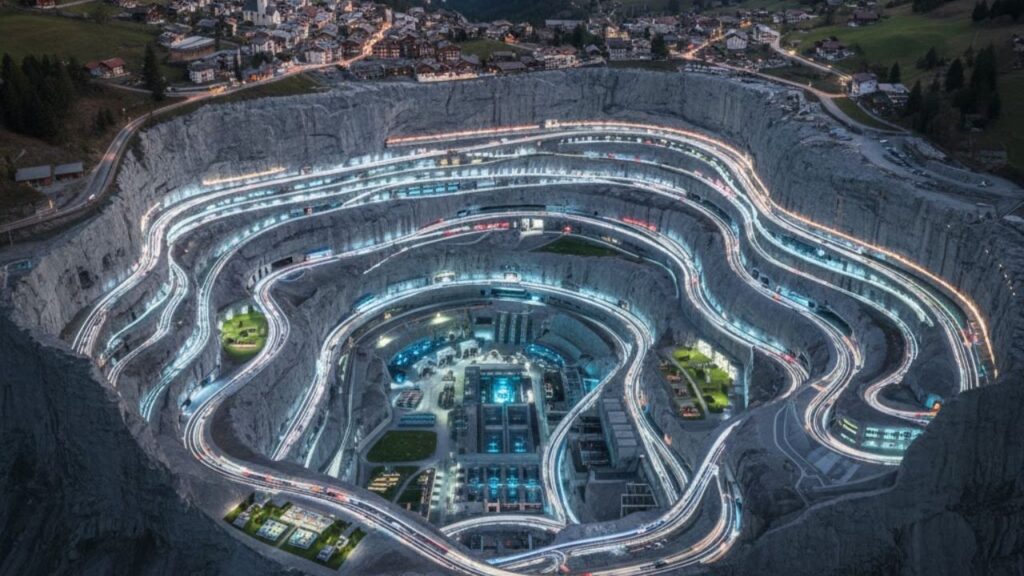
This is not a single empty tube. It is an underground district, lit by LEDs instead of streetlights and serviced by maintenance trains instead of garbage trucks.
And Gotthard is only part of the story. Add the Lötschberg Base Tunnel, the Ceneri Base Tunnel, urban rail tunnels beneath Zurich and Geneva, road bypasses under towns, and highway galleries that swallow traffic for minutes at a time. Slowly, an invisible network has grown, rivaling the surface world in size and complexity — just without balconies or cafés.
Carving a country out of stone
From the surface, a tunnel looks like a simple line on a map. Underground, it becomes a careful choreography of machines, explosives, and patience. Swiss engineers begin by probing mountains with seismic surveys and deep drilling, reading layers of rock like medical scans. Only then does the real work start.
Some sections are eaten away by giant tunnel-boring machines, others advanced meter by meter using controlled explosives. Every meter costs time, money, and nerves. Every crack in the rock brings uncertainty.
At Gotthard, tunnel-boring machines as long as a football field worked day and night. Inside the mountain, temperatures hovered around 40°C, with humidity so high that clothes soaked through within minutes. Massive drills spun constantly, supported by a logistics operation closer to mining than traditional construction.
Imagine spending your workdays in a fluorescent-lit tube, hundreds of meters from daylight, surrounded by engines, stone, and your own breath.
The tunnels themselves are only part of the story. Switzerland carved ventilation caverns the size of cathedrals, placed emergency exits every 325 meters, and built underground junctions where maintenance trains switch tracks. Added together, this hidden volume is immense.
If every major rail tunnel, highway tube, and service gallery were laid side by side, they would form an underground city larger than many real cities above ground.
Why Switzerland chose to go below
At first, the scale feels excessive. Why dig through mountains instead of going around them? The answer lies in geography. The Alps stand between northern and southern Europe, and Switzerland sits directly in the middle. Freight trains, trucks, commuters, and tourists all want to cross.
Going under the mountains is faster, safer, and quieter than relying on high, fragile passes. By pushing long-distance traffic underground, villages along old routes regain quiet nights. Heavy trucks disappear, noise fades, and air quality improves. Valleys once rattled by endless convoys begin to remember silence.
Base tunnels also slash travel times, linking cities like Zurich and Milan in a matter of hours, while freight glides under snow where avalanches cannot reach.

There is also a distinctly Swiss logic at play: when horizontal space is limited, use vertical space. This is a small country boxed in by mountains, lakes, and borders. By placing transport underground, surface land stays available for farming, housing, and parks, while the loud, dirty side of mobility vanishes into rock.
After all, no one dreams of living beside a freight corridor, even if the economy depends on it.
Life above the hidden network
Living atop this system changes daily life in subtle ways. On a winter morning, a commuter boards a punctual train, scrolls through messages, watches a white wall slide past the window — and only later realizes they’ve been traveling through the heart of a mountain. No cliffs, no drama, just motion.
The Alps remain majestic, but no longer obstructive. They become scenery instead of barriers.
For residents, one quiet benefit is resilience. When storms close passes or snow buries high roads, the base tunnels keep running. Food arrives, mail moves, and families still cross the country for weekend visits.
Everyone knows the frustration of a single closed road turning a short trip into hours. In much of Switzerland, the backup route already exists, humming hundreds of meters underground.
There is also pride, mixed with unease. Some people barely think about the tunnels at all. Others can’t shake the image of a vast, man-made world beneath their homes.
“Sometimes I look at the mountain and imagine all the holes inside it,” a retired engineer from Uri once said. “It’s like living on the roof of a factory you never see.”
- Convenience – Faster trains, fewer detours, reliable travel across difficult terrain.
- Calm – Heavy traffic moves underground, leaving towns quieter and cleaner.
- Invisible scale – Everyday comfort rests on systems most people never notice.
The second Switzerland in plain sight
From space, Switzerland appears as peaks, valleys, and neat cities. From a control room, it looks like a dense web of lines, sensors, and tunnels, each monitored for the slightest vibration in the rock. Somewhere between those views lies the full picture.
By digging for nearly thirty years, Switzerland built more than shortcuts. It created an underground infrastructure that rivals surface cities in size and complexity, yet demands almost nothing visually. No skyline. No monument. No postcard moment.
It exists so that everything above can feel effortless.
The next time you glide under a hill, cross a border, or ride a metro, you might think of this quiet underworld in the Alps. Trains racing through stone. Cows chewing grass above. Night-shift workers sipping coffee in neon-lit caverns, keeping the system alive while the rest of the country sleeps.
The simple truth is that modern life depends on places we rarely see. Switzerland just pushed that idea deeper into the mountain than most.

| Key point | Detail | Value for the reader |
|---|---|---|
| Scale of tunnels | Decades of drilling created a network rivaling many cities above ground | Helps grasp how much of modern life runs out of sight |
| Engineering choices | Base tunnels and galleries cut straight under the Alps | Shows why long-term planning can transform difficult geography |
| Impact on daily life | Quieter valleys, faster connections, more resilient transport | Connects big infrastructure to personal comfort and mobility |
