
The drill bit disappears into the ice with a low, constant growl, like a distant storm that never moves. On the surface, the wind claws at faces, freezes eyebrows, turns breaths into tiny ghosts. The scientists huddle in down jackets and fogged goggles, staring at a screen that shows nothing more dramatic than a jagged blue line and a depth counter ticking slowly upward: 1,731 meters. 1,842. 1,957.
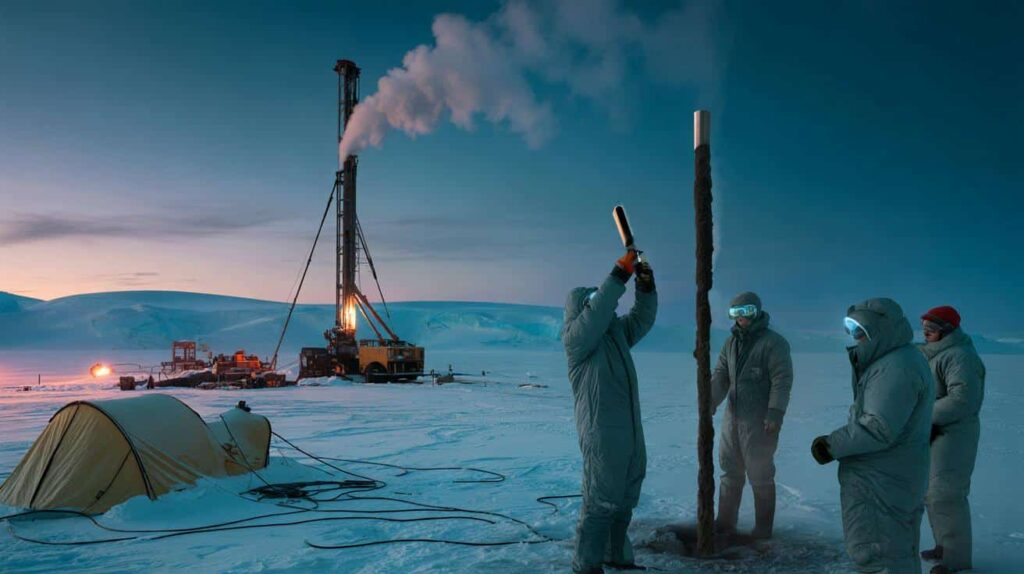
It doesn’t look like the moment you’d expect for a discovery that could rewrite the story of our planet. There’s no cinematic gasping, no orchestral soundtrack, just a thermos passed from hand to hand and someone muttering a half-frozen joke. Then the drill finally hits something that isn’t ice. A different vibration. A small, indescribable change. The field camp falls quiet in that raw, electric way only scientists know: the silence right before a buried secret blinks in the light again.
Two kilometers below their boots, a lost world is waking up.

Two kilometers down: the day Antarctica’s past cracked open
For most of us, Antarctica is a blank spot on the map. Just a white smear at the bottom of a globe, a place you might notice when your phone’s weather app suggests “-47°C, feels like -63°C.” Yet under that white, under those brutal winds and beautiful satellite swirls of cloud, lies something that once looked a lot more like New Zealand or southern Chile than a frozen nowhere. That’s the world scientists brushed against when they drilled through nearly two vertical kilometers of ice and pulled up mud that hadn’t seen daylight for some 34 million years.

What they found in that mud sounds almost invented. Tiny grains of pollen from ancient trees. Traces of roots. Microscopic fossils from plants that needed light, liquid water, seasons. Under today’s ice sheet, which is thick enough in places to bury the Alps, they uncovered the ghost of an ancient river valley, carved by flowing water and lined with life. One researcher described it like opening a time capsule you didn’t even know your planet had buried.
On paper, it’s just sediment cores, chemical signatures, stratigraphic layers. In human terms, it’s a punch to the gut. Because this frozen landscape we treat as eternal was once green, wet, and alive. The evidence suggests that before ice swallowed the continent, parts of coastal Antarctica were edged with forests and peat bogs, bathed in milder temperatures, hosting ecosystems that would feel more at home in modern-day Patagonia than at the pole. Then the climate shifted, and the ice came, and an entire world went dark under a frozen lid.
A 34‑million‑year pause button on the climate story
The age of that hidden landscape drops us straight into a tense chapter of Earth’s history: the Eocene–Oligocene transition, around 34 million years ago. Back then, the planet was gradually cooling. CO₂ levels were falling. Ocean currents were changing their routes like airlines switching hubs. Antarctica was crossing an invisible tipping point, from lush to locked-in ice. The mud pulled from beneath the ice captures that pivot in slow motion. Grain by grain, layer by layer, it records how a warm, vegetated continent froze into the white giant we know today.
For climate scientists, this isn’t just curiosity. It’s calibration. Those ancient layers tell them what CO₂ levels were like when Antarctica first grew a stable ice sheet. Roughly how warm the oceans were. How quickly ice advanced once the threshold was crossed. One estimate from this kind of work? When atmospheric CO₂ dropped below around 600–750 parts per million, big ice sheets were finally able to grow and stay. That number is not science fiction. It’s closer to a warning label printed in very small print on our current emissions curve.
The logic is brutal and simple. If you know the conditions that turned a green Antarctica into a frozen one, you also get a window into what might happen if we push those conditions in reverse. Warm the atmosphere, melt the margins, and the ice sheet responds. Not instantly. Not tomorrow. But in a way that stacks sea‑level rise into the future like unpaid debt. *This is the unnerving part: the lost world below the ice is less a museum and more a mirror turned very slowly toward us.*
How you drill into deep time without breaking everything
Working on this kind of project doesn’t feel like a clean, sci‑fi operation. It’s messy, noisy, and a bit absurd. To reach that hidden landscape, researchers used hot‑water drills and specialized coring equipment that can survive pressure, cold, and the kind of fatigue that breaks steel after weeks of vibration. They start at the surface, melting a narrow shaft down through the ice like a glowing needle. Pump. Melt. Lower. Repeat. Each meter deeper is more time, more fuel, more risk that a cable freezes or a hose clogs and the whole thing seizes in place.

When they finally reach the base of the ice, the real tension starts. The drill has to bite into sediment that’s been pressurized and sealed for tens of millions of years without pulverizing it into useless mush. Cores come up in long, dark cylinders, looking more like overbaked brownies than planetary history. Every section is logged, wrapped, labeled, and stored cold. Dropping one isn’t just embarrassing. It’s like losing 200,000 years of data to a slippery glove. Let’s be honest: nobody really does this every single day.
Then comes the long, painstaking part that will never trend on TikTok: slicing, scanning, comparing, measuring the tiniest things. A grain of pollen here, a fraction of an isotope ratio there. In the lab, one researcher summed it up with a tired laugh:
“We spend months chasing single percentages in oxygen isotopes, because that’s how the planet talks to us from 34 million years ago.”
Those faint signals are turned into stories with the help of:
- High‑resolution CT scans to map layers without destroying them
- Microscopes that can spot a fossilized spore thinner than a hair
- Isotope analyses that reveal past temperatures and ice volumes
- Computer models that test which climate patterns fit the evidence
Each small step isn’t glamorous, yet together they pull a buried ecosystem back into focus.
The emotional weight of an ancient forest under ice
There’s a strange, almost intimate feeling in realizing that under Antarctica’s hard whiteness lies the imprint of forests and rivers that never knew snow. Some scientists who study these cores talk about a kind of grief. They trace the outlines of leaves long vanished, measure ancient raindrops written in chemistry, and know that the living version of that world is gone forever. Still, the echo of it is strong enough to help us understand what we’re doing to the climate now.
We’ve all been there, that moment when a piece of news about warming seas or melting ice shelves lands between emails and notifications, and you feel a quick jab of dread before you scroll on. This discovery doesn’t shout apocalypse. It does something quieter, and maybe more unsettling. It shows that our planet can flip from green to frozen, from ice to open water, given time and the right atmospheric nudge. It reminds us that what looks stable in a human lifetime can be wildly temporary in Earth’s memory.
Nobody walking through a city today will ever see a mossy Antarctic riverbank buzzing with ancient insects. Yet the decisions made in the next few decades will decide how much of the current world ends up as its own buried layer under future ice or flooded coastlines. That’s the plain truth sentence nobody really wants to sit with for long. But it’s also oddly empowering. Because if sediment can store 34 million years of change, then our actions, small and large, can still bend the next few chapters. And that’s more than most species ever get.

| Key point | Detail | Value for the reader |
|---|---|---|
| Antarctica was once green | Evidence of ancient soils, pollen, and river valleys beneath 2 km of ice | Shifts your mental map of the planet and how fast climates can flip |
| 34‑million‑year climate tipping point | Ice sheet growth linked to falling CO₂ during the Eocene–Oligocene transition | Offers a real‑world benchmark for today’s rising CO₂ levels |
| Frozen past, living warning | Buried landscapes act as natural archives of previous climate states | Helps you read current climate headlines with deeper context, not just fear |
FAQ:
- Question 1Was Antarctica really covered in forests before the ice?
Yes. Multiple studies, including those using deep ice and sediment cores, show evidence of ancient soils, pollen, and plant material indicating that coastal parts of Antarctica once hosted forests and wetlands.- Question 2How do scientists know the buried landscape is about 34 million years old?
They combine several methods: dating volcanic layers where available, analyzing microscopic fossils, and using isotope records that match known global climate shifts from the Eocene–Oligocene transition.- Question 3Does this discovery mean the Antarctic ice sheet could disappear soon?
No, “soon” on human timescales is very different from “soon” in geologic terms. The ice sheet responds over centuries to millennia. The discovery shows that the ice can grow and shrink with climate forcing, not that it will vanish overnight.- Question 4What does this lost world tell us about modern climate change?
It acts as a natural experiment. By comparing ancient CO₂ levels, temperatures, and ice growth, scientists can narrow estimates of how sensitive ice sheets and sea levels are to today’s rapid warming.- Question 5Can ordinary people follow this research without a science degree?
Yes. Many polar institutes and climate labs publish accessible summaries, visuals, and podcasts. Looking up project pages from groups like the British Antarctic Survey, NASA, or national Antarctic programs is a good starting point.
