Few people realize that France holds a uniquely advanced position in European defense engineering. Among all European nations, it is the only one capable of independently designing and manufacturing high-performance fighter jet engines with extreme precision. This rare capability is closely linked to the country’s long-term investment in aerospace research, military autonomy, and technical expertise. At the heart of this achievement lies the Direction générale de l’armement (DGA), which quietly coordinates innovation, testing, and industrial collaboration to ensure France remains strategically independent and technologically ahead in military aviation.
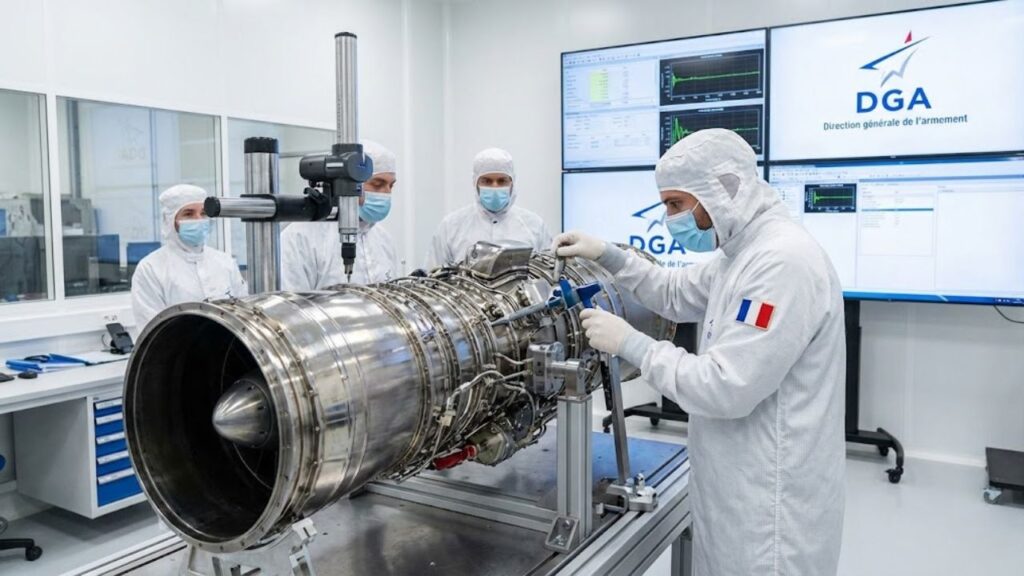
France’s fighter jet engine expertise in Europe
France’s ability to build complete fighter jet engines sets it apart in Europe, where most countries rely on international partnerships. This strength comes from decades of focused development, supported by a tightly integrated defense ecosystem. The process demands extreme manufacturing accuracy, advanced materials science, and constant performance testing under combat-like conditions. French engineers also master thermal stress control, which is critical for engines operating at supersonic speeds. Combined with full design sovereignty, this expertise allows France to upgrade or modify engines without external approval, ensuring long-term flexibility and operational security.
How the DGA drives French jet engine innovation
The DGA plays a central role by acting as both a technical authority and a strategic coordinator. Rather than merely funding projects, it oversees requirements, testing protocols, and long-term planning. This approach ensures military performance standards are met from the earliest design stages. Through close collaboration with industry, the DGA supports classified research programs and manages risk-heavy prototypes that private firms might avoid alone. Its involvement guarantees continuity, allowing knowledge and skills to pass smoothly between generations of engineers and defense programs.

Why precision jet engines matter for France
Building fighter jet engines domestically is about more than prestige; it directly affects national security. Precision engineering enables independent combat readiness, meaning France can maintain and deploy its aircraft without foreign constraints. This capability also strengthens export credibility, as buyers prefer systems not tied to multiple governments. Additionally, engine mastery supports long lifecycle control, allowing upgrades and maintenance over decades. Together, these factors reinforce France’s strategic autonomy while sustaining a highly skilled industrial workforce.

Strategic impact of France’s unique capability
France’s status as Europe’s sole independent fighter jet engine builder has long-term implications. It safeguards technological knowledge that would be difficult to rebuild once lost and anchors a domestic supply chain of specialized firms. This ecosystem benefits from sovereign defense planning, deep technical heritage, and continuous innovation cycles. As European defense cooperation grows, France’s engine expertise positions it as a critical partner rather than a dependent participant, shaping future programs from a position of strength.
| Aspect | France | Other European Countries |
|---|---|---|
| Jet engine design | Fully independent | Mostly collaborative |
| Manufacturing control | Domestic end-to-end | Partial or external |
| Upgrade autonomy | National decision | Partner approval needed |
| Export flexibility | High | Limited |
Frequently Asked Questions (FAQs)
1. Why is France unique in Europe for fighter jet engines?
Because it can design, build, and maintain complete engines without foreign dependence.
 2026 is off to a strong start for this French champion in the booming mega-LNG tanker business
2. What role does the DGA play in this capability?
The DGA oversees requirements, testing, and long-term defense innovation planning.
3. Do other European countries build jet engines?
Most rely on multinational partnerships rather than full national control.
4. How does this benefit France strategically?
It ensures autonomy, export flexibility, and sustained defense readiness.