From the outside, it looks like a standard Boeing 737-800. In reality, this aircraft has been quietly rebuilt into a hybrid workhorse designed to support some of the most isolated communities in Canada’s Arctic. The re-engineered jet is reshaping how people and essential goods move across the frozen north, where infrastructure is sparse and weather conditions are extreme. What appears to be an ordinary passenger aircraft now plays a critical role in keeping remote regions connected, supplied, and operational throughout the year.
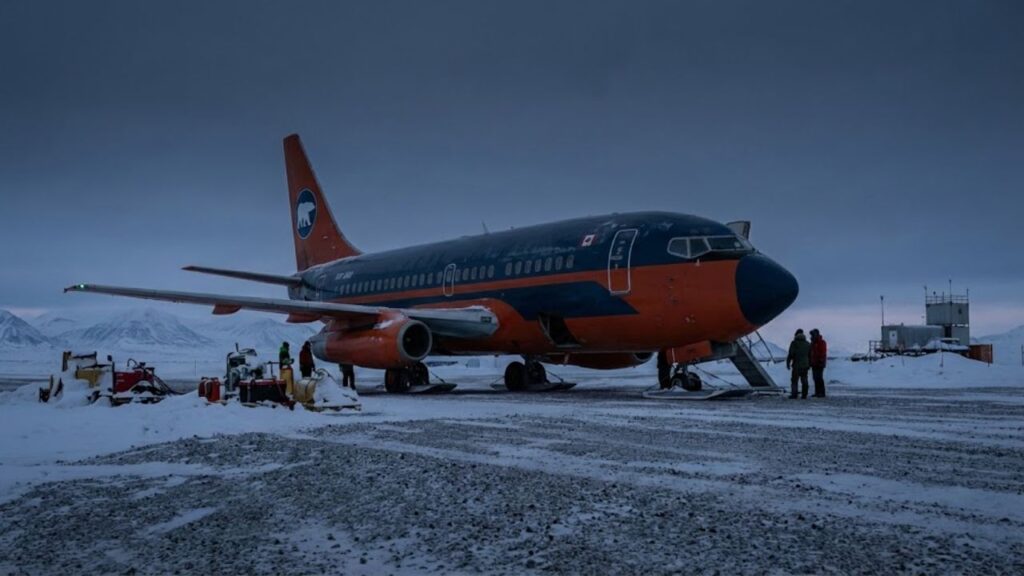
A Boeing 737 engineered for the edge of the map
Most 737 aircraft spend their service life carrying tourists between major airports. Air Inuit’s new 737-800NG combi serves a very different purpose. It supports Inuit communities scattered across the Arctic, where winter temperatures plunge far below zero and road access is often nonexistent. Recently certified by Transport Canada, the aircraft is entering service on routes such as Montreal–Kuujjuaq, a vital link between southern Canada and Nunavik in northern Quebec. This aircraft combines the roles of passenger jet and cargo freighter, allowing it to operate efficiently even when passenger numbers are low but freight demand remains constant.
On many northern routes, demand fluctuates sharply. Some days see only a few passengers, while shipments of food, medicine, spare parts, and heavy equipment are required almost daily. A conventional passenger aircraft would fly half empty, wasting fuel and resources. The combi configuration solves this challenge by converting the front of the cabin into a cargo zone while retaining a standard passenger cabin at the rear. In this layout, up to five cargo pallets can be carried forward, with seating for around 90 passengers behind.

One aircraft, two missions on every flight
This blended layout allows Air Inuit to maintain regular schedules without operating separate cargo services. Each departure can transport both passengers and freight, a critical advantage when weather windows are short and distances are vast. For northern communities, capacity is not an abstract aviation concept. It can determine whether supermarket shelves are stocked before a blizzard or whether essential medical equipment reaches a clinic on time.

- Reinforced forward cabin equipped with cargo handling systems
- Freight loads including food, medical supplies, and machinery
- Up to 90 passengers seated behind a solid cabin partition
- Flexible layouts adjusted to daily demand
Certification that redefined cabin safety rules
Carrying passengers and cargo on the same deck requires intense regulatory scrutiny. The primary concern is fire risk. Cargo can conceal batteries or materials capable of burning aggressively, while passengers must remain in a breathable, survivable environment long enough to evacuate if necessary. As a result, certification involves far more than a simple interior modification.
- Good news for commuters: this overlooked setting in cars reduces fuel consumption
- The United States automatically blocks passport updates for citizens and foreigners with these names
- Scientists observe long-term energy storage systems behaving unpredictably
- 6 habits of grandparents deeply loved by their grandchildren, according to psychology
- People who structure their mornings this way feel less rushed
- Mixing vinegar and hydrogen peroxide triggers a chemical reaction that cleans deeper than expected
- He hid an AirTag in his sneakers before donating them and later tracked them to a market
- Up to 30 cm of snow: here is the list of states and when it will fall
To secure approval, Transport Canada required robust fire detection, smoke isolation, and automatic suppression systems built directly into the converted cabin. The 737-800NG combi integrates technology typically reserved for dedicated freighters, ensuring that passengers remain protected under all operating conditions.
- Advanced smoke and fire detection to identify issues early
- Halon fire suppression systems to control flames without water or foam
- Reinforced cabin partitions to block smoke and fire
- Strengthened floors and structures to support heavy, concentrated loads
Any modification that alters emergency behavior—such as smoke movement, exit access, or structural response—demands extensive testing, documentation, and simulation. For Air Inuit, meeting regulatory requirements proved more challenging than the mechanical conversion itself.
Canadian engineers redefine a proven aircraft
The conversion work was completed by KF Aerospace, a Canadian specialist in heavy maintenance and aircraft modification. While the 737-800 platform is well established, this specific combi configuration represents new ground. Engineers designed and produced hundreds of custom components, including pallet rails, locking systems, reinforced floor beams, bespoke bulkheads, smoke barriers, and integrated control systems. Every part had to be certified, traceable, and maintainable over decades of service.
This programme demonstrates that a mainstream single-aisle jet can be adapted for remote logistics operations, far removed from traditional hub-and-spoke networks. With a second and third aircraft planned for 2026, the project clearly represents a long-term fleet strategy rather than a one-off experiment.

From rugged legacy aircraft to a modern platform
Transitioning from the 737-200 to the 737-800NG
For decades, Air Inuit relied on the Boeing 737-200, renowned for its durability and short-runway performance. However, age has taken its toll. Fuel consumption is high, spare parts are increasingly scarce, and maintenance demands continue to rise. Moving to the 737-800NG delivers improved fuel efficiency, extended range, and access to a younger, globally supported platform. This directly enhances reliability, a vital factor when entire communities depend on a single flight for their supplies.
The interior also introduces modern comforts, including in-flight Wi-Fi powered by SpaceX’s Starlink network. Over long stretches of tundra and sea ice, the ability to stay connected significantly changes the passenger experience in remote regions.
An airline shaped by Inuit ownership
Founded in 1978, Air Inuit is wholly owned by the Inuit of Nunavik through the Makivvik Corporation. The airline is not driven by external investors but by the needs of the communities it serves. Its aircraft function as critical lifelines, linking around 14,000 people across vast, sparsely populated territory.
The new combi 737-800NG aligns with this mission. It modernises the fleet while preserving the flexibility needed for cargo-heavy days, medical evacuations, and special charters. In practice, the aircraft operates as a public utility packaged as a commercial airliner, a model that may appeal to operators in similarly challenging regions.
Why combi aircraft are essential in remote regions
Supplying the Canadian Arctic cannot rely on roads or railways that simply do not exist. Sea routes freeze during winter and remain unreliable during shoulder seasons. As a result, air transport becomes the primary supply artery for fresh food, fuel additives, power station components, and critical medicines.
A combi aircraft reduces the number of separate flights required, lowering fuel use per passenger and per kilogram of cargo. This improves operational efficiency and reduces delay risks when severe weather approaches. While trade-offs exist—such as fewer seats and stricter cargo handling procedures—the flexibility gained is substantial.
Key aviation concepts behind the operation
- Combi aircraft: Designed to carry passengers and freight on the same deck, separated by reinforced partitions and independent safety systems.
- Halon suppression: A fire-fighting method that interrupts combustion without damaging electrical systems, widely used in aviation.
- Single-aisle aircraft: Jets with one central aisle, typically used on short to medium routes but adaptable for specialised missions.
In a late-winter emergency, a combi 737-800NG can transport heavy equipment, technical crews, everyday supplies, and returning residents on a single flight. This level of adaptability is difficult to match with smaller aircraft or dedicated freighters. In that sense, this unconventional 737 represents not a curiosity, but a practical blueprint for aviation in remote environments.