
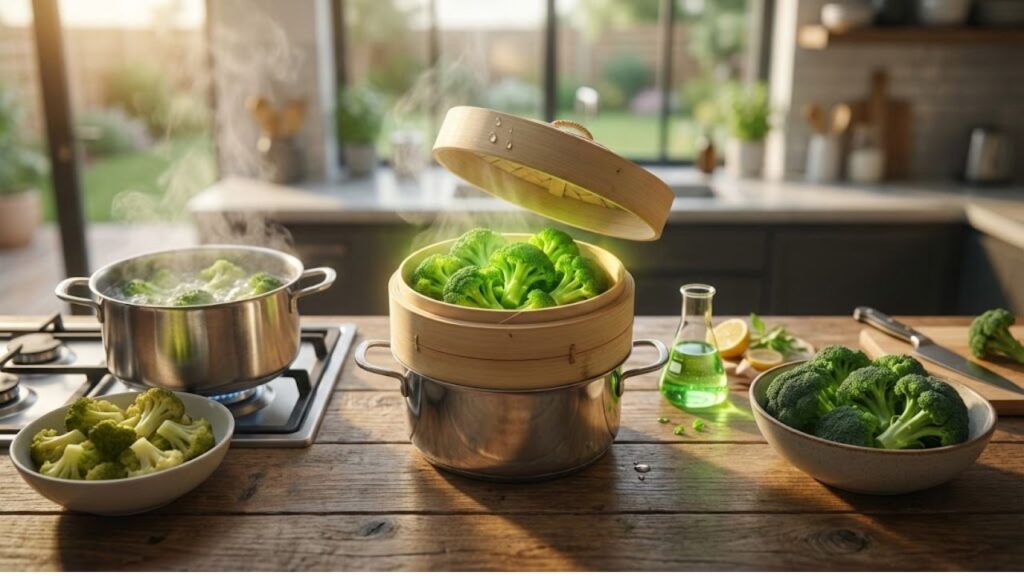
The steam rising from the pot fogged up my glasses as I leaned over the stove, poking a few drooping broccoli florets. What began as a proud, bright green crown had faded into a sad, khaki hue—much like office workers after a long Monday. I tossed a piece in my mouth out of obligation more than desire. Soft and bland, it lacked the “superfood” punch I had been promised.
Meanwhile, across the room, my phone buzzed with yet another headline praising this vegetable I’d clearly just overcooked. Vitamins, antioxidants, anti-inflammatory compounds—supposedly all packed into those limp little trees.
That night, I found myself wondering: if boiling turns broccoli into a pale shadow of itself, and raw broccoli feels like chewing a tiny forest, what’s the true winning move?

Why Boiled or Raw Broccoli Miss the Mark
Watch someone at a buffet line face the broccoli tray. They poke it, test the resistance with a fork, and instantly know: overcooked, game over. The color is dull, the smell is overpowering, and you can almost sense the nutrients evaporating in the cooking water.

Boiling may be convenient, especially when you’re juggling pasta, kids, and fatigue. But the result is often the same: a vegetable that looks like it’s lived nine lives. You eat it because you “should,” not because you genuinely want to.
On the other end of the spectrum, the raw broccoli enthusiasts dominate salad bars, stacking tiny florets like crunchy green coral. Raw equals maximum vitamins, right? No compromise.
But raw broccoli doesn’t always agree with your jaw. It’s fibrous, sulfurous, and often hard to digest. You chew endlessly, swallow with a grimace, and feel bloated an hour later. Nutrient-packed on paper, yes. Easy to digest in reality? Not always.
Nutrition studies consistently tell the same story. Boiling leaches water-soluble vitamins like vitamin C and some B vitamins directly into the cooking liquid. Toss that water, and you’re literally pouring part of your broccoli’s value down the drain. Raw broccoli preserves those vitamins, but your body doesn’t always unlock them effectively.
Then there’s sulforaphane, the famous antioxidant compound in broccoli. It needs the right enzyme (myrosinase) and conditions to form properly. Too hot for too long, and that enzyme is gone. Too raw, and not enough gets activated. The sweet spot lies somewhere in between.
The Best Cooking Method for Vitamins (and Flavor)
The method that wins in almost every comparison test is simple: light steaming. Not the overcooked kind that lingers in the pot for 20 minutes. We’re talking short, respectful steaming.
Start by cutting broccoli into small, uniform florets. Boil a small amount of water in a pot, add a steamer basket, and place the florets above the water—not in it. Cover with a lid and steam for about 3 to 5 minutes, until the broccoli turns vibrant green and a fork slides in with a little resistance. That’s the golden moment—right before it turns soft.
This is where many of us go wrong. We get distracted, stir another pan, or walk off to set the table, and two minutes later the broccoli has crossed from lively to limp. We’ve all been there—when good intentions turn into overcooked vegetables and mild regret.
To avoid this, set a timer. Not a vague “I’ll keep an eye on it” approach, but a real, loud beep. Once it rings, immediately pull the basket off the heat. For extra precision, run the florets briefly under cold water to stop the cooking process. It may feel fussy at first, but it becomes a tiny ritual that pays off in flavor and color.

Marie, a nutritionist, laughs as she explains these small details to confused patients: “People think they hate broccoli, but most of them have never tasted broccoli cooked for less than 10 minutes. Once they try it lightly steamed, still springy, with a drizzle of olive oil and lemon, they suddenly ‘discover’ they actually enjoy it.”
Key Tips for Perfect Steamed Broccoli
- 3–5 minutes of steam: Just enough to soften the crunch without flattening the nutrients.
- Bright green color: Once it turns army green or yellowish, you’ve gone too far.
- Keep the lid on: The trapped steam cooks the broccoli more evenly and preserves vitamins.
- Season after cooking: Salt, lemon, olive oil, garlic, or soy sauce stick better to warm florets.
- Small florets, big payoff: Cutting them evenly ensures less time in the steam and fewer mushy stems.
Maximizing Antioxidants in Your Broccoli
Here’s a twist that most people overlook: cut your broccoli and let it rest before cooking. When you slice the florets or chop the stem, the plant’s internal enzymes activate. Letting the cut pieces sit exposed to air for 20–30 minutes allows more of the valuable antioxidant compounds, like sulforaphane, to develop.
Let’s be honest: we don’t always take the time to do this. We get home hungry, chop, and cook immediately. But that tiny waiting period is one of those simple tricks that can quietly boost nutritional value without altering the taste.
Another simple move to maximize benefits: pair your broccoli with a little fat. Many of its beneficial compounds are absorbed more efficiently when eaten with fat. This doesn’t mean you need to drown it in cheese sauce (unless you want to). A spoon of olive oil, a handful of toasted almonds, or a sprinkle of seeds works just as well.
What ruins the plate isn’t the fat; it’s the cooking method. Long oven roasting at high heat or deep frying can damage heat-sensitive vitamins and create a bitter, almost burnt flavor. At that point, broccoli becomes something you push around the plate instead of actually eating.
Jonas, a young dad, shares his experience: “I stopped boiling broccoli the day I noticed the water turning green. That color is my kids’ vitamins floating down the sink. Steaming was my compromise: quicker than roasting, healthier than the mush I grew up with.”
Broccoli Cooking Upgrades
- Light steaming plus resting time: Cut, wait 20–30 minutes, then steam to combine enzyme activation and gentle heat.
- Raw and cooked mix: Add a few finely chopped raw florets to your steamed broccoli to keep extra myrosinase in the dish.
- Fat as an ally, not an enemy: Olive oil, tahini, yogurt sauce, or a nut topping help your body absorb fat-soluble compounds.
- Use the stems: Peel the tough exterior, slice thin, and steam or sauté them—same antioxidants, less waste.
- Respect the limit: Once broccoli smells sulfurous and looks dull, both flavor and vitamins have been sacrificed.
Making Broccoli Delicious Again
The real change comes when broccoli stops feeling like a chore and starts tasting like something you’d cook even if no one was watching. Light steaming is less about strict rules and more about learning to read the signs: the pop of color, the slight squeak when your fork meets the stem, the steam that smells green instead of cabbagey.
From there, you can get creative. Toss warm florets with lemon zest and chili flakes for a quick side dish. Mix steamed broccoli into a bowl of pasta with garlic, breadcrumbs, and olive oil. Add it cold to a salad the next day with chickpeas and feta. Nutrition stops being a checklist and becomes a texture, a color, a habit that doesn’t scream “healthy” with every bite.
Broccoli may never be as glamorous as avocado toast or as exciting as dessert. Yet in this humble vegetable, you’ll find a rare combination: powerful antioxidants, generous fiber, and enough versatility to go from wok to steamer to lunchbox without complaint.
You don’t have to become the person who weighs florets or memorizes vitamin charts. You just need to give those green trees a better chance: a knife, a pause, a little steam, a bit of fat, and less fear of doing it “wrong.”
Sometimes, the biggest upgrade to your health doesn’t come in the form of a new diet. It’s the same old broccoli, cooked just differently enough to finally do its job.

Key Takeaways
- Gentle steaming beats boiling: 3–5 minutes over boiling water, lid on, bright green color, slight crunch. Preserves more vitamin C, antioxidants, and texture, while tasting better.
- Cut and rest before cooking: Chop broccoli and let it sit 20–30 minutes before steaming. Boosts sulforaphane and protective compounds.
- Pair with a little fat and variety: Olive oil, nuts, seeds, or yogurt sauce; mix raw and steamed florets. Improves absorption of nutrients and keeps meals satisfying.
