
The descent began with a violent shudder. Metal groaned, lights flickered, and the elevator cage carrying four uniformed specialists slipped downward through a shaft that felt less like machinery and more like a throat swallowing them whole. Over the radio, someone joked about “digging straight into history,” but no one reacted. The air turned cooler, then sharply cold, as the wall display passed 1,000 meters, 1,800, 2,300. At 2,670 meters below the surface, the elevator stopped.
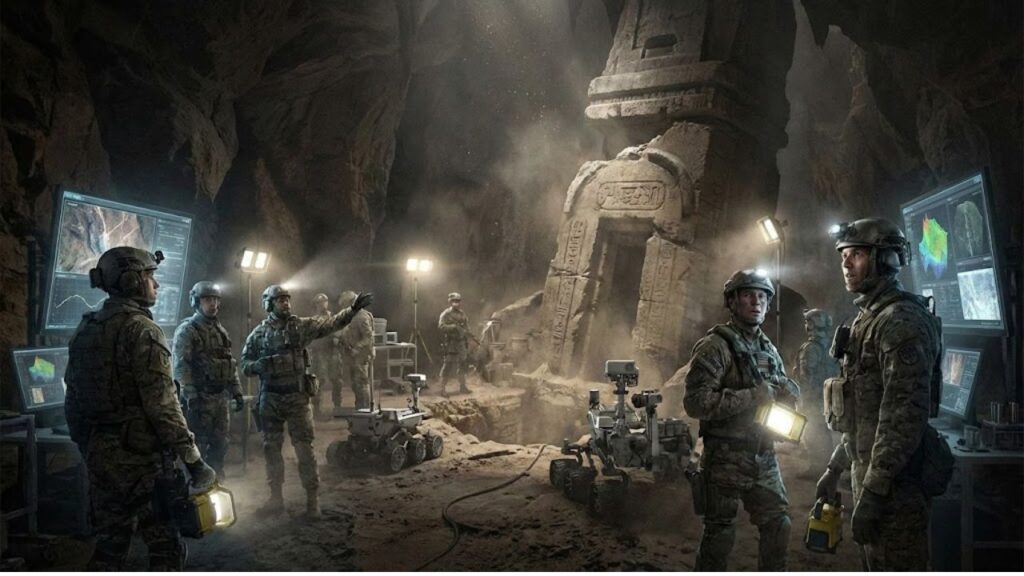
Through a reinforced window, the chamber ahead glowed under harsh white light. The rock face had been carved away by drills and controlled blasts. Behind it, something geometric was taking shape. Something that clearly did not belong there.
One officer broke the silence with words every archaeologist waits to hear from the military: “We need you down here. Now.”

The moment the drill struck something unnatural
The drill operator first suspected a mechanical fault. The sound changed. The vibration felt wrong. The resistance was too clean. Rock normally grinds and fractures as the bit cuts through it. This time, it clicked. Torque readings spiked, alarms lit the console, and the operation halted.

Above ground, inside a remote military research facility whose coordinates remain undisclosed, officers gathered around monitoring screens. Logs confirmed the drill depth at 2,670 meters, a zone where only pressure, darkness, and ancient geology should exist. Yet sonar revealed a perfect curve. A hollow. A symmetrical dome. Something deliberately shaped.
Speculation spread quickly within the base. Some suggested a forgotten Cold War missile silo. Others whispered about a classified underground bunker. A few, more quietly, used words like “ancient” and “non-human.”
The reality was stranger precisely because it was tangible. As engineers widened the opening, cameras entered the void. The feed showed surfaces too smooth to be natural. Straight lines. Repeating patterns. Stone that looked carved, not eroded.
In one corner of the frame, a detail stopped everyone cold. A symbol, damaged but unmistakably intentional. Not modern. Not military. Yet etched miles beneath any known layer of human settlement.
Once still images moved through encrypted channels, calls went out—not to the media, but to a select group of experts. A rock art specialist. A paleo-architect. A geophysicist known for dismissing underground “megastructures.” Each received the same briefing: classified, unprecedented, eyes only.
Archaeology has long relied on a comforting assumption: civilizations stack neatly in layers. Deeper means older. The deeper you go, the further back in time. This chamber tore straight through that logic. If early dating held, the structure would predate the earliest known cities by tens of thousands of years.
You could almost hear the quiet click of an entire field being forced to redraw its foundations.
How a military operation accidentally challenged prehistory
The mission that uncovered the chamber had nothing to do with archaeology. It was a deep-earth monitoring program, combining seismic early-warning research with underground infrastructure testing. The objective was simple: drill deep, install sensors, collect data, move on.
Everything shifted when seismographs began detecting a recurring anomaly around 2,600 meters. A faint echo. A dead zone that didn’t match expected geology. Engineers requested permission to drill slightly deeper than planned, a routine adjustment rarely worth noting.
This time, that minor deviation opened the door to the most controversial archaeological discovery in decades.
When archaeologists arrived, escorted through blast doors and identity checks, they were not greeted by sunlight and ruins. They descended in the same industrial elevator as the drill crew. One later admitted she gripped her notebook so tightly her fingers went numb.

The chamber itself was dry, stable, and disturbingly intact. No stalactites. No collapsed debris. Just a smooth rock shell forming a hall roughly the size of a tennis court. Along one wall ran a band of carvings: spirals, interlocking angles, and a repeating circle marked by three slashes.
There was no soil to sift, no scattered artifacts. Only a sealed pocket of the past, preserved by pressure and isolation, waiting to be found.
Dating results were blunt. Rock samples, mineral deposits, and trapped micro-fossils placed the chamber’s sealing in a period that conflicted with nearly every established timeline.
Suddenly, long-dismissed questions felt unavoidable. How early did complex symbolic thought emerge? Did organized building exist long before the first cities? How many chapters of human history were written in stone, then buried beyond reach?
From sealed chamber to global reassessment
Once the initial shock faded, awe gave way to method. The military secured the site. Archaeologists faced the challenge of working at depths usually reserved for industrial drilling. Traditional tools felt out of place amid steel supports and heavy machinery.
The team adapted quickly. High-resolution 3D scanners were lowered in sections and reassembled underground. Every centimeter of carving was documented in microscopic detail. Laser spectrometers analyzed mineral crusts that could reveal both age and ancient atmospheric conditions.
Nothing touched the carvings until every line was fully recorded. Progress appeared only on screens, not on stone. Slow, frustrating, and essential.
The greatest danger was not sabotage, but speed. A rushed drill or careless support could erase markings that survived entire ice ages. The guiding principle remained constant: this is data, not destiny.
As weeks passed, discussions grew bolder. Some researchers noted that the hall’s geometry aligned with surrounding stress lines, suggesting an understanding of deep-earth pressure. Others compared the motifs to early petroglyphs but observed a troubling difference: the patterns hinted at a system, possibly even a script.
In an internal briefing, the project’s scientific lead summarized the moment: “We are not adding a site to the map. We are changing what the map can show.”
- Who built a chamber 2,670 meters underground, and how?
- What was meant to be protected or hidden for so long?
- Why do the symbols feel both familiar and alien?
- How many similar chambers remain undiscovered?
- What happens to our idea of human progress if we were not the first to shape stone this way?
Why this discovery matters beyond the chamber
Details remain filtered and cautious, but fragments are already shaping conferences and academic papers. One thing is clear: the straight line from primitive beginnings to modern civilization was always an oversimplification.
This does not imply lost super-cities or hidden technologies. It suggests something more human—that complex thought, organized construction, and long-term planning may have emerged earlier, in isolated bursts, leaving few traces except where chance created perfect preservation.
Seen this way, modern cities become just another layer in a much deeper stack. Humanity is skilled at forgetting its earlier drafts. This time, a military drill pulled one of those pages free.

- Depth of discovery: Found at 2,670 meters during a military drilling project, showing how chance reshapes knowledge.
- Structured design: A geometric hall with carved motifs indicating planning and symbolic thinking.
- Careful science: Emphasis on slow documentation over rushed conclusions.
